Tuesday, February 15, 2011

Maglet Losowsky and iPads Reclaimed

Andrew Losowsky has peered into the glass of the iPad and decided that the world of magazine apps is half empty. So we feel it necessary to cheer him up a bit and fill the glass. Andrew pens his blog at The Hospital Club -- one of Covent Gardens best watering holes -- offering us a swig from the bottle in his first paragraph, a convenient summary of his position:

Twelve months ago, the magazine industry was shouting from the rooftops that the iPad was going to be their saviour - but it turns out that all those people lining up to buy one weren't doing it solely to pay for glass-coated editions of Marie Claire. Sales of maglets (magazines on tablets - geddit?) have been far below the costs of developing these apps, and public reaction has been underwhelmed at best. What went wrong? Six things, actually.The Truth Behind the Failure of iPad Magazines

But if you look at the six points he makes it would appear that the glass is really half full. There have been some mistakes - as is surely to be expected with an innovation as startling as the iPad - but there has also been some progress. Take a look at his problems
  1. Publishers are Selling the Same Content Twice. This is clearly a big mistake. But there is no compulsion on publishers to adopt this posture (that they have done so, is largely the result of a separate battle that they have been fighting with Apple about the ownership of user-data). Some publishers, all those who work with Exact Editions, have opted to offer free iPad access to their existing subscribers. There is nothing in Apple's terms and conditions that says that publishers cannot do this, or that digital magazine access has to be sold exclusively through iTunes. Apple's mooted new system for in-app subscriptions will surely encourage more publishers to adopt this attractive way of selling subscriptions, though it may also require that digital/app subscriptions are sold through iTunes.
  2. There are not enough iPads out there. Only 15 million in the nine months! Since Apple will sell perhaps another 40 million this year, and no market analyst predicted, prior to launch, that Apple would sell more than 7 million in the first year, this is a glass rapidly filling up before-we-can-get-organised, point. Come on Andrew this is surely a reason for publishers to get their skates on!
  3. Maglets are competing with everything else on the iPad. Yes indeed, "....magazines no longer have the benefit of being at the centre of our cultural lives. They have to work harder than ever to grab our attention and force their way into our habits, a task that's all the harder when they reside on a fully connected device that contains the latest news from thirty seconds ago..." Which is also a reason for magazines to see if they can persuade consumers to use them on iPads just as they use them in their living rooms. Magazine publishers did not chuck in their hands when the TV invaded the living room, innovative publishers will see the iPad as a similar challenge. Glass half full.
  4. Separate App Syndrome. I think Andrew misses a key point here. Magazine publishers have made a big mistake in designing magazine apps as though each issue was a separate app. This is a valid complaint, but not the point that Losowsky makes, and it is one reason for the disappointing showing of several magazine apps. It is also one reason why magazine publishers have felt that they should market and sell magazines on the iPad one issue at a time, failing to see that selling subscriptions through, or without, iTunes is clearly the way to go. Magazines as apps work very well as branded apps in iTunes partly because magazine titles often confer superb branding and findability on the product (Marie Claire, Elle, Vogue and also niche titles Literary Review, Opera, Index on Censorship). But the branding should cover magazines in their entirety: past issue, current issue and future issues are ideal to function as branded apps in the customer's iPad. This is a glass that needs to be very full -- including the archive.
  5. Magazines are outside the digital conversation. This is indeed a valid objection, but in mitigation the magazine publishers (and app developers such as Exact Editions) can point out that this is a complex and rapidly developing field; better engagement and social interaction with digital magazines is certainly coming. The Exact Editions apps are already stuffed full of links to web pages and email addresses (and on the iPhone, phone numbers that the customer can call). Magazine apps can be highly interactive and they are increasingly becoming more so. Losowsky appears not to have noticed that the iPad itself makes it incredibly easy for a single 'page' or a JPEG to be emailed from any magazine app, it is not a matter of some publishers enabling this. There is nothing that the magazine publishers or the copyright owners can do to stop such informal sharing (which does not mean that magazine apps can be easily copied wholesale; that is a different matter). This is a glass to be shared.
  6. The medium is nine months old. By which I am sure that Andrew Losowsky means that its really too early to be sure: "The truth is that we just don't know yet what varieties of format, design and interactivity will best serve each kind of content, and though some of the experiments in the field are fascinating, most of them are just irritating applications of over-design by people giddy at the possibilities of new formats." This is indeed a matter of the glass being half-full, and a point on which we can agree

Losowsky's excessively gloomy, more than half-empty, headline 'The Truth Behind the Failure of iPad Magazines' is perhaps belied by this concluding (half-full) optimism:
That said, this is still a genuinely exciting time to be working in media. Nothing at all can be taken for granted - except for the simple fact that there will always be a hunger for unique stories, told in a manner in which the text, design, images. and when necessary audio and video, combine to enhance our enjoyment and understanding of the story itself. This ability to make design part of content is the reason why magazines lasted in the first place.
I first noticed Losowsky's piece via an approving tweet, from Erik Spiekermann, perhaps the Lionel Messi of typographic design. This design discontent with magazine apps is not an odd-ball view, most/many good magazine designers are disappointed by the way that magazine iPad apps have been designed so far. My hunch is that the user experience and pleasure in magazine apps will improve as designers and publishers realise that magazine design and book design has to move to a more holistic and a more abstract level, perhaps when designers are less 'giddy' with the possibilities and more relaxed about the opportunities and the 'flow' that comes with touch interfaces. Technology is moving very fast and good digital magazines have to be conceived and conceptualised for systems and services that don't yet exist. From now on all pages are virtual, all stories have addresses, and all interfaces have to be intuitive. This is not a trivial set of challenges for a designer who aims at quality and effect.

Friday, February 11, 2011

On Making Digital Subscriptions Work

All Things Digital has an interesting essay by John Squires: Apple, Google and the Publishers: Here's How to Make Subscriptions Work. Squires used to be a senior executive at Time Inc and is founder of Next Issue Media a company that is stealthily developing a new approach to marketing and selling digital magazines on tablet platforms.

Squires echoes cries of anguish that have been coming from his peers in the consumer magazine industry:

In recent weeks, we’ve heard growing concern from magazine and newspaper publishers regarding the challenge of providing content for mobile media while preserving their print franchises. The concern is nothing new, but it’s apparent that content providers are at risk of losing track of their customers like toddlers in a shopping mall. Squires All Things D
Its news to me that magazine publishers care for their subscribers the way parents look after toddlers in a shopping mall. Squires goes on to say:
Devices like the iPad offer consumers a rich reading experience and offer publishers even more targeted advertising, but the revenue tradeoff as publishers navigate the path from print to this new world is lopsided–and not in a good way.
The problem for Squires is that he can't see the old business model working for publishers with the new digital magazines. Publishers are not going to be 'allowed' to track their toddlers in the ways in which they have been accustomed to do. Furthermore Squires doesn't think that subscriptions are going to work for digital publishers:
Isn’t selling your magazine through an app store and receiving 70 percent of the revenues a great deal? After all, magazine subscription agents and newsstands don’t return anywhere near that amount to publishers. But this is argument misses an important point. In iTunes and the Android Marketplace, there’s virtually no merchandising of magazine products. A magazine app must swim to the top of several hundred thousand other applications. And even in the context of a dedicated magazine store, the publisher won’t control featuring.The value of the brand must pull the consumer through to the purchase. And brands are expensive to build and nurture....Squires All Things D
So the litany of complaints continues. Despite the potential for a 'rich reading experience' life is going to be very hard for digital magazine publishers, they will have to (1) create the rich reading experience (2) support devices on various platforms (3) market their wares (4) do some 'feature control' of their own so that their magazines come to the top of the heap (5) build their brands and (6) figure out how this fiercely competitive and rapidly evolving world is going to work. Perhaps Mr Squires should look to the example of Rupert Murdoch and go and build a publication which will meet those challenges head on.

Squires's proposed solution for this difficult quandary in which the magazine finds itself is to propose some industry wide standard solutions (perhaps it will appeal to the likes of Google, Apple, and Microsoft because) "there’s a significant long-term advantage for the software industry to make friends with 150 million magazine consumers." As though these technology titans are going to reach agreement on standard procedures so that the magazine publishers existing business model can be replicated in the digital framework?

Make what you can of John Squires' specific proposals. The second one astonished me: (the software industry should) "Create simple APIs that connect the handful of major print fulfillment houses to application storefronts so existing print accounts can be harmonized with digital access." Exact Editions has been doing almost exactly this for many of the publishers with whom we work. But note, such a solution has to work potentially for hundreds of print fulfillment houses (surely it is a sign of some Time-induced complacency to suppose that only the 'handful' of 'major' fulfillment houses count). It has to be general and generalisable. Furthermore the trick is to work with the APIs of the print fulfillment houses (not of the e-commerce store fronts), so the discussions have to take place between the publishers and the fulfillment houses and their IT houses and app developers. This sort of business has to be under the control and to the account of publishers for it to work the way they want it to. You do not attach conventional print subscriptions to digital subs -- which is what Squires on a strict interpretation is suggesting as the desired solution. You attach digital or app solutions to print subscriptions. That way the publishers (via their fulfillment houses) stay in control of the crucial customer relationship. There is no point asking Google or Apple to build your digital back-end. They are not going to do that, and furthermore the magazine industry really does not want them to do so. Which is where we started, with Mr Squires bleating that Apple controls too much data and will not provide access to the iTunes accounts of Apple's customers who subscribe to digital magazines. Why on earth should they? An iTunes customer who buys a magazine app from iTunes is an iTunes customer before she is a customer of the magazine app. The position is rather different with a subscriber who is already a customer of the magazine and the publishers can insist that their customers are treated with the respect and reciprocity that they deserve. They are already a subscriber to the (print) magazine and so should be offered free access via the app. The Economist got this right by providing free app access to all its existing print subscribers. Time Inc and the other big American consumer publishers is getting it so wrong by refusing to do this

Work around it, and start publishing digital solutions that customers want.....

Wednesday, February 09, 2011

The Daily is a Convincing App. But is it a Periodical?

I like The Daily rather more than I was expecting. I also think that it has a commercial chance; it is a gamble, but it is potentially a very significant money-spinner. A lot will depend on the execution. Murdoch is prepared to take a big punt on the newspaper's success, and like a good gambler he can do this because he is playing with a limited stake ($30 million in startup costs and $500k a week in running costs). He is not playing for break-even but for a significant win, which happens when he has 1 million or 2 million subscribers. That will take 18 months or two years to pan out, so at most $100 million is at risk. For News Corporation with its huge investment in print newspapers this is peanuts. The upside is that The Daily gets 2 million subscribers from which the subscription income is $80 million ($40 annual sub x 2 million subscribers), Apple's commission and sales tax may bring this net take down to $50 million but the running costs are $25 million. Also there is some advertising revenue which should help.

Murdoch's off the cuff comments at the launch were fascinating and engaged, and I heard them the same way as Peter Kirwan, blogging at the UK Wire, who also fancies the commercial prospects of the new title:

If this makes The Daily sound like a bolt-on addition to the media ecosystem, Murdoch is also dreaming of something much bigger. Away from his script, during an interview on Fox Business News yesterday, his words suggested a bid to promote cannibalisation of print audiences.

"I really believe that everybody in America who can afford one is going to buy a tablet," said Murdoch. Ultimately, he added, he would like The Daily to overtake the 26m audience attracted by American Idol on News Corporation's Fox network.

News Corporation executives may smile at the old man's hyperbole. But the intent is clear. What's more, Murdoch claims that he isn't phased by the prospect of cannibalising print audiences. "Oh, there may be some expensive changeover," he said yesterday. "Net-net I think we will get." Peter Kirwan: What's New about The Daily?

Murdoch is aiming a newspaper proposition at a market which can probably commit to the prices he is putting on it (99c a week or $40 a year). Because he has a clean slate Murdoch has been able to take a realistic view of what an annual iPad newspaper should cost. Net-net, I think he will get.

The Daily has a mid-market feel, a bit like USA Today (2010 circulation 1.8 million, and if I were in Gannett's boots I would move very fast to cut Mr Murdoch off at the pass with a snazzier app in the same class) and it will have a mid-market appeal. It is not very serious, it is gossipy, and the sports coverage impressed me; the illustrations are good and some of the diagrams and 360° photographs are excellent. There is much that one could question or criticize (see some very insightful analysis of the typography and design by Stephen Coles), the social interactivity is ham-fisted at launch, but I will be watching the progress of The Daily with interest.

Murdoch in answer to questions, left open the possibility that The Daily will in due course migrate to other tablet platforms, but it is for this year and next aimed fair and square at the iPad. Nevertheless it is in many respects designed and conceived in a rather conservative magazine fashion: as if it were a newspaper designed for a small format with lots of colour and a fair amount of interaction, snippets of video and short, punchy stories. Which is what it is, mostly produced with traditional print tools. The maganewspaper is, we may suppose, produced with InDesign and could almost be laid out as though it were a print object -- almost, but not quite, since as with other apps generated from inDesign the imposition would not work. The framework and the metaphor is still largely a print metaphor, but one re-scaled for the iPad's dimensions and interface. Like any app it can interact with the web and it condescends to save pages and bookmarks and links in suitably undistinguished web pages, but it is most definitely an app and a tolerably enjoyable one to navigate and browse.

So The Daily is a newspaper and an app, but is it a periodical? I only raise the question, because there is no way, at present, to move back to a previous issue (except through the rather drab web pages which are used for reference, bookmarking etc). The Daily is a daily event and not a newspaper of record which would have an archive of issues that can be opened and re-opened to review and re-read earlier content, so that one could again look at the 360° photograph of Tahrir square that they carried on February 4th (one can see the video carried on that day here). It may be said that a proper archive could be 'retro-fitted' once they get going; but I wonder whether this will happen or whether we will move to the idea of a digital newspaper being a more ephemeral publication (like a news web site) with no full archive? Shall we borrow a word from the French and call such not-for-the-record newspapers 'quotidians' rather than 'periodicals'?

I think that digital magazines certainly will retain their archives, and the apps which map them will have to figure out how the archive is presented and integrated alongside the current number. There is strength in that model and anchoring readers in the quality of your back issues has some commercial advantages.

Monday, January 31, 2011

Magazines Need a Digital Format Before they Get a New Blueprint?

Tomorrow Apple and News Corp are launching a new periodical, The Daily, specifically designed for the iPad. This could be really exciting and I wish it well (I really do, but we will have some caveats later).

Erick Schonfeld over at TechCrunch decides to peg another think piece on iPad magazines on this event: iPad Mags Need a New Blueprint. This is not a blog up to the usual TechCrunch standards but it does attract an excellent comment (from TechPops - who tells us what he wants his digital magazine to be and do) and a thoughtful blog from Mike Cane. Who correctly points out that the Daily is really about newspapers and magazines are not facing the same challenges or the same opportunities with the iPad.

There are three problems with Schonfeld's piece and they are all signs that he does not have a good understanding of the challenge the magazine industry faces:

  1. A digital magazine or newspaper should feel like a media app, not like a PDF viewer. It needs to take advantage of technology to tell better stories. (Schonfeld)
  2. Apple should fix the subscription problem(Schonfeld)
  3. Making these apps social and realtime is the key (Schonfeld)
The first point is a blatant appeal to the gallery. There have been some very poor early stage magazine apps of which the best that one could say of them is that they look like badly put-together PDF-viewing packages. But the reality is that the magazine industry basically knows how to make magazines which in their print form pretty much are PDF packages (or in practice InDesign files, which are not much different). This is where the magazine industry is starting from, and the iPad is actually an excellent way of reading magazines, documents designed primarily for a print medium. Producing a really good iPad app of the print magazine is a very good starting point for where the magazine industry now is. We should recognize that the magazine format is a PDF format until it becomes something else, and any digital magazine platform is going to build out from this heritage. Connected to this point: Schonfeld is right that media apps such as Flipboard are harbingers for the future digital magazine industry, but it is swinging cart before horse to suggest that most magazines are going to become Flipboard-style aggregators. We need thriving digital magazines for horizontal aggregation services like Flipboard to work. Making digital magazines work will mean making them feel like magazines on the iPad (though of course more digital and 'better'), this doesnt mean making them all like Flipboard with its loose and generous visual style. Half the point of magazines is that they aim at individuality and unique presentation in design. That potential for design excellence and differentiation through design and layout has to be kept!

'Fixing the Subscription Problem', we will know more about Apple's moves on subscriptions for periodicals tomorrow following the launch of the Daily, it is widely expected that Apple will makes some changes to its subscription model to encourage periodical publishers to focus on the iPad. But I very much doubt that 'fixing the subscription model' will come close to the demands that magazine publishers have been making. Apple may provide a bit more customer data to publishers, but it will be surprising if it relents on its 30% commission for sales made through iTunes. Magazine and newspaper publishers have some unrealistic expectations about 'fixing the subscription problem' in iTunes. The bald and unpalatable (for some publishers) truth is that the iTunes commercial and subscription model already works rather well, and unrestricted access to private consumer data is not on offer.

'Making these apps social and realtime is the key.' This is again, at best a half truth. We can agree with Schonfeld that digital magazines are going to be interesting players in the social web. But this role may be more asymmetric than other social content players. Magazines, newspapers and books need to think carefully about the extent to which they introduce on-board, two way dialogue. All holds-barred realtime interactivity is not a guarantee of success. We may be more interested in the potential for Tweeting from magazines than in having magazines Tweet at us (see Cane). In any event the social wave for digital iPad magazines is clearly coming, but it may be that the way this should work is not yet fully in view. Its a bit tough to complain that digital magazines havent figured out their social graph via the iPad when Facebook still has not yet produced its own iPad app. If the Daily goes all social at launch (I doubt that it will) the chances are that it will have gone off at half-cock.

I look forward to buying the Daily tomorrow (it will be a shame if it is restricted to North America, surely it will be available internationally?), and I shall be rooting for it. Its best hope is that it does not disappoint and learns to adapt quickly if it has made a couple of bad early choices. The Daily needs to innovate and the chances are that it will make one or two mistakes, and having such a big budget behind it, it may be hard to recover from a mis-step Here are four tricky judgement calls that I shall be looking out for:
  1. How does it handle RSS feeds? It is called The Daily -- which suggests that it will have an editorial focus around a 'deadline'. So in the week of the Cairo events it will be bang up against Twitter, Flickr and Reuters on the issue of periodicity and topicality. Its hard to get the RSS mix right if the editorial focus in on a daily edition.
  2. How will The Daily be positioned in relation to subtly different tablet options that are coming from Android and HP. Has the publication been so tightly designed for the iPad that it will be an exclusive project for that platform? What about the iPhone, will there in due course be an iPhone edition? (I would love to know what advice Apple gave News Corp on this point).
  3. Will The Daily be aiming for a significant advertising revenue base or is it going to pitch its camp solidly on the basis of subscription revenues?
  4. How will The Daily handle the orientation possibilities of the iPad? Are we going to see a design innovation in that area?

Thursday, January 27, 2011

InterDependent Content?

John Battelle has blogged a very intriguing essay on the distinction between the dependent and the independent web. Here he makes the distinction:

The Dependent Web is dominated by companies that deliver services, content and advertising based on who that service believes you to be: What you see on these sites "depends" on their proprietary model of your identity, including what you've done in the past, what you're doing right now, what "cohorts" you might fall into based on third- or first-party data and algorithms, and any number of other robust signals.

The Independent Web, for the most part, does not shift its content or services based on who you are. John Battelle: The Interdependent Web
Battelle goes on to point out:
Consider the sub-category of "content" on the web. It's a very large part of what makes the web, the web - millions of "content sites," ranging from the smallest blog to ESPN.com. Most of these sites don't change what they show us depending on who they think we are. John Battelle: The Interdependent Web
Perhaps a paradigmatic example of what Battelle is getting at here would be Wikipedia, which in spite of being a construct of millions of authorial and editorial acts is pretty much the same wherever or from wherever you are looking at it. But, hold on a moment, note that Wikipedia is changing all the time, and in ways that can be hard to predict (mostly it is getting better) and it is thus highly time-dependent. Independent of the 'self' perhaps? Certainly, Wikipedia aims at a crowd-sourced balance and neutrality. But note the variety of languages in which Wikipedia is now developed and edited. Nevertheless, Wikipedia is a standard bearer for web independence, rapidly changing, multilingual but determinate, and in a certain sense 'objective'. More and more our content services are becoming dependent services. They are not merely web sites. What you see and read depends on who you are and where you are, what you are doing; and you only read bits of what you are reading.

A very strong example of the way in which content services are becoming 'dependent' in John Battelle's sense is offered by the iPad app Flipboard. Flipboard is a pure content service but is totally 'dependent', the only element of 'editorial voice' that emerges concerns the degree to which Flipboard selects and promotes particular channels (eg this week Davos). Flipboard is not really a web service. It is an iPad app, plain and not so simple, but it aggregates a large number of web-based publications (usually via their RSS streams) and presents them to its subscribers with Facebook and Twitter resources inter-leaved in the content mix. What you see and read in Flipboard is very dependent on the choices you have made in the past, both in Flipboard and in your daily activity on Twitter and Facebook. The user is continually creating and assembling his/her own Flipboard anthology. A hallmark of dependence: no two Flipboard users will see the same content flow -- though for sure many components may be viewed in common. One of the key points about Flipboard is that it is at this point iPad-only. Flipboard is a hugely 'dependent' system, its shape is completely determined by its user's profile and activity and yet it is also completely dependent on web technologies and resources though not itself a web resource. There is no Flipboard web service, of course the company has a web site, of course Flipboard uses the web very intelligently. I can link you to stuff that I am seeing and reading on Flipboard, but Flipboard is not itself a source of content. I can't even 'Flip' you the page of Tweets that I am looking at right now.... (OK so here is a screen shot)


Flipboard works, and in my view it works very well, because it builds on mechanisms which were well established well before the iPad arrived. Publications, especially magazines and newspapers have been struggling to adapt to the web by developing their own 'dependent' web services which complement their existing and hard to monetise independent web sites. RSS feeds were an obvious example of this urge to match the daily, weekly, periodical content to the circumstances of users. But blogs and comment functions are equally significant as mechanisms through which 'content' resources have been trying to match their publications to the various ways in which their audience can engage with a publication through the web. What Flipboard brilliantly shows us is that the magazine (or the newspaper) itself can be pulled through to the iPad environment and appreciated or enjoyed as a quasi-magazine on the iPad. The RSS feed hauls the pictures and comments and some of the layout through into the iPad app environment.

Whether Flipboard will itself become a commercially important channel for magazine publishers is another matter. But it certainly shows the industry that it is possible to deliver magazine content to the iPad environment in a form which is both attractive and enjoyable. For magazine publishers the real challenge is now to find out how to deliver the whole magazine in various forms and via a plethora of reading devices and reading environments to readers in a consistent and self-contained way. This is why the publication "as an app" has strong appeal for publishers and the existing audience. The big challenge for the publisher is to see if the magazine or newspaper app, whether on third generation iPad or a second generation Android tablet, can be a satisfactory way of presenting a full publication better than it could ever have been in print. So that in 2015 you know that what your sister is reading on the Samsung Squiggle, or the Amazon Kindle Mk5, is the same thing as the you are reading on the iPad iNfinite.... The challenge is to make publications as dependent as they can be on the whims, devices, preferences and circumstances of the reader but as independant and as reliably referenceable as web pages and print publications. InterDependence is the goal.

Friday, January 14, 2011

Cost Benefits of A Magazine App

One of my colleagues yesterday sent out an email to those of our publishing partners who are not currently offering an iPad/iPhone app of their magazine through iTunes. You can read the email here. It rightly concentrates on the user benefits -- that is the real point of producing an app version of the magazine. A successful magazine app is a good user experience and it should project and promote the magazine to a new and rapidly growing audience. But the email also produced a list of 'Publisher Benefits'. The list is of some interest:

  • Publisher's Account gives you 24/7 access to your app sales
  • Control - You set the price of app (within Apple's matrix)
  • Flexibility - You can change the price at any time and set the number of open access pages you want
  • Visibility - Your app can be found easily in the app store
  • Ease - Exact Editions continue to handle all customer service on your behalf
  • New Revenue Stream - by reaching the new app market
  • Marketing - the freemium app is great exposure for your title to potential subscribers
Perhaps the key item in this list is the one relating to cash -- revenue. How can one quantify or estimate the size of the new and growing market for magazines through iTunes? Here are some considerations:
  1. The market for a magazine app bears some relation to the size of the market for the print magazine. A magazine that sells 100,000 copies a month through news stand and subscriptions will almost certainly sell more as an app through iTunes than a magazine that sells 2,000 copies a month.
  2. The market for magazine apps on the iPad exists, and it is small if you measure your circulation in millions because the market penetration of the iPad is still in its early days. Few magazines have target audiences where iPad ownership exceeds 5% of the existing readership. So it may be unrealistic to expect your readership on the iPad to be larger than 5% of your readership in print. (This is not to say that the potential audience on the iPad is the same as the actual audience in print, far from it, but the audiences may have similar scale).
  3. Note however that the market within iTunes is growing by leaps and bounds -- we expect to see revenues from iTunes growing by 10-20% per month through the rest of this year.
  4. The tablet market is much more significant than the mobile phone market for magazine app subscriptions. We estimate that 80%+ of the Exact Editions iOS magazine app sales are driven by the iPad market (though a significant proportion of users will have their app on more than one device: phone/pod/pad). Customers are buying magazine apps for the iPad much more than for the iPhone. So an Android market will expand the market, but you may not need to deliver Android support until there is a reasonably successful Android tablet.
  5. If your existing magazine subscribers are buying iPads or other tablets, will they expect to see their favourite magazines on the new device they have brought into the home? Do you want them to be reading another magazine or yours?
  6. The Exact Editions platform requires a small upfront commitment from a publisher -- but there are no significant issue by issue costs for the publisher. For the most part we work on a small commission which covers the costs and the support of the freemium solution we deliver. So the publisher who commits to an app on the Exact Editions platform is really opening a new sales channel to an existing market.
So, my bald conclusion is that all but the most specialist consumer magazines should be making profits from apps launched this year. Who knows how the market will grow in 2012? Tomorrow can look after itself, the iPad looks like an interesting target for most magazine publishers in 2011. Forget the bespoke app that revolutionises the news business or the multi-media wonder that transforms the world of fashion publishing with alternative reality cat-walks; such apps may be built, but straightforward readable well executed magazine apps can make money for publishers now. These magazines as apps will look and behave 'pretty much' like the magazines that consumer publishers have produced in print for years, because that is what consumer magazine publishers do produce. But they will be different because magazine apps are a bit different. And in 2012 and 2013 they will start to behave in ways that were not possible or imaginable when magazines were merely print objects.

One thing at a time. And the first thing is to find out whether users like reading your magazine on an iPad or tablet. You may be pleasantly surprised by the results.

Monday, January 10, 2011

The iPad App Market for Magazines

Around the turn of the year we saw a barrage of blogs and articles questioning whether magazine apps were working. The implication being that they are not working at all as planned or hoped for TechCrunch, Matthew Ingram, WWDMedia.

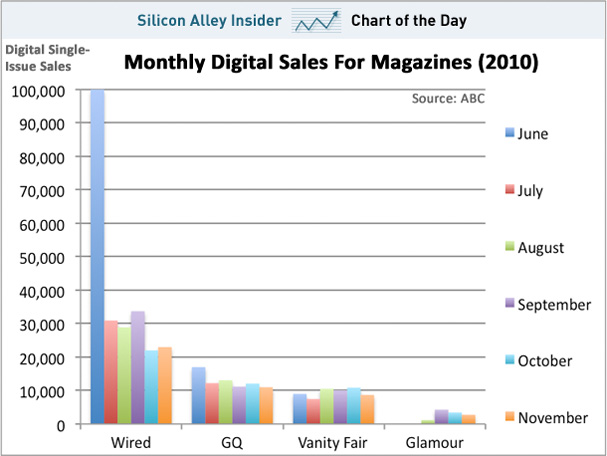
The gloomy news was best captured by a chart from Silicon Alley Insider: Chart of the Day -- iPad Magazines Tank


The story does indeed look pretty gloomy. But when you study the chart more closely the real problem was the extraordinary success of the first iPad edition from Wired. It throws everything that follows into a gloomy shadow. The GQ and Vanity Fair apps had their limitations, but the results and even the trends were not too bad, given that they were very much 'first efforts'.

Our experience has been much less dramatic but much more encouraging, so there may be a case for giving a few sketchy strokes from another picture. But we first need to note and magazine publishers need to recognize a few key points about the app economy and iTunes in particular.

  1. The first point to emphasize is that free apps will get much more traction and much more currency than paid for apps. A free app may get 100 times or even 1,000 times as much attention as an app that the user has to pay for.
  2. Freemium can work well for magazines. Give some content away for free, and make it attractive and easy to trade up to a paid for subscription. Freemium can work either as sheer promotion, where you do not expect to sell much to the iTunes audience, but you wish to whet an appetite. Or it can work well as a first step on the way to paying for something....
  3. If you are going to charge for your magazine app (and if it is really good and it costs you money to make it you should charge for it), recognize that it is a lot easier to sell an app for 99c or $2.99, or even £4.99 than it is to sell one for €9.99. And selling an app for $19.99 is really tough. I am not sure that consumer purchases can be sold effectively for $19.99 or $29.99 on iTunes. This is a fact about iTunes, where users have got used to spending 99c for a track. Purchasing habits on iTunes are different from purchasing habits using PayPal or Amazon. Recognize that fact before you get too far in. Recognize also that purchasing on iTunes can be very frictionless, easier and smoother than PayPal or a Credit Card. iTunes is different from Visa or MasterCard. At low prices, iTunes is better, slicker, easier than any other e-commerce environment, but not at the prices that many magazine publishers wish to charge for annual subscriptions.
  4. iTunes has an amazingly large audience. You cannot ignore it. You should use it to extend and embrace your existing audience. Make sure that your pricing works for your existing readers and your new readers. Make sure that your pricing makes sense to your existing print subscribers. Think about that.
One of the key things about the iPad is that it has given publishers a good reason to re-engage their existing audience in the concept of digital access. We think that this is the really, really good news about the iPad. Digital subscriptions for your existing audience are a key part of the reason for embracing the iPad. The point is that a magazine publisher can quickly and efficiently convert his print audience to a digital audience at low cost using free access to the digital feed as a reward for print subscribers. That way the circulation of the print audience is confirmed and strengthened and at the same time a new digital only audience can be won. Because the publisher sells digital access (via iTunes or directly) to those customers who do not want to buy the print service.

The data about the uptake of apps using the Exact Editions platform is confidential to the publishers of the magazine concerned. But we can publicize a few data points about the uptake of two nameless magazines. These are both high quality consumer magazines with an international but mostly ex-US audience. Both magazines have had freemium apps in the marketplace for several months at affordable prices (£4.99/$6.99 or less for 30 day subscriptions). Both have had respectable uptakes. In the case of magazine A, there have been nearly 50K freemium downloads and nearly 2K purchases. In the case of magazine B, there have been nearly 20K downloads and approaching 3K purchases. Incidentally, when publishers see this data, they are sometimes surprised by what appear to be 'low' conversion rates. Publisher B was inclined to put in some 'pre-qualifying' friction when he saw the rates (eg a form collecting email addresses); publishers with this reaction are severely underestimating the 'friction-free' style of iTunes and are also underestimating their need for exposure and promotion. The appropriate reaction would have been "Why haven't I had 60K downloads?" A 2% purchase-response rate is good for iTunes freemium apps. For both magazines the monthly purchases have been reasonably steady, steadily growing, and have shown a good ratio of renewals (ie renewals through iTunes). The renewals figure is perhaps the most telling point about the data. Apple has not yet implemented a really easy form of renewal, and it will be very much in Apple's interest for them to offer a form of 'automated' or 'unless I say otherwise' renewal, but even so magazine subs are being renewed at an encouraging rate. Neither we nor the publisher know who these renewing customers are, but Apple does give one sufficient data to tell that specific user ID's have repurchased.

Another point that gives us some confidence in the iPad and its future is that these are still early days. Neither of these 'respectable' consumer magazines have had anything like the promotion and attention of the Wired or the GQ apps. The publishers have given them some 'mind share', and some linkage and advertising via web pages and email campaigns, but I am pretty confident that the promotional budget in both cases has been " low to minimal". Sensibly enough, the publishers concerned have opted for low risk promotion and advertising because they have been experimenting, assessing reactions and feedback. These are still early days, because the iPad is not yet 10 months old, there are still barely 10 million iPads in the market place (many of them in the US). The potential for consumer magazines when there are 50+ million iPads in the market (ie early 2012) is obviously much greater. Another factor that gives me confidence in the potential for publishers making significant profits from their digital editions is that these two publishers have for different reasons not yet begun to exploit the full range of access options for their public. Publisher A has been promoting digital subscriptions through the web, but has not yet offered 'universal subs' to his existing print subscribers. When this is done he will experience a big uptake in app usage and app sales. Publisher B has not yet begun to promote or advertise the option for web subscriptions to the digital edition, when he does so there will be a substantial increase in digital revenues. The Exact Editions platform allows the publisher to promote digital subscriptions across the range: (1) directly as web subscriptions to a purely digital service (2) through iTunes as a way of selling 30 day subs to an iTunes audience; and (3) as an added value service to the existing, renewing and new print subscription audience. It is the potential publishers now have for a cross-platform and integrated, convergent solution for the magazine audience that is most exciting innovation about the iPad. Apple deserves a lot of the credit for that.

Tuesday, December 21, 2010

Syncing Multiple Issues and Bonus Media in Apps


Last week Exact Editions introduced an upgrade to the iOS app platform. The new release (4.1.0) sees two important improvements.

First, publishers can now incorporate 'Bonus Media' in an app on the iPad -- and for the moment, this deeper level of interactivity will only be available through the iPad. The solution we have built enables a magazine to offer its iPad readers, short video clips, sound and additional photo images (eg from a sporting event or a fashion shoot) in a consistent and easily navigated way. The additional content is included in the app, cued with icons in page flow, accessed via the menu at the top of the screen (next to the '?'/Information icon) and once accessed in a wifi zone may be synced to the user's device so that the media can be enjoyed even when not on-line. The first magazine to benefit from these enhancements was SXSWorld, and there are now open examples of this multi-media content available for any user of this free app; simply download the free app and turn to Issue 4 in Volume 4. Here are a few screenshots:


Bonus Media are signposted in the menu bar


The user can flip through a sequence of additional photographs, not included in the printed magazine.


The second significant upgrade in the Exact Editions platform is that syncing of multiple issues is now supported. As many as you like -- or as many as the memory on your iPad permits. Previously, the rule was that the most recent issue in a subscription would be synced to the iPad/iPhone, readers who wanted to access back issues were completely dependent on access via an internet connection. Now a user can sync back issues (or unsync them) by checking/unchecking the the list of back numbers for each title


Syncing multiple issues through the check boxes on the issue list

If we were asked to summarise the Exact Editions view of magazine apps, I guess one could say that our view is that the whole magazine in its digital form should be an app. The whole magazine should be an app and the relevant archive for the magazine should be accessible and readable (of course 'searchable') from within the app. The whole magazine should be there in the application, but when it is there, it is of course fine to add extra interactivity and linkage. And 'extra', or 'bonus' media. Why not? Some magazine publishers on the other hand seem to have taken the view that a magazine app should be constructed and distributed on an issue by issue basis. Although this may sound like a simpler approach and an easier target, we think that starting with the whole magazine in its entirety as a digital resource is easier for both readers and publishers.

Tuesday, November 30, 2010

Google goes into Culture Commerce

The rumour mill has it that Google will launch a Chrome netbook, cloud-based, computer before Christmas or early in the New Year. When you put this rumour alongside the others coming from the Googleplex you get an interesting picture

  1. Is Google going to buy a big package of movie rights? Is that why it has hired the former Netflix executive George Kynci?
  2. Google is possibly quite close to signing a deal with the major music labels for its cloud-based music-streaming service.
  3. For a couple of years, Google has been apparently on the brink of releasing a digital books service in collaboration with book publishers. Most recently Dan Clancy told us that Google Editions will be launching very soon ("très bientôt")
The rumours about the Chrome netbook suggest that its really all about the web, cloud-based productivity and web browsing, but if its launch is accompanied by, or closely followed by, a Google distribution and e-commerce solution for books, films and music, the market place for publishers and entertainment companies may change very fast. Google will be a formidable competitor if it becomes an information publisher and an e-commerce platform for film, music and books. Competitor primarily for Apple and Amazon, Google may well be seen as more of a 'friend', because more collaborative and more open than either Amazon or Apple, by the big incumbent publishers and media groups. Knowing, as we do, the way Google works (quiet launches, 'beta' services, and something of a scatter gun approach) I think its unlikely that Google will launch a fully fledged, cloud-based, Chrome-machine, with a multi-channel, multi-media dashboard in place in the first quarter of next year. It is surely more likely that this hardware platform and this constellation of media services will each emerge in their own good time. But if the plans come off and Google has these publishing partnerships in good order, it is highly likely that Google will be selling a lot of consumer products next Christmas. And I do not meant via Groupon; a commercial solution that can stream all kinds of media stuff from your locker in the cloud to Android and Chrome platforms, will be a dazzling consumer attraction

Wednesday, November 24, 2010

The Economist's Economical and Effective iPad App

And having played with it a bit, I would say that it is a very nice production. Take a look at it here.

There are four aspects to the Economist app that I particularly like:

  1. It has been delivered as a complementary (ie free) offering to all existing subscribers. Exact Editions has been helping magazine publishers to make this bridge to current print subscribers for a while, but a lot of industry experts seem to think that this is something very difficult to do, or somehow not allowed by Apple's e-commerce system, or just generally impossible. Since the Economist is now doing this with no trouble at all (the sign up was very easy, and you only need to do it once -- as is the case with Exact Editions' universal subscriptions) perhaps we will now no longer read claims that it is not feasible to do this. There will be followers......
  2. The Economist delivers all its six editions through the same app, and the user can select which 'regional edition' she wishes to receive. That is a very good plan, simple and in a sense generous. But a generosity which costs the publisher nothing (once it is decided, as it ought to be decided, that all the editions are deserving of a digital service).
  3. The Economist app delivers the individual stories clearly and well, with re-sizable type, and pictures and diagrams in place. Achieving this smoothly and with consistently good results is not easy and must have involved planning a fair degree of integration between editorial work-flow and the app delivery framework. Well done. I also recommend the Economist for choosing a deployment for the iPad which, I am fairly sure, can be easily adapted to other digital form factors that are surely coming. I doubt that the design and editorial process involved in producing the app in its variant forms is onerous, on an ongoing basis. So the planning and integration will be a good investment.
  4. I especially like that The Economist does not try to do too much, or to introduce multi-media and fancy additional features at this stage. This is an app for the weekly publication, not for the web site. The RSS feeds do not clutter up the app, though they can still be found on the web service, of course. The app will be ignored by some so-called experts for not being more ambitious and daring as a publishing innovation. But they have chosen the correct path: get the basic magazine up and running and then take it from there. It will not be difficult for them to introduce more interactivity into the framework they have built.
What is there not to like? Since I am very much in favour of the Economist's app these hesitations or questions, are not intended to be dismissive of what they have achieved:

  1. The Economist app is what I would call a good 'ebook' style of digital edition. The format and design quality of the original publication is mostly lost. Page numbers, and paginated format has gone. The print ads have gone (if I want to apply to be Director General of the World Water Council I will need to go to the print edition). The internal cross references are also gone, and that matters. Furthermore, the user no longer has a simple equivalence between the print edition and the digital edition. This dissonance imposes a bigger cognitive overhead than is generally accepted.
  2. There is as yet no search and no archive, one guesses that these features will be added. Perhaps they should really be there already.
  3. The navigation possibilities with the app are not as rich as in many other magazine apps. The hierarchical order of the magazine has been preserved and can be rapidly flipped, but I was looking for a 'scrubber bar', to be found in most magazine apps, or a 'page flow' widget such as is found in Exact Editions apps.
  4. The Economist's ebook style solution works well for the Economist (which is a more text heavy 'magazine' than most). But I doubt that the same process will work for a very heavily illustrated and page-beautiful magazine. The Economist calls itself a 'newspaper' and I feel that its app solution is better suited to a serious newspaper than to the majority of magazines, where considered layout and clever illustration is a key element in the pleasure of the reading experience.
  5. Furthermore the Economist does not have the benefit of being a platform solution. The Economist is a big enough and a good enough magazine to contemplate building its own solution, but many advantages will come from working with a raft of similarly designed offerings. For most magazines that is an important consideration.
  6. Although, I applaud the decision not to launch with many multimedia bells and interactive whistles, the digital magazine is very short of linkage. Linkage to the web and linkage to other information resources that matter to readers. The Economist app will be better, much better, when there is more.
The Economist have produced a good solution for their loyal, influential, and large readership. They have also shown the magazine industry that developing a solution for your existing subscribers is an important first step. They have not yet shown how great an iPad magazine could be, but those steps are in the future and they have made a good start. Rival publishers should take note and take stock.

Tuesday, November 16, 2010

Apple's Next Announcement: Android Compatibility?

It seems as though the Apple announcement about the availability of Beatles music via iTunes was not such an earth-shaker. Fred Wilson's tweet was the best riposte that I have seen so far ("I've had the Beatles on iTunes since I bought all of their CDs and ripped them back in 2001 #muchadoaboutnothing" tweets Fred).

But here is an announcement that really would surprise the digerati: Just suppose, Apple decides to offer the iTunes app store via Android?

I guess most experts would dismiss this out of hand. Is it not the point of iTunes and the app store that it gives users and potential purchasers a compelling reason to purchase Apple hardware not the devices that come from other manufacturers? Surely Steve Jobs would never want to do this? Wouldn't putting iTunes on Android be a way of endorsing the competing Android standard? Surely Google would never allow that?

But before we dismiss the idea, give it some consideration:

  1. The prospect that Google might ban an iOS4 emulation environment for Android would surely, in and of itself, be enough to encourage Apple to produce one. Google would lose its moral high-ground if it pulled such a trick.
  2. Apple would surely sue anyone who built a 'clean room' iOS4 environment for Android, but that doesn't mean that Apple could not choose to do that directly. Apple has a choice as to how to play this issue of 'standards' and 'fragmentation. It would be sweetly ironic if Apple brought the Apple standards of e-commerce and app regulation to the small Apple-blessed part of the Android spectrum, letting the rest of the Android world hang on to the devils and dangers of unregulated experimentation.
  3. Apple may not want to appear to endorse Android at this stage, but as Android approaches a degree of maturity Apple will be more interested in 'managing', 'stabilising' and 'participating' in the evolution of standards and expectations that are being set by the non-Apple universe. Apple could exert considerable influence in this way if there is a large library of iOS-compatible apps running through Android.
  4. Apple is capable of using the 'embrace to extend' strategy beloved of Bill Gates. Remember how many observers (including many music publishers) were surprised when iTunes for Windows appeared in 2003 and the way in which this step re-inforced Apple's position as the primary avenue for digital music sales.
  5. When Apple's music and media goes to the cloud, then there will be little reason for Apple not to offer its music service through the Android eco-system. If the music and the media properties are positioned as cross-platform, why not make the same choice for the apps environment.
  6. Android manufacturers and designers would love to inherit the wealth of apps available for iOS4. There would be a bargain to be struck if Apple were willing to license its environment to particular manufacturers or network operators. Bargains being struck means that Apple gains leverage and position.
  7. Apple will gain additional software revenues through its 30% tariff on any app sales through the Android environment. Concurrently providing a direct Android solution for its committed developers would be a way of keeping the lead that Apple already has in the developer community. It might postpone the time when Apple's developers give equal or greater weight to the Android platform. As the market for apps matures, the percentage of Apple's profits that is coming from e-commerce will increase and the attractiveness of revenues from an Android-compatible market will increase.
  8. It is unlikely that any Android device manufacturer could produce a device that completely matches the specification of the iPhone, still less the iPad, in every particular. Some apps will not travel outside iOS4. The Ocarina app for example might not seamlessly translate to the best Android phone solutions, what with the differences in microphone positioning and function. But Apple will like that, complete inter-operation across the board, might be too much of a threat.
  9. Apple could decide to run an iOS emulation environment across the Android phone environment, so iPhone apps cross over and iPad apps do not. Keeping iPad apps restricted to the iPad hardware whilst the iPhone apps are allowed out. Again, Apple has choices and can play this game of extension and standardisation in ways that suit Apple and its customers and developers. Google's 'hands off' position on Android begins to look a bit more like a 'hands tied' stance.
  10. That Apple have not done this so far, is absolutely no guarantee that they might not be inclined to do it in the future.
There may be some element of the Android and iOS4 licensing that means that such a direct app cross compatibility cannot happen, (if so I am not sure what this road block could be). But if it is a possible development, then I am sure that Apple and Google will have done a bit of 'what-iffing' to consider the potential outcomes from such a move.

How will we be Reading Magazines in 2020?

We have been informally polling readers of this blog to find out how we think magazines will be read in ten years time (you may still enter the poll here). We offered eleven different options for magazine reading a decade from now. According to those who have completed the magazine poll these are the likeliest options:

  1. On a tablet (something like the iPad)
  2. In print on paper delivered via physical distribution
  3. On an e-ink device (something like the Kindle but with colour)
  4. On a device or medium unlike any of the others in this list
At the bottom of the list
  • From an image projected to a surface by a mobile phone (or something like that)
  • On heads-up interactive goggles
  • On silicon brain inplants
I guess we only put 'silicon brain inplants' in the hope of attracting the science fiction audience, but I am a bit surprised that 'On a device or medium unlike any others in this list' did not climb higher than the number 4 slot it now occupies. At the beginning of this year, Apple's iPad was still an unknown quantity, quite possibly a huge flop in the making; and yet now 9 months later, for many people it looks like the most likely way in which magazines will be read in the next decade. Surely there is a chance that something still better, and quite unheralded, may come along?

Well our sample of respondents does not think so, and this very same sample also thinks that it is very possible that the printed paper magazine will still be up there contesting the number one spot with the iPad or its successor of 2020.

We constructed this poll because we thought it might throw up some data that we should consider at our private (invitation only -- and I am afraid they have now all gone) Roundtable to discuss the current state of digital magazines at the British Library on December 1st. The theme of the Roundtable is: Bringing it all together: iPads, online and print; So we probably guessed right in putting iPads and other Tablets as the first of our themed discussions for the roundtable. These seem to be some of the tablet-related issues that may be addressed by our panelists on the day:

  • Are tablets now defining the format for digital magazines in the future?
  • Is it a problem that Apple makes by far the coolest device.
  • Will there be lots of tablet platforms? Apple, Android et al (this begins to look complicated!)
  • And what about mobile phones? Distinct or v different opportunities?
  • Can magazines sell/distribute digitally direct? Or do they need to go via an iTunes or a platform?

Friday, November 12, 2010

Magazine Publishers and Horse Dentistry


It seems that every other day brings a new bout of moaning about the limitations of the Apple iPad system as a digital magazine platform.

But are these complaints justified, or is it really an indication that magazine publishers are both missing the bus and looking a gift horse in the mouth? The latest piece of mis-guided bleating comes in an otherwise sensible article from Damon Kiesow in Poynter Online. He says:


What publishers and consumers need from Apple is a real digital newsstand, which would allow:
  1. One-stop shopping for multiple publications
  2. The ability to buy a single issue or subscribe
  3. Capability to connect print and tablet subscriptions, including any package discounts
  4. A central location to access purchased or downloaded publications
  5. Sales via iTunes or a publisher's own circulation system, with royalties adjusted appropriately
Damon Kiesow 3 strategies emerge for charging for iPad publications

These sound like reasonable requirements. But the plain fact is that iTunes and the app store pretty much does all that right now. Let us take them one at a time: (1) iTunes is a one stop shop for lots of publications, it is hardly Apple's fault if plenty of magazines have not ventured in there yet. Even so, the iTunes news stand is better stocked with newspapers and magazines than any other digital news stand. And getting stronger. (2) (the ability to buy single issues or subscriptions) as Kiesow acknowledges earlier in the article Apple through the iTunes app store allows publishers to sell single issues or subscriptions (at Exact Editions we enable publishers to sell 30 day subscriptions to their magazines which is not the same as selling single issues; but there are plenty of publishers and platforms selling single issues through iTunes) (3) (connecting print subscribers to apps) but as Kiesow recognises there is no obstacle to a magazine publisher connecting its existing paid subscribers for free to the app which is being sold by Apple in iTunes (he cites the experience of People magazine, but at Exact Editions we are encouraging all magazine publishers to do this: connect your existing subscribers for free through the branded app which you are offering in iTunes. This is completely within the letter and spirit of Apple's rules and guidance). (4) is completely baffling, because iTunes so obviously just is that; iTunes is a central location for e-commerce, for storing magazine issues and for providing users with access to archives. How would or could an Apple kiosk do that better? (5) (a system for 'sharing royalties') is already in place and Apple has the rather marvellous adjustment that a publisher can choose how to play the game, the publisher can either sell via iTunes in which case he will find that Apple have taken a 30% commission from the sale, or he can choose to give the magazine away, or indeed provide free access to subscribers from whom the publisher has charged an annual or monthly subscription (outside the Apple system). Not only can publishers connect customers who they have acquired via the iTunes system to their existing deals and print-based offers and incentives, but they can do that without paying Apple a cent for the business which is happening outside iTunes. Apple is being a lot more 'open' about this than will be some of the competing digital news-stands that are coming along.

All this should be known to the complainers in the magazine industry and I think that the real source of the griping, grumbling and equine mouth inspections is elsewhere. Perhaps these are the real problems:

  1. iTunes is not a complete digital back-end system for magazines. Publishers are used to having a specialist distribution house handle all complications to do with physical distribution and maybe they are hoping that Apple would be able to do this in the digital sphere and look after the magazine publishers special interests in the way that fulfillment houses have done. Once this is formally stated the idea is ludicrous, but some magazine experts talk as though its Apple's job to deliver, in full working order, the digital back-end of their industry. This is perhaps the burden of Kiesow's request that the putative Apple kiosk should 'connect' the print and tablet subscription ('including any packet discounts' -- I like that requirement: consider the extreme complications that could arise from blending infinite varieties of print/digital discount packages the magazine publishers will dream up; that modest requirement will keep Apple's engineers busy for years). But Apple is not in the magazine or newspaper business and it is not their job to build a system which solves the transitional dislocations of those industries.
  2. iTunes does not have an exclusive magazines-only zone. Like the iBooks store. This is true, but it may be a good thing for the magazine industry that Apple does not have a required format and delivery solution for magazines. The jury is still out on the iBooks solution, and perhaps Apple is being very wise in waiting to see how digital magazine delivery evolves. Why should they plump for a possibly half-baked digital standard when we still don't know what the right digital format for magazines is? Certainly Apple has not solved all the problems of digital magazine production, the result is that there is a rather interesting ferment of development and innovation. If Apple had developed a pre-packaged solution (cf Amazon and their so far half-hearted and not very good magazine delivery) we would not be witnessing these exciting experiments within iTunes.
  3. Apple is not being friendly enough to the existing magazine business. There have been a chorus of complaints about Apple not providing sufficient information on app usage to developers, or to magazine publishers who produce apps. The magazine industry is used to having its own tame auditing service (ABC and BPA being two of the biggest industry consortia providing such information), specifically geared to the magazine industry and its advertising customers. Apple has shown no signs of opening up its books to ABC or the BPA and is frankly unlikely to do so. Why should Apple be unmovable in this respect? Primarily because the business of auditing advertisements has moved on, and there is now no conceivable rationale for having an advertising metric which is exclusively tailored to the magazine industry. Google, Apple, Microsoft and Facebook etc will be the advertising networks that count in the future and they will all be trans-media (web, TV, film, digital publishing, social networking all in a big mix). Since 2005, the boom in digital advertising has shown that measurement and auditing is so closely tied to implementation and operations that it is naive to seek to recreate a magazine-specific analysis or distribution solution. Digital magazines will need advertising but they will need to work with digital solutions and digital metrics which are not narrowly specific to one industry or one media type. It certainly is not in Apple's game-plan or in their interest to gerrymander a magazine specific solution for reporting and measuring usage on magazine apps.
  4. It is hard to sell magazine subscriptions through iTunes. Kiesow correctly points out that Apple enables publishers to sell subscriptions, and there has never been a problem about doing this (we have been doing so at Exact Editions since the iPad launched). In contrast to Android, Apple in iOS 4 and iTunes actually has a rather effective way of providing in-app purchases of subscriptions. The problem for the magazine industry is rather different: iTunes customers are hugely biased towards buying stuff that is at the low end of the iTunes price matrix. It is very hard to sell annual subscriptions to magazines through iTunes at the prices that magazine publishers would like to charge (and perhaps need to charge). This is a real problem but it really is not Apple's fault, and they can hardly blamed for this supposed shortcoming. iTunes works very well for low-priced transactions. But it is hard to see annual magazine subscriptions through iTunes flowing off the digital shelves at prices of £20/$30 and upwards. So it will be interesting to see how Newsweek fares with its experiment of selling 6 months subscriptions through iTunes at $14.99. iTunes apps are pretty 'frictionless' when priced at $0.99 or $1.99. But it is much harder to sell subscriptions at $9.99 or $19.99. Perhaps Newsweek will start a trend, or maybe magazine publishers should stick with the scheme of using iTunes for customer acquisition and then upselling them to an annual subscription purchased via a credit card direct from the publisher (where consumers are happier to spend $9.99 or $29.99, for a publication they really value).
The conclusion that one should draw from all these niggling gripes about Apple is this: publishers do not realise how lucky they are, magazine gurus should stop complaining and use the Apple service for the tasks it performs so well, and get on and sell or freely provide (in the case of existing subscribers) access to the magazines that they can now deliver digitally or in print. When you think about it, it clearly would not be a good idea for the magazine industry if Apple did provide a complete and end-to-end solution for digital magazine distribution. Magazine publishers need Android, and Windows 7 and pure web distribution to preserve their independence and choice. They need alternative channels for magazine distribution not just an iTunes route to market. Magazines, not Apple need to control and manage their own digital distribution, and if Apple were suddenly to produce a comprehensive digital magazine service, this would be dangerously sedative if it stopped innovative publishers from looking to alternative digital distribution routes and technologies.

Friday, November 05, 2010

Adobe's Magazine Solution for the iPad

Here is an informative video podcast from the Adobe evangelist Terry White: "Adobe Digital Publishing to the iPad: A First Look"

It is a 15 minute overview of the solution for building iPad apps that Adobe is building for magazine publishers. As you might expect there are some neat software solutions in the package, especially notable are tools for placing video in a document page, for interactive/panoramic 3D photos and model rotation, and for full integration of a web page in the document. Cool stuff.

But the thing that really struck me with this overview is that Adobe is taking a big, and surely quite a risky bet on the way that we are going to read and interact with digital magazines. Adobe have decided that the information architecture for the digital magazine will be very different from the conventional paginated, linear, sequence of the printed magazine. The Adobe solution is entirely built on the proposition that digital magazines should have a matrix style of layout, with pages arrayed left/right in the horizontal plane, and also up/down in vertical 'stacks'. This concept seems quite natural for a 'story', or a set of photos, or a collection of cartoons, which can be read in the vertical 'drop' whilst the ordered contents of the magazine move along in the horizontal mode. This sounds like a logical way of planning a magazine issue and there is apparently no reason why a digital magazine should not be so arranged. We have seen quite a few early magazine apps already employing this, washing-line, information layout, by no means all of them from Adobe's developers. I am not convinced that users really want to read magazines in this way; but if they do, Adobe will be in a very strong position because they now have a direct set of tools for bridging magazine publishers from the InDesign package with which most high-end magazines are now produced, directly to a file format and an information architecture for the iPad to which Adobe are building an extensive and complementary set of tools.

On the other hand, there are several reasons for thinking that this big bet on the next stage for magazine architecture could be the wrong way for magazines to go digital. Here are some:

  1. Each magazine issue has to be precisely designed for the iPad, perhaps page by page, with adjustments and tweaks. The automatic layout tools in the package cannot guarantee a 100% result. This means more work in the publishing/design stage.
  2. Twice over. The magazine on the iPad should really have two sets of pages adjusted for the different aspect ratios of the landscape and the portrait mode of viewing the device. Terry White suggests in the video that the digital magazine could be designed for presentation in only one orientation, but that really is not a good option for the iPad. Magazine apps, or even ordinary documents, that can only be read in landscape or portrait mode on the iPad feel very lame.
  3. And then the magazine has to be re-engineered again for the iPhone (if that is supported) which has different proportions to the iPad.
  4. Redesigned, or re-tweaked, many times more (it is probably much worse than you think) since magazine publishers will need to review and tweak the magazine layouts again (twice) for as many alternative devices as will require magazine apps with different aspect ratios.
  5. Multi-page, multi-column, layouts work better in the horizontal plane than when read in vertical scroll mode. What do we do about that if the whole of the magazine is being matricised?
  6. This bi-valent, matrix, layout is arguably not a good solution for magazine users, because the arrangement of a digital magazine not only changes in potentially confusing ways as one switches a device between landscape and portrait mode, but it also confuses the reader as one transitions between different devices, or from print to digital. The overhead imposed on a publisher in needing to refine designs for different versions on different screens, is bad enough, but it is outweighed by the cognitive 'overhead' for users who need to relearn how to navigate and understand a magazine which is being presented in different ways on different devices.
  7. Are readers going to be happy with a reading style for magazines which is completely different from that used in reading newspapers or books? Are digital books meant to work as well in matrix mode as magazines? What about newspapers?
  8. Will this matrix layout work efficiently when you have magazine apps, book apps and newspaper apps on the same screen; for there will soon be bigger touch screens? Or when we wish to consult two issues of the one magazine? Matrices hog space in both dimensions.
Adobe need to have an app-building solution for the magazine industry where their software is an essential and highly regarded creative tool, but there are reasons for doubting the generality and flexibility of their current approach. If there are a score or more Android hardware devices in the next year -- three, four, or five of which achieve some level of consumer acceptance -- Adobe's decision to couple the design of a digital magazine so closely to the screen size and the hardware spec. will be sorely tested.

Tuesday, November 02, 2010

Khoi Vinh's Indigestion and the iPad

Khoi Vinh published, last week, a damning and severe critique of the current state of magazine iPad apps. Here are a couple of extracts:


My opinion about iPad-based magazines is that they run counter to how people use tablets today and, unless something changes, will remain at odds with the way people will use tablets as the medium matures. They’re bloated, user-unfriendly and map to a tired pattern of mass media brands trying vainly to establish beachheads on new platforms without really understanding the platforms at all.....

Take the recent release of the iPad app version of The New Yorker. Please. I downloaded an issue a few weeks ago and greatly enjoyed every single word of every article that I read (whatever the product experience, the journalism remains a notch above). But I hated everything else about it: it took way too long to download, cost me US$4.99 over and above the annual subscription fee that I already pay for the print edition and, as a content experience, was an impediment to my normal content consumption habits. I couldn’t email, blog, tweet or quote from the app, to say nothing of linking away to other sources — for magazine apps like these, the world outside is just a rumor to be denied. (My iPad Magazine Stand Khoi Vinh)

In fact Khoi is pretty gloomy about the prospects for the magazine industry:
The fact of the matter is that the mode of reading that a magazine represents is a mode that people are decreasingly interested in, that is making less and less sense as we forge further into this century, and that makes almost no sense on a tablet. As usual, these publishers require users to dive into environments that only negligibly acknowledge the world outside of their brand, if at all — a problem that’s abetted and exacerbated by the full-screen, single-window posture of all iPad software. (My iPad Magazine Stand Khoi Vinh)
There are some excellent responses to Khoi's depressing account of the magazine industry prospects in the comments which his blog has attracted. The best full-out response that I have seen comes from Mike Turro.

Without a doubt the future of magazines–both as an industry and a publishing framework–is uncertain. However, to write off the reading experience provided by a good magazine as a relic of the print world is extremely shortsighted. When Khoi offhandedly and anecdotally declares “that the mode of reading that a magazine represents is a mode that people are decreasingly interested in” he is assuming (though he does give a slight nod to the contrary) that the current use patterns of the web’s most emphatic users (also iPad’s early adopters) are an indication of the eventual use patterns of the population of tablet users as a whole. Khoi is certainly a smart guy, but it may be a bit early to make that call. (@Khoi Vinh's Beautiful Mistake Mike Turro)
Mike Turro calls Khoi Vinh's mistake, "beautiful". I am not so sure about that -- it could be a blunder, attributable to his indigestion through consuming too many unripe apps. It seems to me that 'magazine designers' are particularly excited and in many cases particularly disappointed by the possibilities of the iPad, because they have been thinking of the iPad as a new medium and a new design challenge for their typographic and layout skills, as though magazine publishers could own or control the device the way they control paper stocks and printed colour choices. But the iPad is not the medium but a digital device. Magazines will grow and change as they work out the potential of digital media, but they start this adventure the way they are. That is nothing to be ashamed or worried about. The excellence and remarkable quality of the iPad is that it is really a very 'neutral' digital enabler and any virtual, digital, media object should be able to thrive in its embrace. We should not be designing magazines (newspapers, books, films) for the iPad but for their audience, an audience that is increasingly digital and which will now have Galaxies and Droids as well as iPhones and iPads, and this means we should now be designing digital resources which can gracefully leap into different devices and across various media platforms. So if there is a reason for sticking to proven formats (pages, paragraphs, layouts, inserts, wrap-arounds, even belly bands and overlays, indices, cartoons, charts and tables) this is not because these formats are inherently digital, they are not, the reason for sticking with them is that the users/readers understand and enjoy this traditional 'grammar' of type. Too many of the magazine apps that we have seen for the iPad have been designed and engineered precisely for the iPad in a way that will make them impossible to deliver for the iPhone or the successful Android tablet which will surely appear in the next 6/9 months. A publisher or designer who crafts their magazine app specifically for the iPad is building in obsolescence and writing in tablets of stone a message that should be digital, transferable and evolving. The challenge which the iPad and other digital manifestations of the magazine will present to the publisher is this: how can we make a magazine that works well in print and in a range virtual manifestation on tablets, games consols and many other digital gadgets that we have not even considered yet? As Khoi Vinh and Mike Turro both recognise, this is very early days for the iPad and for tablet apps.

The requirement that a magazine should be consistent across a variety of print and digital manifestations certainly does not mean that it should be the same in those 'editions'; if, to take a specific and local example, you look at Exact Editions apps you will find that there is stuff that you can do with them on the web that you cannot do with them on the iPad, there is stuff that you can do with them on the iPhone that you cannot do on the iPad and there is plenty that you can do with them on the iPad that you cannot do on the web versions. The various digital forms of a magazine will be different from each other but they should have a common core; and a clever designer will make sure that a 21st Century magazine not only looks good in print, but also in its many digital variants where additional layers of interactivity and sociability will certainly accrue. I have been struck by the insistence with which the readers who subscribe to the magazine we support with apps and digital editions want the app to reflect and to represent the magazine that they know. They expect it to be on the iPad and they do not expect it to be something completely different from the magazine they may have been loyally reading for a decade and more.

Monday, November 01, 2010

Gramophone


Gramophone (The world's authority on classical music since 1923) joined the Exact Editions platform last week. The free trial issue has lots of intriguing articles:

If you have a subscription and are lucky enough to have an iPad, you will want to read it on that device, with the Exactly app from Exact Editions.