Exact Editions is running a public poll to find out how we think that magazines will be read in ten years time. If you haven't yet voted on the issue, please do so.
The sample voting is still small, but I am not surprised that the leading candidate in this race is:
The tablet (something like the iPad)
This is beating 'print on paper delivered via physical distribution'. A bit lower down the list is the option for genuine 'don't knows': ' a device or medium unlike any of the others in this list '.
While I am not surprised that the iPad (or something like it) is the most favoured choice for our most preferred magazine reading medium for 2020, I would have been very much surprised if you had told me 18 months ago that this tablet-type solution would now seem to be the most promising future vehicle for magazines. The iPad is astonishingly successful, but it is only 7 months old. The way that a magazine app should work on the iPad is still very much up for grabs. The way that users will want to use digital magazines is not a settled issue. There is a lot to be done! There are strategic choices to be made!
Exact Editions is running this poll as travaux preparatoires for a round-table forum that we are hosting for movers and shakers in the magazine/technology space in London, on 1 December. One of the key themes for discussion on that day will be 'iPads and other tablets', but another theme, the fifth and last that we have listed for the round-table is 'the social graph'. We are pondering the relevance of the social graph to the shifting technical base of the magazine industry as it goes digital: Few magazines/newspapers have really tapped the social graph (yet). Are Facebook and Twitter the real new frontier for digital publications? Although the social graph and the social context of digital magazines is not yet the top item on most digital magazine executives 'worry list' I cannot help but wonder whether the issue of magazine format and delivery is intimately bound up with the question of how magazines can be most easily integrated into the social graph. If the tablet, an iPad or its equivalent, becomes the primary way in which we interact with our closest, but absent, friends and our wider web acquaintance, then the magazine publishers who are now gearing their publications for tabletisation or iPad delivery will have made a prescient move.
The iPad is a surprisingly social device, more so than a notebook computer or a mobile phone. I do not think that it is just the novelty element in the iPad that makes me much more willing to pass mine around -- much more willing to pass it around than to pass around my mobile phone. The momentary, or episodic, lendability of the iPad may have something to do with its 'touchability' which is itself of social value in a small group, and magazine publishers will be reassured to know that this 'physical lendability' is very limited. Sharing a magazine subscription via the same iPad is feasible for mother and daughter, or husband and wife, but not really practical amongst a wider group of friends.
Thursday, October 28, 2010
Will Magazine Reading Be More Social?

Friday, October 22, 2010
How Will We Read Magazines?
We are running an on-line poll on the way that magazines are to be read 10 years from now.
If this is an issue on which you have views, go and cast your vote. Remember we are not asking how magazines will be read next year, or in 2012, but in 2020! These are the choices:
- In print on paper delivered via physical distribution
- In print on paper delivered by home printer device
- On a tablet (something like the iPad)
- On an e-ink device (something like the Kindle but with colour)
- On a mobile phone (something like the iPhone/Blackberry)
- From an image projected to a surface by a mobile phone (or something like that)
- On a personal computer (the equivalent of today's PC or Notebook)
- On a TV-type of home entertainment system
- On silicon brain inplants
- On heads-up interactive goggles
- On a device or medium unlike any of the others in this list
Oh yes, there is an incentive for completing the poll: you will be able to see how the votes of others have been cast (totals only -- this is an anonymous poll), and you will be able to come back in and check the results again later. But we will also blog about the result here next week.
One reason we decided to construct this poll: at Exact Editions we are running a round-table discussion for 50/60 leaders and key decision-takers in the magazine business, the round-table to be held at The British Library, on December 1st. The focus of the discussion is very much on the promise and potential from current digital technologies (our theme is "Bringing it all together: iPads, Online and Magazines in print"), and in preparing our themes and thoughts for this event we thought it would be useful to consult the wisdom of crowds on the imponderables and the various sea changes which confront the industry.
Although it is very hard to be right about this kind of issue, it is of fundamental importance to the industry and its decision takers. Which is one reason why the magazine business has shown so much interest in the potential and performance of the iPad as a magazine reading device.
Tuesday, October 19, 2010
Universal Subscriptions
Exact Editions has always worked to help publishers offer digital editions to existing print subscribers. Our first contract made provision for what we called 'Combined Subscriptions' a route whereby a publisher could add the digital sub for any of his print subscribers. In practice, this never worked too well (uptake was slight in most cases). For quite a few reasons:
- Our web service is designed to handle annual subs (ie 12 months) and it was very difficult to build in more flexible alternatives without confusing the customer experience in the e-store. Many consumer magazines rely on quarterly subscriptions that are renewed 'automatically' via direct debits from the customer's bank.
- Most consumer magazine publishers (back in the day) felt that they ought to charge a premium for providing print+digital subscriptions. And this has NEVER worked -- basically because consumers do not see why they should be paying a premium for buying the magazine twice .... To the consumer it seems obvious that the subscription is for 'one thing', the magazine in two different forms, no way would a rational agent pay twice for the same thing. To the publisher it seems obvious that the 'consumer' ought to be paying more for getting a better service. I do not know who is right, morally, in this dispute. In practice, however, the consumer is right. The consumer is always right, and purchasers will not pay for what we used to call 'combined subscriptions'.
- We used to call them that, but we now call them 'universal subscriptions'. This is a term that we picked up yesterday from Colin Crawford. And 'universal' is clearly a better term, because 'combined subscriptions' sounds ugly and complicated. 'Universal subscription' connotes a simpler, a more open-ended and a more comprehensive solution to which existing print subscribers, the lifeblood of most magazines, deserve full access. But the Exact Editions service is more universal than 'combined' because it allows a publisher to offer the print subscribers, access through the web, through the iPhone, and the iPad. One might expect also to add Android access to that range of universal access.
- The 'universal subscription' proposition is clearly better for the consumer than the prospect of paying extra for access to a digital or an iPad edition, but it is really much better also for the publisher, because the publisher or his distribution arm maintains control of the subscriber list. We can only guarantee to provide publishers with a reliable universal service if the Exact Editions platform can verify subscription status in real time. The big consumer publishers who have been nagging Apple with the demand that they have access to customer data have been pushing at the wrong door. Much better to retain control of the customer data on their own side, and then enable suitably qualified users of Apple iOS devices (ie existing subscribers) to access the accounts which are maintained at the publisher end. Some shrewd newspaper publishers are already using this approach (WSJ, Financial Times).
Nicholas Negroponte: Books will be Gone by 2015
Nicholas Negroponte, interviewed on CNN, makes the bold claim that (physical) books will be gone by 2015. I am supposing that he means more precisely that at some point in the near future, books will be more read and browsed as digital resources than as print on paper objects. To sharpen up the prediction, in which year will we see the switch over point, when more books are read on a digital medium than in Gutenberg-style print on paper? Will the big switch-over from physical books to digital books take place in:
2014 Negroponte is being cautious
2015 Negroponte is spot on
2016
2017
2018
2019
2020
2021
2022 Hard to see this far out
Later Negroponte is talking through his hat!
To take part in this poll go here (Condorcet Internet Voting Service). Results and some comments will be posted on this blog at a later date.
Thursday, October 14, 2010
SXSWorld Magazine as a Free App
SXSW World is the second magazine to use the Exact Editions iPhone/iPad app platform for free distribution. Dazed & Confused was the first.
SXSW World, as you have probably guessed, is the magazine from the organizers of the wildly successful music/film/technology/culture fest held each spring in San Antonio, Texas. With an iPad or an iPhone you can now read this quarterly magazine for free. In this blog we are going to use it to pin-point the basic controls that are to be found on all the Exact Editions apps, but if you have an iPad we strongly recommend that you go and pick the app up and play with it yourself. Try all the orientations, all five free issues, and all the functions on the app's toolbars. Any written or verbal explanation is a poor substitute for the experience of driving the app yourself. But, as second best, we provide some screenshots with explanation:
The Front Cover. Note each of the page numbers on the cover have a green spot, and a click on the highlighted number takes the reader straight to the referenced page. Note also the tool bars at the top and bottom of the window. These tool bars (which disappear after a few moments, but can be recalled by touching the screen) carry the main navigation controls. The Exact Editions apps are designed to give all available space to page images of the magazines and books carried, but the user will soon find out that all the software controls for the app are readily available in the unobtrusive tool bars. Starting at the bottom left:
This triple-decker sandwich icon, is in fact a table of contents icon, it takes the reader to the main table of contents in the magazine (or book), as here:
Again, we draw attention to the interactive links highlighted in green on the digital table of contents page (zip codes, email addresses, urls, as well as page numbers are highlighted). The iPhone, since it is a phone, will also present the phone numbers as highlighted for click-to-call. The grouping of three icons at the middle of the tool bar at the bottom of the window are for moving through pages.
Naturally the arrows are for moving right or left, and the left arrow is 'greyed out' in this snap because we are at the front cover of the magazine. Sorry there is no way that you can go left here! The open book, or concertina, icon in the middle is perhaps the most powerful of the navigational tools in the set we offer. It opens up a quick browse view of the magazine, which we call 'PageFlow', which is in some ways similar to the iTunes 'Coverflow', but rather more 'page-y', since it shows pages in recto and verso views as you move through the publication (naturally, by sliding your finger over the stream of pages).
PageFlow is so blisteringly fast on the iPad that this soon becomes a very valuable way of controlling and navigating the magazine as a virtual object. The slider bar with its bead (to be picked up and slid along the bar) is streaming through the same underlying PageFlow, but even more quickly, and this is especially useful for really large volumes.
The thumbnails used for PageFlow are small, but with an illustrated magazine they contain sufficient information to be highly useful, especially for finding again pages that you may already have browsed.When you have slid to the right part of the magazine, two pages will be open in the 'valley' of the page images. You tap the left hand page, to go to the left hand of the opening, tapping on the right hand page takes you to the other one. If your sliding navigation has 'overshot' the mark you can touch any of the other visible pages in the sequence to go direct to that page. Seven pages on each side of the opening are immediately available. As it happens we want this page:
This image can be expanded (spreading fingers) to a higher resolution:
I am not sure that we need to see Matthew Vaughn in higher resolution than that!
The last icon on the bottom tool bar is to alternate between double page and single page views.
Which takes you to the double page spread:
We have only covered the controls that are available from the bottom tool-bar. Next time we shall cover the set of controls that come at the top of the page.

Tuesday, October 12, 2010
The iPad is Magical but it is not a Mystery
Dan Bricklin has an excellent blog post about the extraordinary but hard-to-define magic of the iPad. It is one of those rare blog postings that one would like to offer to every one who thinks about the way apps are working on the iPad and what the iPad can do for publishers and readers. Here is a chunk of Bricklin-wisdom:
The way I see it, what makes the iPad magical is that with it we are the magician. The iPad is our own specially marked desk of cards. We now have power to easily and confidently control things that we previously did not. It is a very empowering tool.
With the iPad, we are the masterful magician, not the audience watching in awe.
Why is this so? Isn't the iPad just a big iPod touch?
As I pointed out in my first iPad essay, the iPad gives us more screen space than a pocket device like an iPhone to expose control points and to make the operation of those controls clear and easily accessible with fingers. The iPhone-size screens have room for mainly one major UI-control cluster plus a small toolbar or two -- when the keyboard is up there isn't room for almost anything other than a small view into what you are entering with little context. The iPad does not have such severe limitations, having room for many controls and explanatory information. You can sit back in your seat (like Steve Jobs at the announcement) and comfortably control the device, unlike an iPhone where you pull it to your face and squint to see the controls (especially if you are over 40 like I am).
The use of touch and the application of the capabilities of the graphics processor to give the illusion of smooth flowing, directly manipulated operations enhances the feeling of control. The larger screen in a still-portable flat form factor makes it comfortable for multiple individuals to watch as any one of them controls changes -- public magic, not private exploration. The wireless connectivity quickly brings requested data in on demand. The large screen has enough room to give you context and depth of information from that data. Is the Apple iPad really "magical"?
This is helpful and enlightening because much of the magic in the iPad is a result of its simplicity and the way in which its form factor (mid-size, touchability and screen resolution) encourage a direct and human relationship between the object as instrument or display, and the reading or viewing subject as mover and navigator. The success and the magic of the iPad is both subtle and simple, but it is not a mystery, because the way it works is very simple but with a high degree of user control and involvement. Bricklin goes on to note that the iBooks app is only 'so so' in the magic stakes.
Likewise, I've found some other reading applications, like magazines, that look really nice, and seem to give you control, but that fail to deliver enough when you try reading and perusing the publication -- you feel hampered and long for bound paper that you can skim through and with which you can easily flip back and forth with the right feel. As they say, "God is in the details" -- details of implementation are important and can distinguish the winners from the losers.Bricklin does not say this, but I think that many of the newly re-designed magazine apps have been making a grave mistake by supposing that users (or shall we call them 'readers') want something very different from the print magazine that they already know. Most subscribers and readers like the magazine that they subscribe to or read because it is the way it is. For a loyal reader of The Spectator, or The Wire, the digital edition of the magazine, whether on the iPad or on Android, or the web, has to be recognizably the magazine to which the customer is a loyal subscriber. Of course things will change, and they should change, when the magazine becomes digital. But breaking the mould, and starting again, is a mistake because offering readers a new 'matrix' organisation for the magazine framework that they already know is really taking control away from the reader. We know the way a magazine works and we understand that it can be quickly flipped through with sideways skimming. Asking or expecting the reader to navigate with new radically new conventions is likely to puzzle and distract. Similar thoughts apply to multi-media. It is great, indeed magical, that magazines can now incorporate sound and video in their digital manifestations. But magazines are not TV programmes or chat shows. After a bout of early enthusiasm and exuberance, I suspect that magazine publishers and editors are learning that video and hypermedia devices should be used sparingly and subtly in iPad editions. As Dan Bricklin puts it "The challenge in app design is to give the user a feeling of appropriate and comfortable control." You don't do that by ignoring all the subtleties and 'affordances' in the wonderful print objects which are the starting point for creating magical, digital, magazine apps.
To me, a computer is a tool. You use tools to get things done. In the case of the iPad, you can use it to read, to write, to watch, to search, to communicate, to play, and more. The challenge in app design is to give the user a feeling of appropriate and comfortable control.
Monday, October 11, 2010
Do you Design for the Device or for a Virtual Page?
We are hearing reports of what may be the first significant competitor for Apple's iPad: the Samsung Galaxy Tab. Here are some comparative notes from Tim Bray (who is likely to be pre-disposed for an Android tablet and against Apple's iPad), and here is a brief overview of a Tab being put through its paces at a Trade Show by Noah from PhoneDog.
I do not know whether the Galaxy Tab is good enough to provide significant competition to the iPad, but the signs are that there will soon be a 'good enough' Android competitor for the iPad. One interesting point: it looks as though the seven inch form factor may be a significant point in favour of the Tab. Plenty of people find the iPad a bit too hefty, a bit too big. This is an area where Apple will face competition, choosing a different form factor (size and aspect ratios) is a good way of differentiating a rival product. There will be plenty of different form factors: 5", 7", 9", 11" etc.... From what we know of hardware markets and mobile opportunities such differentiation is inevitable.
What message should this be carrying to magazine and book publishers? The obvious message is simple, physical and ergonomic: your consumers will next year be carrying and unpacking devices with very different form factors and screen sizes. If you want your product/service to be readable and useful you absolutely have to factor this in to the information architecture of your magazine, or book. To redesign your magazine for each and every new form factor..... that way lies madness.
As luck would have it, I have this weekend been playing with another creditable 'home-produced' magazine app for the iPad: Esquire's new app. The result is a pretty decent magazine-like experience on the iPad with a degree of interactivity and playfulness. But it is very much of a one-off solution. It will be interesting to see whether Esquire persists in offering such an issue by issue app; an implementation which has a substantial overhead in terms of design and creative input, over and above the production and design of the print magazine. Furthermore the designers have so clearly tied their app to the iPad platform that they would need to engage in comparable investments to deliver interactive versions for the 5", 7", 11", and 12.5" platforms that will be hitting the market next year. The Esquire app, although it is designed for the iPad paradoxically shies away from even this target by being implemented purely for the portrait mode of presentation. The app doesnt swing when you swivel! To most iPad users that is going to feel very wrong.
So here is a number one rule for magazine designers: when you are planning digital implementations think about virtual pages, not about actual pages or specific aspect ratios. That way you have a chance that your precious investment in an iPad app will be adaptable to the next screen size that emerges in the Apple range, never mind Samsung, HP-Palm, or Dell. And if Samsung have hit on a good form factor, there will probably be a new format from Apple soon!
Friday, October 01, 2010
The New Yorker App: Fabulous but Flawed
One of the best magazines of all time and the acme of American style, The New Yorker, this week they launched an iPad app, and it is in some respects a brilliant effort. There are some very strong aspects:
- A sensational front cover by David Hockney, painted on the iPad with Brushes and with a second interactive page where you can see the way he painted it (brush strokes re-played). One might say that this is a very simple idea and a very straightforward implementation. But it is nevertheless brilliant. This will be copied many times by iPad magazine covers and digital magazine art; but perhaps never bettered.
- There is a funny commercial for their new app by Jason Schwartzman (directed by Roman Coppola) and you can see Jason taking a shower with his iPad here.
- The visuals in the app are mostly fabulous (we have a bevy of design quibbles, but this is very much a first effort and the designers have taken some risks) and the quality of much of the design of the magazine comes through brilliantly.
- Some of the ads are astonishingly strong, especially the small ads with links -- for example try the Swan Galleries ad with its links through to catalogues for current auctions which can all be viewed with great detail from within the app. This placement gives the right kind of information-dense ad incredible 'focus' and visibility.
- The cartoons are, as is to be expected, brilliant and can be viewed in place, scattered through the magazine, or together in a cartoon gallery.
First, the information design of the Condé Nast apps inherits a matrix-framework built for them by Adobe. The Wired apps were the first to show it, and it seems as though this duplicated portrait/landscape rendering of a magazine layout could become a standard Adobe packaging technique. The app produced in this way is rather 'portly' (though much smaller than the Wired apps) and it seems that The New Yorker has some reservations about the approach. We saw the Deputy Editor, Pam McCarthy, noting for All Things Digital, that the Adobe method of scrolling a long story doesn't work, “It’s pretty clear that when you have a 10,000-word story, smooth scrolling [in the vertical] is not a good option,” she says. For me, the Adobe technique of hanging each story as though they were page proofs draped on a 'washing line' through which users can navigate the magazine as a matrix, is not a good option either. Furthermore I am sure that Adobe will have to change their model of what a digital magazine is, because representing and designing a magazine in two different orientations creates more work for designers and, much worse, it creates unnecessary work for digital readers who have to learn about two slightly different digital representations of the magazine both variant in important respects from the magazine as it has been loved and learned in print. Finally, in precisely targeting the screen size and functionality of the iPad (the app is not at all available for the iPhone) Adobe seem to have created an endless design treadmill for their magazine customers who may have to produce subtly different solutions for each tablet platform. The only practical way to solve this looming problem (there will soon be many tablet formats and Android will not help by having variant app standards) is to treat the print magazine as a virtual book (if you insist a 'page turning' object) and then build interactivity on top of the virtual book. In that way a scaleable and generative solution can be delivered for a large range of reader devices. You will find more precise questions about the design solutions chosen for the app at MagCulture, but this fundamental issue of order, predictability and information architecture is the basic flaw in the Adobe method.
The second reservation, is that Condé Nast seem to be stuck in a publisher stand-off with Apple their necessary distribution partner for the iPad (no one can get an app on to the iPad without Apple approval!). Condé Nast President Bob Sauerberg as quoted by the Wall Street Journal:
The astonishing thing about this comment is that Condé Nast already has a broad and a deep connection with its long-term consumers (the last time I looked it had just over 1 million of them), and it could easily enable them to access the iPad app if it adopted the strategy which the Wall Street Journal itself adopts of giving free iPad access to print and existing digital subscribers. There is no need to ask Apple's permission to do this. If Conde Nast does not switch on its loyal print subscribers -- which is perfectly within the constraints of the iTunes/Apple proposition -- it is very rich to complain about Apple not allowing the company to connect with its readers. When Sauerberg was promoted he noted
"It is important to the New Yorker that we have offerings that allow long-term relationships with the consumers. Obviously, we don't have that in place for the moment with Apple. We are very keen to do that." WSJ, September 26
"We want our readers to engage with our brands in a variety of ways, and we feel our success will be based on being able to provide our content seamlessly across every appropriate platform that exists now and in the future. We want to take that engagement and continue to try to increase it and revalue the consumer proposition. We want to do that with our magazines and our websites and our digital applications." (Folio Magazine -- Transcending Print Q&A with Bob Sauerberg)Fine words and correct. But where is the follow through? The iPad could be a seamless bridge to the consumer's existing subscription (well a small hump of a bridge, almost, almost, seamless). The iPad actually gives Condé Nast a very straightforward way of serving existing print subscribers and were Condé Nast to do this, they would immediately have a much stronger digital connection with many of their readers and one which in the long and the short-term will serve them much better than a relationship mediated and controlled by Apple. To argue that Apple is not letting you connect to your subscribers when you do not connect the subscribers that you already have, and for which Apple will make no charge, is simply absurd.
Apple's Segmentation and Service Integration
There is a brilliant and highly perceptive article on Apple's strategy by Mark Sigal over at O'Reilly Radar. Read it all, but here is an excerpt:
In the real world of building products and attacking market opportunities, market segmentation is the process of defining and sub-dividing the aggregate, homogeneous market into addressable, targeted needs and aspirations buckets. Buckets that are in turn, thresholded by demographic, psychographic and/or budgetary constraints.
Market segmentation strategy enables a company to drive complete, unified product solutions that are harmonious with messaging, customer outreach, and channel strategies for selling and supporting customers.
In this regard, Apple's product strategy is a study in market segmentation. Versus merely trying to stuff a product, burrito-style, with as many different features as possible, they target specific user experiences, and build the product around that accordingly. Apple's segmentation strategy, and the folly of conventional wisdom
Mark points out that Apple has defined and addressed these market segments (or buckets) by delivering a range of devices which have differing but powerfully complementary and mutually attractive portability, wearability, pocketability modalities. Apple has brilliantly seen that in the age of mobile computing it is highly desirable to offer your users different styles and weights in which devices may be donned, doffed, cuddled, clutched or tethered; best not to have them 'lugged' or 'humped'. The way the devices look and the way they feel matters more if you are carrying them around. Their touchability, weight, balance, their reflectivity and colour -- all these are important with tools which are becoming almost a part of our wardrobe (or at least will often be taken out of our handbag). Style becomes an aspect of function when the objects are to be worn and carried. He also provides us with a helpful diagram of the range:

Mark Sigal goes on to point out that this segmentation is complemented by highly effective integration at the level of the OS (to a degree -- making us parenthetically wonder when will iOS 4 move out towards the desktop and down towards the Nano?) and most importantly, and more universally, through the e-commerce platform iTunes and the media layer. The media layer is universal; we should reflect on the defensive strength that gives the Apple product skeleton. We should reflect on the accretive potential that this breadth of cultural objects gives to the device constellation. Because there are many, many more, choices at the media level it is essential for the Apple eco-system that the individual choices of consumers are shared within their individual device grouping. The media layer is where the consumers individual choice reigns supreme and it is in this sense the most 'open', the most consumer-committing, and potentially one of the most profitable aspects of the differentiation strategy.
Further, when you see how Apple has used its vertical integration of the iPod media player and the iTunes marketplace across all of its devices to create a billing relationship with 160 million consumers vis-à-vis simplified discovery, purchase and distribution, it provides a window into how they've facilitated a market segmentation approach that is simultaneously harmonious and discrete. Apple's segmentation strategy, and the folly of conventional wisdomHarmony is key, the range and mutually supporting quality of the Apple product segmentation is making it very difficult for competitors to mount an effective challenge to the iPad, and to an extent to the iPhone. And we notice that hardly anybody is trying to mount a competitive challenge to the iPod Touch which may be the most effective, defensive/aggressive, unit in the Apple line-up.
Life is difficult for the consumer electronics and device manufactures who compete with Apple, but following Mark Sigal's analysis what are the implications for media owners?
- The first point to understand is that Apple's strategy is broadly media friendly. Especially to media that wish to establish subscription services to Apple's large iTunes audience. The device manufacturer and the mobile network operator may be in direct competition with Apple, but the media producer should aim at a symbiotic relationship with the leading mobile media platform.
- Furthermore the Apple strategy is working and it needs to be followed. But notice that this does not mean that a media owner should aim at segmentation at the service level. Quite the opposite. Books, films, magazines, newspapers, TV shows should be sold as all-in inclusive services wherever possible. The media should flow between all the device options that confront the consumer and wherever a publisher can establish a direct relationship with a consumer, that relationship (a subscription) should be transferable to any other device or access solution that the consumer is wearing/lugging. Segmentation at the device level should be married to integration at the service layer.
- Apple is building its services on top of web solutions. Apple's universal media layer is driven by web services, as (See John Gruber on Apple and the Open Web where he points out that Apple is heavily invested in HTTP but not much in HTML). Follow that model. The web is fundamental to all media distribution, and it is at the level of web distribution that the media owner can hope to provide a fluid service for users who may be part in and part out of the iOS device network.
- There will be scores of new device options in the next two years. Apple's present lead in media delivery will be steadily encroached. Avoid the mistake of building solutions for devices (there will be 5", 7", 9", 11" and more screen sizes on tablets next year). Respect the integrity of your product and your service and deliver the same solution everywhere, as far as possible. The best solution may not be fully deliverable on some platforms, but make sure that the core offering is available there (even if some of the bells and whistles are missing).
- Consider, at every step in your relationship with Apple, that the consumer is king. Apple will not lightly grant access to consumer information and private data that the Apple devices may obtain, or that ill-mannered apps might obtain without the consent of users. Apple will not and should not pass on this private data and do not expect them to do so.
Tuesday, September 21, 2010
An iKiosk for iTunes?
There has been a spate of news stories in the last few days about Apple preparing (or discussing) a central kiosk for newspapers and magazines. See Bloomberg and the WSJ. This is mostly speculation, but it may be well-informed. It is surprising that Apple have not already launched a common framework for delivering newspapers and magazines via subscription. Many observers assumed that it would be there when the iPad was launched, in much the same way that the iBooks app is there. In much the same way that iTunes is there so that users can buy music.
One reason that we havent already seen an iKiosk is that it is a challenging proposition to build such a service, and perhaps even more challenging to win the agreement of the major publishers who need to be signed up for it. In an excellent post M C Siegler at TechCrunch summarizes the obstacles. He points to four areas of difficulty:
- Publishers do not want to surrender control of their subscriber lists and the associated or derivable data on individual use. Apple does not want to allow publishers to 'grab' intrusive information from users of Apple devices.
- A thirty percent Apple-tax on subscriptions sold through iTunes is too big a chunk for the publishers to surrender.
- Timely publication (especially of newspapers) is a challenge.
- Handling full publications (and their archives) is a problem -- remember the first Wired App was over half a GigaByte.
Take the issue of 'timely delivery'. Magazines and newspapers that are fed to an iKiosk have to appear in their digital format a few hours after they have been released in print. Or, better, they have to appear in their digital format before they appear in print. The book publishers and Apple have weeks to play with in transforming files from a printed book into iBooks. But an iKiosk must be much faster. If digital newspapers and magazines are to appear reliably and pretty much instantly on the iPad/iPhone they need to be processed automatically from a content management system to an app service. How can this be done, without congestion and additional work in over-stretched design and editorial offices? How can this be done automatically by Apple? Apple can not afford to reach back into the editorial and content management systems of the publishers. This requirement raises in an acute form the question of what a digital magazine/newspaper really is. Is a digital periodical something like a web site or an RSS feed, something elastic and flowing which can be updated in real-time and adjusted from moment to moment through the period of live publication? Or is the starting point for a digital periodical the fact that it is a series of determinate issues, each of which need to be automatically transformed from something like a PDF file into something like a set of virtual pages? Are we talking feeds or pages? Or both?
One last point. These apparently well-informed (because repeated) rumours about an Apple News Stand do not tell us whether the service will be for iPad and iPhone or for iPad only. If Apple's new news service is aimed solely at the iPad, I think we can expect a very adventurous and cool solution, but in being tied to the iPad it will raise even more challenges for publishers who do not want to be platform-specific. If, on the other hand, Apple backs a much looser format comparable to the ePub solution used for iBooks, then we should be able to use and read newspaper on the iPhone with comfort.
Thursday, September 16, 2010
Readerly and Writerly Apps by Emma Bradfield
Dan Franklin of Canongate recently noted the potential Barthesian “writerly” nature of apps. Having written to death (pun intended) on Barthes's seminal essay as an undergrad, I geek out a bit when literary allusions are still pertinent outside the academic world (take that Avenue Q and your hurtful song).
Franklin suggested that books have the opportunity to be more “writerly” as an app than in hardcopy, because they “can be much more thoroughly explored on multimedia devices”. With some interactive apps, it's most definitely the reader at the reigns, creating his or her experience, taking the lead and being liberated from preconceived notion of the Right Way to read a book. Indeed, I think Barthes would be jumping for joy if he could read the description in the App store of the recently released MyFry app, with its “non-linear structure [which] allows you to create your own personal narrative”.
In light of the topic, perhaps I should have started with the conclusion, gone onto the end and finished with the middle. However, in keeping with my essay-writing days, I'll stay old skool as it's easier to follow. No one is sure yet how the digital audience want to consume their literature, but the replica model remains tried, tested and successful, delivering a product with is faithful to the original, without disrupting the traditional reading experience too much.
I mostly agree with Joe Pine about people not wanting millions of options, they just want the exact product they want. At Exact Editions, the content remains the same, it's the way of accessing it that changes. Reading your favourite title in print, digital and app, depending on your needs at a particular time, we feel is important. More and more of the magazine publishers we work with are opting for combined subscriptions, so that their readers can read content in three different ways without paying thrice. I'm not sure how book publishers could offer 'combined subscriptions' to print purchasers, but if they could, I trust it would be a significant breakthrough for the book publishing industry. Perhaps the book industry can take a leaf out of the vinyl market's book, and offer download vouchers when the book is bought, just as print magazines come with reference numbers to be entered online to receive the digital and app.
“Writerly” apps, might be intimidating for some and a bit tiring for others, but I'm sure it depends on personal preference. Perhaps a lot of readers are happy with a more “readerly”, passive experience of reading on the iPad, online and in print, after a long, hard day at work, or on a lazy Sunday afternoon, without having to add to it? I, for one, prefer to curl up and just read, but then I've always been a self-confessed book-worm, and not a gamer.
Tuesday, September 14, 2010
The Future of Magazines
We have been thinking about organizing/hosting a round-table discussion with some of the digitally aware magazine publishers that we know in the London-based magazine industry.
If we are to host such an event it is clear that this should not be a sales pitch for Exact Editions. A round-table discussion needs to focus on the broader context that confronts the industry as it gradually (perhaps too gradually) moves into a digital framework. If a 'round-table' discussion is not to be a sales pitch, it is important that we identify the broad issues and the strategic matters that should be at the focus of board-level discussions in the magazine industry. These seem to be some of the key issues:
* are digital magazines very different from the magazines that we know? Should they be very different?
* are consumer magazine publishers being too slow to adopt business models which work with the iPad and with a new generation of readers who are primarily digital?
* should print subscribers be offered digital versions as a part of their print subscription?
* is the print audience morphing into a digital audience? Or will we be running with 2 quite different audiences (as seems to have been the case with the web visitors and print readers for many magazines in the last few years)?
* has the iPad radically changed the user's expectation of a digital magazine?
* is the iPad really important, a game-changer, or a flash in the pan?
* beyond the iPad, where will we see the next new digital device which will present a big distribution opportunity for the magazine industry?
* are apps replacing the role of the web site for magazines? Or are web sites and apps complementary?
* how do you make money from apps?
* what is the role of multi-media or interactive elements in a digital magazine?
* can consumer magazines re-establish themselves with strong subscription revenues from digital editions and apps?
* what part of the revenue from digital magazines will come from advertisers?
* how are digital magazines going to adapt to the requirements and opportunities of the social web (Facebook, Twitter etc)?
Mulling over these, as it seems to me, key issues, I am struck by the thought that the challenges that face the industry now are very different from those that we were discussing two or three years ago. The iPad is part of the explanation (which means that it really is a game-changer). But I think there is another important difference. Magazine publishing is now entering a more confident, and a more hopeful phase. Publishers, designers and editors are becoming much more optimistic and positive about the prospects for digital magazines. There is less gloom and doom, and a renewed belief in experimentation and innovation. These are good signs for the industry.
Thursday, August 26, 2010
Twitter ROI
Yesterday I watched Cision's webinar on Social Media ROI. I guess webinars act as an all-singing all-dancing white paper, promoting thought leadership whilst simultaneously advertising your wares in a more interactive way (there was a Q & A session at the end). Happily, Cision didn't go for the hard-sell, and it was actually pretty informative.
The comments about Twitter were particularly useful. It seems the number of Twitter followers you have has fast become synonymous with the number of Facebook friends you had at uni; breaking through that all important 1000 threshold might make you look popular online, but confirmed 200 “Attendees” on your 21st birthday Facebook event doesn't remotely translate to 200 of your nearest and dearest incarnate on the day (luckily, as my card was behind the bar).
The same goes in the Twittersphere and corporate accounts. It doesn't actually matter how many Twitter followers your company's account has, as a high number of Twitter followers does not necessarily equal a higher number of X sold (subscriptions in our case).
I guess it depends how a company chooses to use Twitter, and who it is they are targeting.Twitter can definitely be used as an effective B2C tool for customer services. It's somehow comforting to think there's a human responding from the vast faceless corporation that is @Starbucks. I think this is great, and if our subscribers chose to tweet us a problem rather than email, we'd be sure to respond (although providing detailed technical support in 140 characters would be a challenge).
Since taking over the Twitter account, however, I quickly realised that, for Exact Editions at least, it's much more effective as a B2B marketing channel than B2C. We provide a platform for 100s of magazines, and we can see that, say, Jazzwise fans aren't going to talk jazz in a forum of thousands of subscribers to different titles; it'd fall on deaf ears, and social media is supposed to be, well, social, not a monologue.
Therefore, our subscribers choose to ask about the subjects relevant to their magazines on the magazine's individual Twitter accounts, and this leaves @exacteditions free to tweet about the things we understand best - digital publishing news, Exact Editions technological updates, blog post alerts etc. Putting out a search for our company name from Tweetdeck has already yielded a few leads from publishers interested in digital editions and iPad apps and we hope to continue in this vein. As the Cision chap pointed out:
Retweet frequency > Twitter followers (154, since you're asking)
And this is a much more accurate KPI – we know we're on the right tracks when others in the profession are engaging with our views and perpetuating them, adding to them, refuting them, and generally causing that all important “Buzz” or “Chatter”, that leads people back to www.exacteditions.com to work with us.
Monday, August 23, 2010
Apple iTV -- A Big Change?
Kevin Rose (founder of Digg) has a well-informed, short blog on the prospects of Apple's iTV, which he suggests will be announced in September. According to Rose:
The rumor: Apple will be releasing a revamped/renamed version of their 'Apple TV' set-top box, called 'iTV'. The box will run the Apple iOS (same as the iPhone/iPad), and be priced around $99.
(Kevin Rose Why Apple's iTV Will Change Everything).
The only quarrel that I have with Rose's piece is his headline. So far from changing everything, my bet is that this is just one more 'chock stone' in the more or less impregnable media arch that Apple is building. It changes very little and will probably be as successful as Apple's other recent innovations, because they are all moving in the same direction. Its an obvious gap in their media line-up: having a market for film, audio, books, magazines, newspapers and now TV will make the Apple constellation (iPhone, iPad, iTouch and iTV) an incredibly tough proposition for any head-on competitor, Sony, Google, Microsoft, HP etc.
Apple will be even harder to overtake when they have planted the idea that your iPad, or your iPhone is the default remote control for the family TV. One can also guarantee that they will evade the charge of monopoly by making sure that the iTV platform is 'semi-open'. TV companies will be able to sell programs, through iTunes, but channels will also run on the hardware and nobody will be obliged to put stuff in iTunes..... its just that if you don't do that you will be missing a major market opportunity. Apple will also control the consumer data and jealously protect the 'privacy' of viewers information requirements/habits. The TV consumer electronics companies will suddenly realise that a lot of the value they capture has migrated to the lowly, and hitherto neglected, remote control. No need for touch screen TVs if the control is touch screen. Nielsen will lose its pre-eminence in measuring audience and ratings. And the TV network and cable companies will suddenly realise that a great deal of leverage over their output has magically gone over to the touch sensitive iPad/iTV device, which is the switch to their conduits. Apple disintermediates most of the big players by inserting their iDevice in the space between the layers of hardware and program. Who else gains from this disruptive innovation? Consumers of course, and the program producers and independent production companies. That is the way disintermediation works.
TV companies may be appalled by this prospect, but all other media organizations will understand that this innovation gives them just another very strong reason to get their apps on to the iPad/iPhone platform.
Friday, August 06, 2010
Nick Bilton's Grammatical Clanger
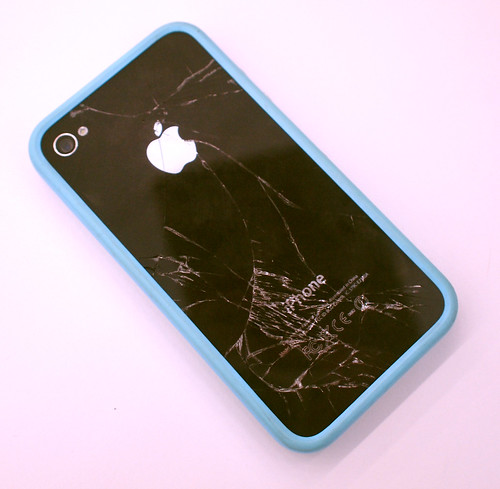
Nick Bilton who blogs for the New York Times has dropped and smashed the front of his Apple-loaned iPhone 4. Here it is a complete, fragmentary, mess.
I thought it would work beautifully until I dropped my iPhone on the concrete on Tuesday evening. The phone’s glass became a Humpty Dumpty look-a-like.
I’m still trying to figure out whose fault it was? Of course, I’m mostly to blame for being clumsy and dropping the phone. But is it also Apple’s fault for creating a gadget that breaks so easily? Electronics Designers Struggle With Form, Function and Obsolescence
Musing on this mini-disaster leads Nick to consider that perhaps the requirement that electronic devices should look and feel uber-slick has led Apple's designers to sacrifice function for form and to build objects which are insufficiently robust.
Jason Brush, executive vice president of user experience design for Schematic, a branding and design agency, noted in an interview that the fragility of electronics today might not lay in the form and function debate, but rather that gadgets are not meant to be long lasting.
“If you purchased a Leica Camera a hundred years ago it would still work today. It was bullet proof,” he said, “But electronics today are not built with permanence in mind.”
Mr. Brush said that electronics are now built as fashionable objects that serve a functional purpose. “When things are made to look beautiful versus being designed to last for 100 years, the products form can look vastly different,” he said. (NYT)
Clearly Mr. Brush is on to something here. iPhones are not built to last the way that Leica phones are, or were. But surely Jason Brush and Nick Bilton are missing the key point with this criticism? Apple's devices (iPhone, iPad, iPod Touch etc) are obviously not built to last, they will be improved upon very soon; more germanely they are not built to be objects in the sense in which the Leica was an object. The Leica camera is a specific functional tool with which quite specific and well-framed tasks would be performed in a professional manner. Nick Bilton has committed what philosophers like to call a 'category mistake'. He has mistaken the iPhone for a Leica-like object when it is clearly an adverbial-appendage. The iPhone and the iPad are not truly objects, they are adverbs. They are only parenthetically about taking pictures, they are mainly about doing all kinds of stuff, much of which you hadn't even considered to be do-able in that way, or at that remove. They are multi-purpose mediators through which the web and the internet interacts with the user. It is moot whether they are appendages to us, or appendages to the web through which stuff now happens. The creative process is now all about the web (subject) doing (verb) to us (object) in a certain way -- perhaps most stylishly in the Apple way. The iPad is, by some distance, the most adverbial of the range of devices that Apple has produced. That it is a range of devices, each of them invoking their own adverbs, and hard to copy or emulate is the key Apple's 'defensive' stance in relation to Android and other competitors. Any company that wants to compete with Apple now has to do some deep syntactic analysis. The adverbial genius of the iPad is that it has redefined and clarified the adverb 'gorgeously', 'stunningly', 'veridically' or 'lazily' in the way that we interact with the web. The genius of the new iPhone is that it has appropriated the adverbs 'instantly', 'face time' (which in spite of sounding like a process, is on its way to becoming an adverb characterizing conversation), 'unintentionally' and 'magically' to the previously more or less routine but increasingly mobile business of using a telephone.
So, Nick Bilton really should not worry about breaking an object (especially since it is one that had been loaned to him by Apple, 'generously'). He has lost an object but gained access to a range of adverbial devices each with unique performance envelopes through which he can interact with the web in the way that Apple envisages smart journalists now need to do that. Guiltlessly and perhaps carelessly. Hold on for the iPad nano, Nick.
Monday, August 02, 2010
Apps and Print Subscriptions

Saturday, July 31, 2010
The Enviable Attractiveness of the Magazine Format
Flipboard had a great introduction a few weeks ago"A Prettier Way to Browse the Social Web" (NYT). Robert Scoble went overboard "Overall this is an extraordinary iPad app and one that will shake the media world for quite some time". Scoble may be partly to blame for the amazing user response which promptly swamped and downed the servers which drive this clever and rather beautiful app. For a while new subscribers have been filtered and phased in through rationed waves of invites. My invitation arrived a couple of days ago, and after a few sessions and hours of enjoyment I share Scoble's enthusiasm. It is a lovely app, and really a new thing that can only work in the iPad ecology (crisp colourful images, touch, speed, cacheing and that lovely screen).
Flipboard so far only runs on the iPad (but there must be ways to bring it to the iPhone 4 with its fabulous screen) and if you have an iPad I advise you to get it. It is to this point entirely free. Here is a short video that gives you an impression of its smooth and seductive operation. The company describe Flipboard as your 'personalized social magazine'. It certainly feels 'magaziney' in a very good and attractive way. It should also be very interesting to magazine publishers in showing how it might be feasible to integrate magazine content with social networks. How magazines can integrate with social networks is really the next big challenge for the digital magazine industry and Flipboard have taken a crack at the problem. At this point Flipboard only directly supports feeds from Facebook and Twitter. But that is enough to be getting along with; in my opinion, Flipboard is very Twitter-friendly, even though it may not become my favourite iPad client for tweeting (I dont have a favourite on the the iPad at all). Flipboard is actually rather more disruptive of the RSS-feed market and professional blogs than it is of the magazine industry. Interesting, because in my view RSS feed apps look rather thin and uninspiring on the iPad, and Flipboard has jumped in and gone beyond the RSS feed/reader approach to create a rich smorgasbord (images, YouTube, Tweets, as well as extracts from web articles) rather than the text-heavy RSS drip feed. If you thought that RSS feeds might be disintermediating old-newspapers and magazines, you maybe thought wrong if newly Flipped magazines and newspapers start re-intermediating familiar layouts and formats. Some commentators have suggested that the 'aggressive scraping' that Flipboard does is a substantial breach of copyright (it will for example, take cues from your Twitter feed and cache lots of images and stories overnight that you might want to click-through to when you wake up to read your Twitter stream, this cacheing is in most/all cases done without permission from hosts).
We don't know what the legal issues with such pervasive, background, ferreting and cacheing may be. But if I were a magazine publisher, I would start figuring out some partnership deals with Flipboard and tell the company lawyer to calm his aggressive and injunctive instincts and keep quiet whilst we watch what could be going on here that interests magazines. The deals should involve advertising revenues and/or subscription services: there is already an Economist collection, a 'section' in Flip-speak (more magazine lingo), taken from the Economist's free web services, why not have a full content-stream available through a Flipboard subscription? Flipboard is going to be a great host for iAds. Free and curated collections should have great promotional value for the magazine brands behind them. Flipboard is definitely a vessel which magazine publishers should aim to climb on board -- rather than sink the ship through charges of copyright infringement. The way Flipboard manages to co-ordinate and mix pre-packaged content selections from established media with the randomness of Twitter or Facebook feeds is truly impressive. And the Flip metaphor in both borrowing from and breaking the magazine paradigm, is much more attractive and compelling than the simplistic grid of Google's Fastflip (itself perhaps a source of inspiration/exasperation for the Flipboard founders).
So, I really like Flipboard. But the thought that really stays with me is that its conception and execution is an enormous compliment to the magazine industry and the quality of the illustrated magazine format. Users and technical gurus love Flipboard because it combines social agility with the extraordinary attractiveness of magazine layout on the iPad. The remarkable and delicious touchability of magazine stories and picture callouts all this with page sliding, or flipping. Heck, Flipboard even has a table of contents which you make for yourself as you work with it. But it really is a table of contents and the sections within it are also organized hierarchically in good old magazine style. Hear this magazine publishers and editors! Magazines look fantastic on the iPad. iPad developers who want to make their apps look truly elegant and readable ape the style and layout of a magazine. The iPad is made for digital magazine go to it!
I find it strange that many magazine editors and publishers want their magazine to look less like a magazine on the iPad. As one of our more go-ahead magazine publishers said this to me the other day: " I want to do something different with the products other than just serve them up in a different format - what are your thoughts?"
Exact Editions have quite a few thoughts on this topic. Starting with the observation that putting magazines to work as apps is NOT just serving them up in another format. But the big news from Exact Editions this week is that we have started serving digital magazines to the print subscribers of one of our most long-established magazines. The subscribers have been learning from the address label which accompanies their weekly magazine that a complementary digital edition is theirs, as soon as they choose to log in. They can in fact use this Shared Access Code with their personal subscription account on either the web, or in their branded magazine iPhone/iPad app.
More about this in our next blog. But in the meantime I leave you with this poser: if the coolest app in the Apple universe is trying to look as much like a magazine as possible on the iPad, why are not more publishers trying to make their digital magazines or their magazine apps look even more like a magazine on the iPad? Rash prediction: I think that the best digital magazines in the next few years are going to be more interactive than the ones we commonly see now. But they are going to be even more magaziney than you imagine. Getting digital magazines right is a matter of making their format entirely magazine-like but totally appropriate for digital delivery. Flipboard may be borrowing ideas and architecture from the magazine industry, but it is also pointing the way in which digital magazines can steal back some of that innovative glitter.
Wednesday, July 28, 2010
Why the iPad is Still Really Good for Magazines
It seems that quite a few of the big magazine companies are unhappy about the way that Apple is managing, 'controlling' if you like, the app store. First there was an article in Folio magazine, then this was picked up by All Things Digital and then the blogosphere erupted. According to Folio magazine:
.... getting an app approved can be a frustrating ordeal, especially when publishers find out at the 11th hour that their proposal has been rejected (in what increasingly seems to be arbitrary fashion). Condé Nast famously had to rework its iPad apps when Apple announced that it wouldn't accept Flash. The iPad is Great But Remember—It’s Apple’s Way or the HighwayThis is loose reporting. First, developers obviously hear 'at the 11th hour' (which just means 'at the end of the process') that their app has or has not been approved by Apple. Do you think that they would be happier to be told before they submitted it that their app was going to be rejected? There is no timetable involved, there is no guaranteed outcome to the process. It is an 'approval' process. Second, the Apple approval process is certainly getting to be more predictable and less arbitrary. There are some reassuring signs that it is loosening up somewhat. Third, it is ludicrous to suggest that Condé Nast were caught by surprise that Apple would not support Flash. This was clear well before the iPad was launched and should have been obvious to anybody who was following Apple's strategy for the iPhone in 2009. Apple would have had to change tack significantly to support Flash and if Condé Nast were listening to Adobe whispers, rather than Apple directions, they were clueless. Adobe .... words fail me. It is not doing a good job for the magazine industry.
And Peter Kafka at All Things Digital says:
Time Inc. executives “have been going nuts,” trying to figure out how to get Apple (AAPL) to approve a subscription plan. One of the more desperate suggestions, which apparently didn’t get traction: Pulling the publisher’s apps out of the iTunes store altogether.
Subscriptions, whether they’re for ink-and-paper magazines or their digital editions, are a big deal for Time Inc. and every other magazine publisher. They value them in part because they provide recurring revenue, but primarily because they provide a treasure trove of data. Time Inc's iPad Problem is Trouble for Every Magazine Publisher
Some bloggers have turned this into a generalised fact. The e-consultancy blog reports it as a universal truth that magazine subscriptions are not allowed: "So far, no other publisher has been able to sell subscriptions through the iTunes store either." This is completely false. Exact Editions has been selling subscriptions to magazines through iTunes for nearly a year. Plenty of other developers are now doing so. Exact Editions may have been the first developer to help magazine publishers sell subscriptions through iTunes, but there are now dozens more. Peter Kafka has got it wrong in suggesting that Time Inc does not know how to sell magazine subscriptions through the iTunes system. The problem is, as he hints in his next sentence, that Time may want to develop its own in-app subscription service and its own analytical reporting on customer usage. Both of these are no-no's with the Apple iTunes terms and conditions.
Apple is being more explicit and more open with its policies and its directions to the market than it was a year ago. The terms and conditions for app development are now published. If Time is not reading the developer agreement that it has signed up to, that is not something to "go nuts" about. Apple should not be blamed for objecting to magazine publishers trying to re-invent the wheel on in-App subscriptions. iTunes already supports in-app purchasing on magazine subscriptions and the market will get very messy if there are lots of different terms and conditions for buying stuff through iTunes. Nor should Apple be blamed for not allowing publishers to invent and deploy any form of spy-ware or tracking software that they attach to 'their' magazines when deployed in iTunes. One of the snags with the still nascent Android app developer market is that there is not yet a recommendable and standard method for deploying in-app subscriptions. I hope that there will be soon. But, when it comes it will have arrived because Google or a major Android player deploys it. The Android market-place will not work if each participant re-invents all the commercial rules. Apple is doing us all a service in trying to establish solid and consumer-trustable e-commerce standards. Apple is also, in my view very rightly, jealously guarding and defending the privacy of its users. If the magazine publishers (or the games publishers) were allowed to deploy all the intrusive and malevolent data-collection services that can be devised for mobile e-commerce we would all be the losers. I am not suggesting that Time Warner will put intrusive tools in its apps, but I am saying that we need a gatekeeper to make sure that rogue publishers and developers do not abuse the system. On this, I trust Apple more than I trust Time Warner or WPP. Apple has to do some of this for the apps market if it is to be trustable, and Google will have to do something similar for its Android market it its going to work.
There are ways of selling subscriptions to magazines in iTunes; there are ways of selling subscriptions to digital magazines on the web that can then be read with a free or paid for iTunes app; there are ways of doing most of what magazine publishers want to do. Some of it can be done within the Apple e-commerce system. Some of it has to be done in another way. But the fact is that the iPad is a wonderful device on which to read a good magazine and the big magazine publishers need to get on board quickly and with subscription services that users will buy. Apple is not stopping them. They are reluctant to sell through Apple to consumers whose identity they cannot track. But the plain fact is that this is always the way they have sold single copies through the news stand, nobody knows who buys a news stand copy. iTunes is the digital equivalent of the kiosk. It is the way publishers can sell magazines to the general market, without getting much feedback on who is buying. That is a good start, but iTunes is not a good way of selling annual subscriptions at the prices that publishers would like to charge for annual subs to magazines or newspapers. iTunes is not a good way of selling to a highly targeted market. B2B publishers will sell some magazines through iTunes but it is not the way they are going to nurture their core audience (precisely because the publisher will find it hard to determine exactly who the readers are). If the big publishers want to sell annual subscriptions to consumer magazines they will need to figure out how to sell them direct. They will need to build their own digital circulation and not expect Apple to do it all for them. It can be done and is being done. The best place to start will be by converting the existing print subscribers to digital subscriptions (not 'instead of' print subscriptions but 'as well as'). Furthermore, magazine publishers should be careful for what they wish. To hope or expect that Apple is going to solve all their distribution and platform problems is to bank on a solution that would be uncomfortably monopolistic and threatening to their long-term interests.
Get cracking on the iPad, but look also to what you can do with the web to sell subscriptions to your services. This is the direction that magazines should be taking.
Saturday, July 24, 2010
In Praise of Not-Reading
Reading is, in these days, an over-rated activity.
Most of what is most important about books is now about not-reading them. I was reminded of this deep but counter-intuitive truth by a blogger (An American Editor) recently complaining that his To Be Read pile (TBR Pile) was getting unmanageable because it was full of ebooks that often cost nothing and were without physical presence.
Which brings us to the special problem of ebooks. Yes, ebooks are a special problem because they take up virtually no space — just a bunch of bits and bytes, digits if you will, on a disk that can store gigabytes of digits. And so that TBR pool steadily grows. I looked this morning and I have more than 300 TBR ebooks, and that pile keeps growing. Acquiring Books for the TBR Pile: The Special Case of eBooksAmerican Editor is here admitting to a very old-fashioned mistake. He has not caught up with the twenty-first century. Books are now not really for reading -- or to be more accurate -- they are only occasionally, under the most special circumstances, for reading. Publishers are partly to blame for this (culpable, since all publishers, especially of newspapers and magazines, know that their profits are entirely dependent on selling stuff that the customers do not read) and digital book experts would be much more on the button if they spent less time fretting about 'reading'. And part of the problem is that the digital experts operate with a vastly over-simple model of what reading is. The conventional wisdom is that proper reading (sometimes called 'long form reading' -- a ghastly phrase for a dubious concept) is the measurable phase in which you open all the pages of the book and look at them, the hours and minutes through which a book, conveyor-like, passes, between the moment that you bought it and the moment that you shelve it in your personal library, never to be looked at again. Incidentally, 're-reading' is a much more interesting concept than mere 'reading', but we note that in passing and may return to the topic on another occasion (you will have observed that you can do that with writing as with reading). This Taylorean model of, conveyor-like, reading predicates that in serious reading our eyes scan more or less consecutively the whole book from page 1 to page umpteen. Efficiently and quickly. The time and motion expert holding a stop-watch, just as Google analytics calibrates our use of the Google library. As though reading a book might not actually comprise understanding it, or failing to enjoy it, or realising pretty instantly that it was not worth reading at all. Under any circumstances.
Of course, reading has always been, but is becoming steadily more, episodic; very little of our reading is like this conventional model of continuous reading, and most of us who now work in intellectual or bureaucratic activities which involve web-based reading, spend a lot of time, yes reading, in ways which are not at all like the way you first read and enjoyed Babar, P.G. Wodehouse or Jane Austen. You see, we spend a lot of our time and energy deciding what not to read. And these decisions matter. Possibly even as much as enjoying Babar, or re-reading Jane Austen.
Our understanding of digital books would be much better if we spent less time wondering about how we might read them, and a lot more time thinking about the ways in which we may use them without necessarily, or even at all, reading them. For certainly, and beyond all doubt, when there are 20 million books in Google Books Search we will not seriously, continuously, read more than the tiniest fraction of them. There are a lot of things that we need to do with books and it is not at all clear to me that we have a framework in which these activities can take place with digital books, half as effectively as with print books. For example, we need to be able to:
- search them (that activity appears to be brilliantly covered by the already mentioned Google Books Search)
- provide access to them (possibly well covered, in the USA, by the afore-mentioned)
- buy them
- listen to them
- lend them to a friend or a colleague
- translate them (well)
- quote from them
- (ideally) cite them when we quote them
- non-consumptively compute them (we none of us know quite what that might involve)
May I recommend (unreservedly, though I have forgotten most of it, and disagreed with much of it) Pierre Bayard's How to Talk About Books You Have Not Read. Which, in case you mistakenly decide not to read it, has many reviews here.
Wednesday, July 14, 2010
Google Books Search over the Summer
Judge Chin is still considering his decision in the case of Google ..... His ruling may come this week, next week, or in a few months. Only he and his team have a good idea of that. Meanwhile Professor Pam Samuelson has produced a very thorough, balanced, somewhat critical review of the proposed Settlement and of Google's efforts in a 60 page paper for the Minnesota Law Review. If you haven't been following GBS too closely, this is an excellent place to get an insightful review and summary of what has been going on. If, like several hundred lawyers and digital library experts you have been following GBS too closely for years, you will already have read her piece and it will have reminded you of stuff that you had forgotten. Her conclusion:
The future of public access to the cultural heritage of humankind embodied in books is too important to leave in the hands of one company and one registry that will have a de facto monopoly over a huge corpus of digital books and rights in them.
Google has yet to accept that its creation of this substantial public good brings with it public trust responsibilities that go well beyond its corporate slogan about not being evil. Google Books Search and the Future of Books in Cyberspace
I have been a 'qualified' supporter of Google Books Search from the beginning. The qualifications are coming more to the fore. Whatever Judge Chin decides, we can be sure that Google Books Search is going to be mired in legal complexities for years to come. The international ramifications of the venture are hopeless and will sap energy and innovation. Google Books Search, if it is approved, will work badly and too patchily for European literature and libraries, and it will be especially rough and unsatisfactory for British literature, libraries and universities. It will be a mess of conflicting and irresolvable copyright regimes for years. Google itself seems to find it hard to innovate or roll out new services. A clean and direct implementation of Google Editions has been 'promised' for this summer, or this year, but it has been promised before. Several times. No doubt part of the reason that it is being held up is that its roll out may have unpredictable or unwelcome legal consequences (or unwelcome splash-back from the court of public opinion). Google Editions when it comes should be a very useful and popular service, but Google have to get it out of the door before it can properly grow and bed itself into the array of digital books that is now mushrooming.
Pamela Samuelson points to the lack of substance in Google's mantra 'we will not be evil'; but its arguable that Google has failed in a more fundamental and troubling way. It has failed to sacrifice the idols of its founders; it has failed in corporate governance. Page and Brin met and worked together in a project for digital libraries. The Google Books Search proposition was clearly motivated in part by Page's promise to digitize the libraries of his alma mater the University of Michigan. The two big leaps in the Google Books enterprise, were first to dream of digitizing millions of books in one universal searchable index (the original project, defended by an appeal to 'fair use' and the transformative effect of a large database of books) and then secondly to aim for a commercial settlement to the 'class action' suite, through which Google, the authors and publishers would effectively enclose, exploit and privatize millions of copyrights for which they cannot claim ownership. I suspect that the Google Books project, and especially the Library component, has always been too close to the goals and aspirations of Google's young founders. The big and aggressive steps that the company has taken to stake out its claims have been part of the founding DNA, the dreams that brought Brin and Page together. The third 'founder', Erik Schmidt joined the company in 2001. At about that time the initial steps for the Google Books enterprise may have been taken, perhaps Schmidt may have been too much the 'new boy' to question the goals of the original founders. Schmidt should have spotted that there were copyright problems, he should have noticed that there were at least issues of politesse involved in digitizing and then using for profit, stuff that did not belong to Google or to the Universities with which they worked. I bet that he has since then wished that the aims of the Google Books undertaking were more clearly understood within and without the company. And more cautiously and generously drawn. At some point Google has to take a much more humble view of its role, and at that point things might start to work in its favour.