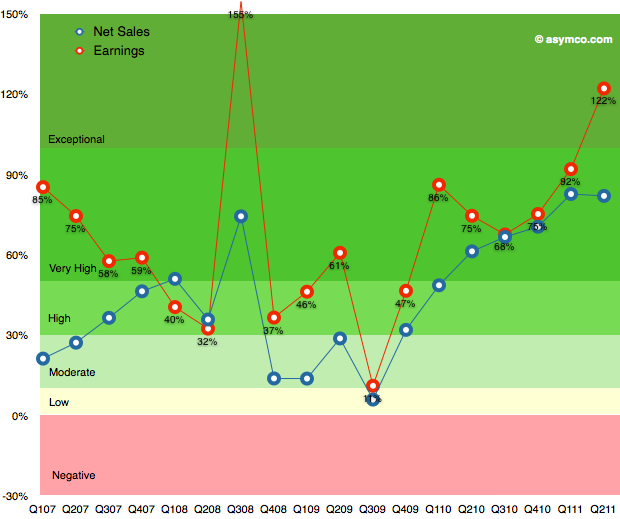
Apple is poised to become the biggest company in the world by 'market capitalisation'. It maybe briefly inched ahead of EXXON yesterday in chaotic market trading, but it will very surely be well ahead of the pack by the end of the year. Apple's sales and profits are rocketing and the value of the company is still being significantly underestimated by the markets.
The remarkable fact is that although Apple is now a large company by any standards (annualised sales of over $100 Billion) its profits and its sales turnover are still growing at an amazing rate. Big companies can be very profitable, and big companies can sometimes grow revenues quickly, but Apple is doing both of these things consistently, quarter by quarter. As can be seen in this chart produced by Horace Dedieu

For fuller discussion of the chart see Asymco's note on Apple's growth scorecard for second quarter 2011. In Asymco's deadpan style these sales and profit growth stats are dubbed merely"exceptional" or "very good". But Asymco is being too phlegmatically Finnish, it is frankly unprecedented for a company with annual sales of approaching $100 Billion to be growing year on year at 82% (and in the preceding quarters 83%, 70%, 67%, 61%, 49%, 32%, 6%). You have to go back to Q3 2009 to find the merely respectable figure of 6% annual growth!
The crazy thing is that there are some very strong planks in Apple's growth strategy that we still cannot infer from reported figures. Only Apple knows, or can guess, how strong a part of the growth story will come in the next decade from the sale of music, film, books, and apps all coursing through iTunes and all generating a 30% turn for Apple. This IP-derived cash will become an important part of Apple's revenue streams and even more of its profits, because the marginal cost of selling more digital media through iTunes is very low.
We dont know much about Apple's revenue from apps in iTunes, but we do know, from a press release, that Apple had cummulatively paid out over $2.5 Billion to app developers by July 2011, which means that Apple has retained $1.1 Billion from its share of sales of apps through iTunes (over the 4 years that apps have been for sale in iTunes). At the iPad 2 launch event in January Apple had announced 2$ Billion in payments to app developers, so it is probable that Apple sales from apps will comfortably exceed 1$ Billion in 2011.
Buried within these gross figures, that are reported in bald outline, there will be an amazing amount of detail that is available to Apple only. Apple now has a good deal of insight on the relative buying patterns of owners of iPhones and iPads (now 150 million and 30 million owners in each case). Apple has a lot of information on individuals buying habits for music, film, and for apps, for games, productivity tools, ebooks and magazines and newspapers. Very little of this information is aggregated or understood outside the confines of Cupertino. It would be very interesting to know what the average iPad owner spends on media in the first quarter or the first year of 'ownership', on games, music, ebooks and periodical subscriptions. If the 'average' iPad owner spends $6 per annum on magazine subscriptions through iTunes there is already an annualised market for nearly $200 million in magazine subs. That figure may be too high at this stage when there are so many 'experimental' magazine apps out there doing their publishers experiments. But it is not outlandish to suppose that periodical subscriptions spending could soon head towards $10 or $20 per owner, which will mean that the market will soon be measured in billions. It would be informative/encouraging to know whether expenditure on various classes of media tends to increase or flatten out? There is a widespread belief that app purchases tend to focus around the very low prices on the Apple pricing matrix: 99c or $1.99. That stands to reason, but many publishers and developers would like to have more information, more guidance on pricing at higher levels for more sophisticated offerings. I suspect, and we have smidgins of data that bear this out, that iTunes is now selling relatively big ticket items well (by 'big ticket' I mean items priced at $15 or over, even $50 and over) Apple does not currently have a way of guiding developers and publishers on these issues: except through reporting sales on specific apps -- which Apple does well, promptly and fairly, in my opinion.
I suspect that the information that the market-wide information Apple now has on some of these issues is both quite surprising and also of minimal use to Apple's competitors. So I expect that Apple will find ways of conveying more information that will help to guide the deliberations of its developers and publishers.
From the snail's eye view that we have at Exact Editions one can say with confidence that Apple's potential for revenue generation through iTunes and the app store in particular is extraordinary. Here are four things that we have learned since Apple introduced its automatic renewals within iTunes:
(1) Renewals are good. We have limited data (less than three months) but there are indications that subscriber renewals through iTunes will be over 75%, possibly over 90%. Month by month. If annual renewals are also good, Apple's and the publishers revenues from digital magazines enter a virtuous spiral.
(2) Any special interest consumer monthly magazine with a paid annual circulation over 10,000 print subscribers will make good money from deploying a branded app in iTunes. The revenues from iTunes, even after Apple's commission, taxes, and Exact Editions development charges, will significantly exceed the costs (there must be some exceptions to this rule of thumb, but we have not seen them yet). A magazine that has 10,000 subscribers in print will find 1,000+ subscribers in the 200 million consumers that have iTunes accounts. Next year that proportion will be higher, when there are 250 million iPads.....
(3) The gap between appreciation of magazines on the iPad ("I love my magazine") and appreciation on the iPhone is widening ("the page IS small"). Most iOS magazine apps are being bought by iPad owners. The new iPad 2 is also clearly better than its predecessor for magazines. We think that the iPad 3 may mark another step change, especially for highly visual magazines.
(4) A significant proportion of users who subscribe to a magazine in iTunes will choose the expensive option of a 12 month sub, rather than the easy option of a 30 day sub. Though all our publishers offer discounts for annual subs when they price their subscriptions for iTunes, in nearly all cases the reward for the 12 month sub is small -- 10/15%. So we have been surprised to see 20%, 25% even 30% of subscribers opting for the bigger ticket (it varies with different magazines). Surely the adoption rate will be even higher when magazine publishers decide to start experimenting with promotional annual subscriptions in iTunes. This is excellent news for publishers who wish to maximise subscription revenues on the digital side, it is very good news for Apple also, though it is going to be another 9 months before we start to find out how good the annual renewal rate in iTunes is!
Wednesday, August 10, 2011
Apple Knows Plenty

Tuesday, June 28, 2011
Apple's Mega Newsstand
At its World Wide Developer Conference at the beginning of the month, Apple introduced iOS5, a close integration with Twitter and its plans for a Newsstand within iTunes. There was a brief overview of the Newsstand service in the presentation and this mention in the Press Release:
Newsstand is a beautiful, easy-to-organize bookshelf displaying the covers of all your newspaper and magazine subscriptions in one place. A new section of the App Store™ features just subscription titles, and allows users to quickly find the most popular newspapers and magazines in the world. If subscribed to, new issues appear in the Newsstand and are updated automatically in the background so you always have the latest issue and the most recent cover art. Apple Press Release, June 6, 2011There is quite a lot yet to be decided about the precise shape and operation of the Newsstand but what we know looks promising. We know that its coming in the fall, which means that it must be near completion; we know that it will enable background downloading; and that it will present the front pages, front covers, of newspapers and magazines in a more topical and attractive way. We know that Twitter will be available as an omni-present system-call in the new iOS. We also know that Apple's newly introduced in-app subscription process, with automatic iTunes renewals is working well, many mainstream publishers have announced that they will support it. This is a separate but important development. We also know that Apple has relaxed its previously announced, but over-restrictive policies on pricing of subscriptions "outside" the App store. Apple will not be 'leaning over' and requiring publishers to charge no more for digital subscriptions on the web or on Android than they charge within iTunes. Apple is loosening up a bit.
This really could be the very best news for the digital magazine and newspaper industry. Here is why:
- Apple sold nearly 20 million iPads in the year to April 2011. We do not know how many they will sell in the second year, but it seems reasonable to expect a very large number. Another 50+ million units seems probable. Three years after its launch the iPad could certainly have a 200/300 million installed base. That is scale.
- Apple has decided to bring some marketing and retailing focus to periodicals within iTunes. This is what the Newsstand announcement really amounts to. Apple will arrange focus and in-store presentation and highlighting. It is as though Tescos or WalMart announced that they were going to have a big newsstand kiosk in a prominent place within all of their retail outlets. The Newsstand will be a sales focus and it will attract masses of titles. Since periodicals have never been aggregated and retailed at remotely comparable scale, it is quite hard to envisage the potential for a newsstand which has tens of thousands of titles in all the main languages. Apple would only be doing this if it considered that newspapers and magazines could be a big category. Apple is building a platform from which it can sell billions of news and magazine subscriptions.
- It would appear that Apple will be going for a very 'format' neutral Newsstand. Apple has not said that all magazines and newspapers should have a specific file format, as happens with iBooks. It has not said that newspapers and magazines should or should not be 'interactive', though it seems certain that interactivity will be there (see most newspaper apps). This is ingenious because it allows/encourages publishers and developers to experiment with different sorts of delivery format. Apple is offering a sales platform, a payment platform, a cloud-based delivery and access platform. But it is not dictating the format or precise implementation of magazine services. This is ingenious in two directions. It encourages publishers with the advantages of a genuine platform (scale in distribution, and simplicity in payment and licensing for customers) but does not constrain publishers or developers in the services that they may offer. The platform does not appear to constrain the potential for innovation and diversity, except perhaps that these periodicals will of necessity have issues and front pages (even that limitation may be negotiable). Since magazines and newspapers have extraordinary diversity in their appeal and in their production processes, this is a masterstroke for Apple. And it is also clever in a second way since it enables Apple to be quite agnostic about how magazines and newspapers should be delivered. Apple does not have the heavy responsibility of managing content and dragging timely editions from publishers' workflow. Apple allows innovation within the iOS guidelines and will benefit (to the tune of 30%) from not having to do the experimentation or day to day content management on their publisher's behalf. Apple does not even expect to host the titles (as it does for iBooks).
- Publishers will complain about Apple's 30%, and although I have some sympathy for the complaint, one notes that Apple's recent loosening of its pricing rules, has given publishers an enormous opportunity. Magazine publishers especially. Magazines know how to sell subscriptions to consumers. They have been doing that for years. Magazines have a business model which encourages them to sell direct and they should certainly use that to build direct relationships with their subscriber base. But they should also welcome Apple as the cornerstone of their digital promotion. Apple is not telling its book publisher partners or its music industry partners that they should sell direct. Furthermore, there is little chance that Jeff Bezos will echo Steve Jobs when he said: “Our philosophy is simple—when Apple brings a new subscriber to the app, Apple earns a 30 percent share; when the publisher brings an existing or new subscriber to the app, the publisher keeps 100 percent and Apple earns nothing.” (Apple Press Release, February 15, 2011) Replace 'Apple' by 'Amazon' in that sentence -- and I am not sure that Jeff Bezos would even recognise it as grammatical, he would certainly stumble if it were included in the Kindroid press release.
Wednesday, May 18, 2011
Too many Hoops for Hulu for Magazines?
Next Issue Media has launched a 'Preview Service' with seven magazines sold on subscription or as single issues. Next Issue Media has been called the Hulu for magazines and is the creation of Condé Nast, Meredith, Hearst, News Corporation and Time Inc. Only seven magazines currently feature in this Preview Service, but they are top drawer items: The New Yorker, Popular Mechanics, Fortune, Esquire and Time etc. The consortium is advancing on a narrow front both in content selection and in delivery channels, and at this point only the Android operating system, but no phones, and the only tablet device is the Samsung Galaxy Tab. Narrower still: since at this point the magazines are only available via the Verizon WiFi service and an app in the Vcast (Verizon) app store. But more magazines and more channels are promised for the autumn (more details at MediaMemo -- Peter Kafka).
There are plenty of difficulties in running consortia, and I take my hat off to the NIM team for getting something out of the door when all the backing companies will inevitably have very different views on how the terms shall be crafted, and wary of precedents being set. Perhaps for this reason they are at this stage offering 'monthly subscriptions' and 'single issue purchases'. Supporting two very different access/license models indefinitely could get very complicated. Its also complicated for consumers that, depending on the title, 'existing print subscribers are eligible for a free or discounted digital upgrade'. If a subscriber to two print titles gets free access to the New Yorker but has to pay a digital upgrade for his sub to Popular Mechanics, NIM's customer support lines will soon be red hot. Building a system that manages all this reliably, will not be a trivial undertaking. And the consortium will lose its way if the magazine access model is not standardised across all the titles served, when 100s of magazines are on offer. Allowing publishers to set the price of their services is one thing but allowing the publishers to set different access models and subscription rights is fraught with difficulties.
It is going to be a challenge for this Hulu for magazines to achieve the Hulu-style popular momentum that they will need to secure the continuing support of their backers. But they do have a chance, because their backers are strong media players, all with an interest in maintaining some leverage over other players who will be driving digital consumer acquisition. Having a 'tame' Android platform with some market penetration will be useful for all these publishers. But consider the range of devices that Next Issue Media will be playing with or against. These will include:
- Apple for the iPad (in pole position)
- Apple for the iPhone (not to be overlooked as its a somewhat different delivery proposition)
- Amazon for Kindle
- Amazon for soon to emerge Android App store (and likely Amazon media-consumption Tablet). Amazon may have several tablet form factors.
- Barnes and Noble magazines on Nook and next generation Android tab
- Android app store (ie the Google managed app store, with flavours for several levels of Android phone/tablet). Lets call this 6a, 6b, 6c.....
- Blackberry Playbook platform (with its own set of 'Android' complications)
- HP Web/OS (Next Issue Media say that they will support this before the end of the year)
- Nokia/Microsoft tablets when they come...
Wednesday, May 11, 2011
Apple's Terms of Trade Finally Win Acceptance with Magazines
Suddenly the dam seems to have broken and the major consumer magazine publishers are lining up for iPad editions sold on subscription through iTunes.
In the last ten days, Time Inc, Hearst and Conde Nast have all announced moves towards selling their leading consumer magazines as subscriptions on the iPad. They are also offering free iPad access to their existing print subscribers, a simple and very necessary step as we have been emphasizing for months.
In disclosing these new offerings the major consumer magazine companies have been stressing that Apple has been willing to make concessions and to grant flexibility (see reports of such by Peter Kafka at AllThingsDigital). I expect some modest concessions have been granted, but on matters of detail and to help with 'bedding in'. Apple has not had to modify its developer contract or bend on its commission terms. Apple has the whip hand and, more to the point, Apple will not make concessions on issues that put obstacles in the way of the successful operation of the iTunes service. Apple will not make concessions which force it to re-write its end-user license agreements. Apple will not make deals with magazine companies on its 30% commission when it has been completely impervious to the pleadings of the music publishers on royalty rates. The bald and uncomfortable truth for these giants of consumer publishing is that Apple is not going to do deals. Apple is not going to cramp the economy of iTunes for the sake of the magazine business. So what follows?
- Magazines will sign up to the iPad service in a growing avalanche. Now that the big 3 of the US consumer magazine business have moved over to the Apple way of doing business, we expect that most major magazine companies will move over to producing iPad apps for their key magazines.
- Within 12 months iTunes will contain many more iPad magazine titles than has ever been collected in one physical kiosk or emporium. Finding titles in such a rich product mix will become more of a problem. But magazines are better placed than most categories to thrive since magazine titles are (usually) so clearly branded and so distinctive.
- The magazines in iTunes will be offered primarily on a subscription basis. Hitherto iPad apps were being offered on a single issue basis.
- The major consumer magazines in all the major national markets will soon be offering iPad apps through iTunes and they will also be offering free digital access to their existing print subscribers. Magazines will do this because in that way they retain more control over their subscriber base and can avoid having all their subscription services handled by Apple. They retain, indeed enhance, the crucial relationship that they have with paying customers.
- The prices for digital magazines within iTunes will be pitched at increasingly aggressive levels, Bloomberg Business Week costs $36 per annum. The Esquire iPad app will apparently cost $19.99 pa. Apple's pricing rules mean that international pricing will level-down to the best home market subscription offers (US subscription prices for consumer magazines are low in comparison to European prices).
- These recent announcements have all been focussed on the iPad. Conde Nast and Time Inc are committed to producing iPad apps, it is not clear whether the iPhone market is being by-passed or merely temporarily left behind.
- Android apps also appear to be taking a back seat. It will be interesting to see whether this week's Google I/O, now in its second day, has any mention of digital magazines. Not much sign of them in the opening sessions.
- The apps that are being produced for the iPad bear a remarkable similarity to the print product. The idea that a magazine app needs to be something radically different from the page-oriented, highly designed and issue-based package that we all know, is losing ground. Most magazine publishers cannot afford to run two parallel design, production and editorial processes.
Monday, April 25, 2011
Conde Nast Needs to Redouble its Bets on the iPad
AdAge is carrying a story that suggests that Conde Nast is pulling back from its out and out commitment to iPad apps. With hints and whispers that its initial forays have not been working too well. An anonymous company source opines:
"It's a shift," one Conde publisher said. "The official stance was we're going to get all our magazines on the iPad because this is going to be such an important stream. The new change is maybe we can slow it down. In my opinion it makes Conde look smart because we have the ambition, but we're not rushing."The piece has a sufficient concrete detail on Conde Nast's plans and intentions to suggest that the story stands up. So what has gone wrong? Nearly everything.
"They're not all doing all that well, so why rush to get them all on there?" the publisher added. AdAge: Conde Nast Taps Brakes....
Conde Nast's mistakes can be divided between mistakes about the direction of the technology, and mistakes about the kind of success that digital magazines should be aiming at on a new tablet platform. First, mis-taking the direction of the technology:
- For no good reason at all, Conde Nast assumed or hoped that Apple would back-track and embrace Flash before launching the iPad.
- Conde Nast has relied too much on an alliance with Adobe and a fallacious confidence that Adobe's knowledge of the design and content management process in print production would somehow enable Adobe to come up with a winning magazine app work-flow. But Adobe's Creative Suite software solutions for building apps seems to be unreasonably cumbersome. Too slow and too complicated and in most cases the finished article is disappointing as an app.
- Conde Nast (and most of the other big magazine publishers) have expressed the hope that Apple would gradually 'loosen up' and provide publishers with access to consumer usage data sufficient to support the existing advertising revenues that magazine publishers depend on. The idea that digital advertising revenues and metrics will be controlled by the magazine publishers is a major delusion (incidentally even less likely to be realized in the Android tablet market which many consumer publishers are gazing at fondly).
- It is tempting to think that you can charge your existing subscribers MORE for delivering an iPad app. Tempting but fatal. First, because your existing subscribers will feel that they ought to have free access to stuff that they have already paid for in print (see the comments on the iTunes page for the New Yorker iPad app). Second, because publishers who price their digital offerings as though they were competitive with their print offerings will lose print subscribers: if a publisher treats his print and digital editions as though they were 'substitutable' purchases and prices them accordingly, he will find that the market treats them as substitutable. Above all, publishers have to look at this from the subscriber's point of view. The point of having digital and print editions is that you capture your subscribers from two different directions, not that you force them to choose between print and digital.
- Like most consumer publishers, Conde Nast have been looking at the apps market as though it was a completely new opportunity. When fundamentally a magazine app has to be the magazine, and this gives the publisher real strength if they can leverage the resources in their back issues and the archive. Far too many consumer magazines have ignored their archives when producing apps. Yet the archive is something that can most easily be given new impact and immediacy from a digital perspective. Since Conde Nast already has a fabulous archive for eg The New Yorker and Wired, they should have designed their apps to take advantage of this richness.
- Conde Nast is still not selling its iPad apps on subscription -- now presumably as a mark of its displeasure with Apple for not providing sufficient access to consumer data. However much Conde Nast may be irritated by Apple's firmness/intransigence, it should be selling subscriptions to iPad and iPhone users, not selling one issue at a time. The iPad is most certainly and obviously a market for selling subscriptions. Music companies know this, games companies know this, film and TV companies understand this. Magazine publishers are good at selling subscriptions and they also know that it takes time to build subscriber momentum behind a magazine. If the Conde Nast management wastes two years from the launch of the iPad in not-selling-subscriptions their successors and heirs will pay a bitter price for this intransigence and this slow start.
Tuesday, April 12, 2011
Are Magazine Apps like Games on the iPad or more like Books?
Bloomberg Businessweek produced a pretty effective and straightforward app for the iPad earlier in the week. And it got predictably mixed reviews from the magazine app critics. Grudging and faint praise, at best. Here are some typical gripes from Techcrunch:
It is a perfectly serviceable magazine app. But it is underwhelming. There are no extra photos beyond what’s in the magazine, or even much in the area of additional multimedia other than a video intro every issue by one of the editors about how cover they chose the cover, and a couple audio interviews to accompany columns by Charlie Rose and Tom Keene. Erick Schonfeld Bloomberg Underwhelms with iPad App (Demo)
Erick Schonfeld's reaction here is very typical of the criticism that magazine apps tend to attract. The critics seem to assume that a magazine app should really be something else. Its got to be more than a magazine. Heck, otherwise what is the point? No extra photos, not enough additional multimedia, just the magazine..... It is as though the magazine app needs to be specially designed and uniquely conceived for the iPad platform. In much the same way that computer games need to be adapted and versioned for the hardware platform on which the game will be played.
We should look more closely at this question of what else a magazine app ought to be, other than the print magazine. But, first, consider how unusual this approach is. Content publishers do not, for the most part, look at the iPad and say, "How can we become something completely different on this device?" Hollywood does not think that films on the iPad need to be a qualitatively different entity from the film that one might see in a cinema or via a DVD. The point is rather that via the iPad the consumer gets an experience which is in someways pretty much as good as having the art-house experience (or not quite as good as, which is why we still like going out of an evening). Book publishers are not expecting books on the iPad to be qualitatively different from the books that get published on paper. Can you envisage the fury that would result if the Stieg Larsson books were not the same in their iPad editions as they are in print? Throw in an extra chapter? Have an extra deviation in the plot, an optional app-loop with more time in Australia or Poland, or additional detail on how to apply or remove tattoos, handcuffs, ride motorbikes etc? Publishers and readers are pretty sceptical about iPad app books that merely chuck in various bits of video/visual over-matter, or even passages with the author reading the book. These so-called 'enhanced editions' have something of the air of cosmetic surgery. Messing the book up is not going to do anybody any good, the sag lines show up pretty fast. Why should we not expect magazines on the iPad to be magazines? Just as we expect films to be films? The Exact Editions platform does support and facilitate bonus media for publishers who wish to make their magazines more interactive and use multi-media elements, but it is not clear that this is what readers expect from their apps. Most magazine publishers are sensibly enough avoiding the gimmicks, but many self-appointed app experts, consider that magazines should be something different. Qualitatively better on the iPad and radically different.
There are things magazine apps can do better than print magazines, for the most part these are qualities that come from having a digital magazine. They are not specifically iPad/appy tricks and affordances. And Bloomberg Businessweek certainly gets some of these things right:
- The app carries with it an archive of previously published issues
- The app supports search across the archive
- The app is free to existing print subscribers (for its loyal customers the iPad app is a jolly good bonus -- making that work for your readers is simply good publishing)
- The app has significant potential for sharing and commenting (email, Twitter and Facebook)
- Bloomberg provide real-time news and share price feeds linked to mentions in the articles, for all the major corporations with stock ticker labels.
- This is an app with the potential to grow and evolve in interesting ways
Wednesday, March 16, 2011
iPad Usage is Shooting Through the Roof
We yesterday introduced a straightforward way for our publishing partners to access Google Analytics reports for any of the individual titles that we host for them. Data is available in the amazingly atomic detail supported by Google Analytics, for each title, issue, and page. Also, Google makes it very practical to select specific date ranges, whereas the data we had previously collected from our own logs was lumped together in coarse monthly buckets. The traffic data is aggregated for each magazine, so there should be no privacy issues. Furthermore, each publisher has access to his own data, and stuff that is generic or 'cross publication' is not reported via the Google system. The data spigot for each magazine can be switched on as soon as a publisher sends us their Google Analytics code.....
I love the way Google Analytics can provide flexible geographical breakdowns of the data it aggregates:
33 visits from Bari and 71 from Bologna.
Whenever we collect data on our users we are surprised by the extent to which the iPad is making such a big difference to the digital magazine business. Here are a few data points:
- In the last year we have had more visitors to our website from iPad users than from the iPhone (this time a year ago there were no iPads anywhere outside Apple)
- These iPad users read/access twice as many pages as iPhone users
- The iPhone usage has also shot up in the last year. Six times as many visitors this year as in the previous 12 months.
- iPod usage is also significant and is at about the same level as Android usage. Much smaller than iPhone use but, surprisingly, slightly more sticky (both Android and iPod are slightly stickier than the iPhone)
- Blackberry and Symbian use is low, and Windows barely registers (guess that is Windows 7?)
- Our aggregate visits from mobile users (March 14, 2010- March 14 2011) have increased more than 10 times from the previous year (1000%+)
- Looking at one particular magazine which has been quite popular on the iPhone/iPad, it has had over 20,000 freemium app downloads in the last year and roughly one in 6 of those freemium downloads has led to a sale.
- We regard 1 in 6 as a good conversion rate. The conversion rate for different magazines varies enormously.
- Price is a big factor in the conversion process.
- iPad sampling has marginally outdistanced iPhone sampling. This is really surprising since there must be at least 10 times, perhaps 20 times, as many iPhones as iPads in the market for this particular magazine (which has mostly a UK circulation).
- We do not yet have relative conversion rates but we would expect the conversion rate to be significantly weighted to the iPad -- we know this from smaller samples.
On the other hand our publishers are now in the position that they have access to what Google know about the digital distribution of their magazines and something of what Apple know. Google and Apple are pretty much ignorant of the other guy's data. At Exact Editions we see it as our task to help publishers get their digital magazines on as many platforms as possible and to maintain an overall control of that distribution and data. That ultimately gives publishers a position of some strength.
Monday, March 07, 2011
The Post-PC Digital Magazine
Steve Jobs got some attention last week with his claim that Apple, unlike most of their competitors, was now working mostly in a Post-PC world
I've said this before, but thought it was worth repeating: It's in Apple's DNA that technology alone is not enough. That it's technology married with liberal arts, married with the humanities, that yields us the result that makes our hearts sing.
And nowhere is that more true than in these post-PC devices.
And a lot of folks in this tablet market are rushing in and they're looking at this as the next PC. The hardware and the software are done by different companies. And they're talking about speeds and feeds just like they did with PCs.
And our experience and every bone in our body says that that is not the right approach to this. That these are post-PC devices that need to be even easier to use than a PC. That need to be even more intuitive than a PC. And where the software and the hardware and the applications need to intertwine in an even more seamless way than they do on a PC.
And we think we're on the right track with this. We think we have the right architecture not just in silicon, but in the organization to build these kinds of products. (Apple Event: March 2011)
The iPod, the iPhone and the iPad are all, in Jobs's view, Post-PC Devices. Apple has a particular vision of a Post-PC computing environment, and at some stage it will be challenging to deconstruct the vision with which Apple is building its Post-PC system.
But right now, it would be worth asking ourselves a Post-PC digital magazine should behave.
- A Post-PC digital magazine should be immediately accessible to a reader who is familiar with the print magazine.
- If at all possible it should be 'magically' the same magazine, but in some indefinable ways better.
- If a Post-PC digital magazine subscriber has a subscription to the print magazine they should also be entitled to access their magazine subscription on the iPad (this is one of those magical properties). If Conde Nast really thinks that Pre-PC subscribers will be happy to pay additional prices for Post-PC issues of the same magazine, they are living in a universe where tablet PCs have styluses. Quite clearly out of touch.
- The Post-PC magazine should be better in some 'definable' ways also: it should be searchable; it should link to appropriate web resources (urls, email addresses, YouTube, iTunes etc); it should be browsable, bookmarkable, likable (in the Facebook sense) and Tweetable.
- A Post-PC digital magazine should be a publication in which some advertisers will want to advertise (but I am not sure that I see how Apple thinks that magazine advertising in digital magazines could work). Digital magazines should be good places to advertise because they will attract specific and definable audiences of committed consumers. So there needs to be a Post-PC way for those connections to work....
Wednesday, February 23, 2011
Apple's Powerful Position
It seems as though the blogosphere is only now waking up as to how extraordinarily powerful Apple's position with the iTunes/iOS/iPhone/iPad stack is. Apple's critic's (and in this case the most effective critics are significantly long-time supporters) are concerned that Apple is over-reaching: the objections are focusing not on the level of Apple's commission (though plenty of people think that 30% is too high) but on the way that Apple's rules appear to reach through to 'regulate' the way in which its partners can price services outside the iOS platform. Marco Ament,
A broad, vague, inconsistently applied, greedy, and unjustifiable rule doesn’t make developers want to embrace the platform. Subscriptions and the new in-app purchase requirement Marco Ament.And another shrewd critic
If I am interpreting this correctly, I can’t bring myself to see it as reasonable. Not only do businesses have every right to price their products on the open market as they see fit, .........John Gruber, usually very loyal and positive about Apple, notes at Daring Fireball that he agrees entirely with Drance.
I also don’t see how it’s even remotely enforceable. Are Apple staffers seriously going to check every vendor website for sale prices on a regular basis?
I think a great deal of this drama could go away if Apple dropped section 11.13 ....... (about pricing away from iTunes).... Your prices on your store are your business; just don’t be a jerk and advertise the difference all over ours. About This Whole Subscription Hubbub Matt Drance
It is unlikely that Apple will do much about this hullaballoo, except perhaps to clarify that the rules are not going to be enforced in an aggressive and over-reaching way. The trouble is that it is not obvious how they can be enforced in a clear and unarbitrary way and if there is too much fog and vagueness that could be a real bane for Apple developers. It is almost inconceivable that Apple will back off the 30% commission (the music publishers have been griping about it for years), so we had better get used to it.
There is another feature of the Apple infrastructure that needs to get some critical attention. The available prices. The App Store Pricing Matrix has 85 levels (99c to $999.99) and ranges across currency bands ($, Can$, Aus$, UK£, Yen etc). The matrix could be host to a few problems which someone in Apple needs to think about:
- Will this pricing matrix become the default pricing regime for all cultural services and software? If the rules say that a publisher has to price stuff outside iTunes at a price equivalent to or higher than the Apple pricing matrix, is that not going to appear in a very poor light when the regulators come and investigate?
- Are Apple sure that there is not scope for a price level beneath 99c or 115¥? Is it 'offside' for a developer to offer 49c or 99¥ specials? The 99¥ price 'looks' pretty good to me. No restraint of trade investigation will like the Apple rule which says that virtual stuff is either sold at 99c or given away. Apple may not want to sell apps at less than 99c, but if Disney want to do 49c apps off its own e-commerce system, why not?
- Then there are prices at the high end, off the Apple scale. There are B2B magazines with extraordinarily high personal subscription rates. There are excellent, technical, specialist and very influential magazines (finance and law) sold on subscription that cost as much as a safari holiday, many of these will work well as iPad applications. At the moment the Apple matrix does not stretch to those subscription levels (for the annual sub). I suppose that the publisher can at least comply with the rules by offering a monthly sub at $299 (weekend in Paris), but should it not be feasible to offer an annual sub at $2,999 (7 days in Kruger National Park)? There may be few takers at the high end, but Apple is not averse to 'high ends' that will attract a 30% commission.
- The really devilish problem is that currencies move. I don't think that the Apple app pricing matrix has yet been revised, but at some stage it will need to be. The Australian dollar will shoot through the roof, or the British pound will sink like a stone. When that happens and the prices in the Tesco downloads store start jumping as a direct result of a new Apple Matrix that will be a political hot potato.
- Worse still, when currencies move (they do) and the matrix has to be rearranged, there will be enormous disruption to the 'self renewing' subscriptions in the iTunes ecology which Apple has now introduced. Prices will not self-renew if they change. This circuit-breaker is very correctly a rule in the Apple pricing system to protect consumers. At some point the matrix will become very misaligned with the real world of fluctuating currencies and Apple will push through some revisions. Revisions which may be mildly annoying to consumers but hugely damaging to developers who have come to rely on renewals.
Tuesday, February 22, 2011
Aligning app with print with web
We learn a lot from support. Yesterday we had this message:
Really great job with the ipad edition!We certainly welcome David's ideas and appreciate his appreciation. The thought that really caught my attention is that the 'web presence could be more aligned with the print version -taking advantage of the digital interaction- and the overall image of the magazine.' Because this appears to be pointing to a deep strength of magazine publishing in a digital age. With clever design, good interfaces and solid platforms, it is possible for a magazine to be the same magazine (recognizably the same to its loyal readership) in the very different manifestations that it has in the app format on the iPad, in the rather different guise it may have as an iPhone app, or as an Android app (different again for phone or tablet), on the web, and of course in print. Through all these manifestations it seems that there is a key value to keeping the magazine aligned with the print edition/version. The magazine as an app is different from the print edition (so it is wrong to view it as a mere replica) but it is stronger if it is recognisably the same magazine, albeit an edition with greater interactivity, searchability and findability. Keeping the web presence aligned with the print edition and the app version(s) is a core value.
I'm an old fan of the mag -since 1997- and is just marvelous to have it in this digital format. I have the XXXXXXX group at last.fm and a group at facebook with some people -if you like to have the admin pass to this communities please tell me, i think you'll do a better job to mantain it.
I'm a webdeveloper with 10 years in the field, i think the web presence could be more aligned with the print version -taking advantage of the digital interaction- and the overall image of the magazine. If you could be open to accept some suggestions i'll be happy to send you some of my ideas...
There is a natural temptation to look at digital technology as replacing analog modes. This is happening, but as the physicality of the print object is becoming obsolete it also seems as though we are finding ways in of reinventing and repositioning analog devices (books, magazines) as virtual objects in a digital framework. This is why books and magazines and newspapers are likely to survive as reading objects in a world of apps and digital reading systems.
Tuesday, February 15, 2011
Maglet Losowsky and iPads Reclaimed
Andrew Losowsky has peered into the glass of the iPad and decided that the world of magazine apps is half empty. So we feel it necessary to cheer him up a bit and fill the glass. Andrew pens his blog at The Hospital Club -- one of Covent Gardens best watering holes -- offering us a swig from the bottle in his first paragraph, a convenient summary of his position:
Twelve months ago, the magazine industry was shouting from the rooftops that the iPad was going to be their saviour - but it turns out that all those people lining up to buy one weren't doing it solely to pay for glass-coated editions of Marie Claire. Sales of maglets (magazines on tablets - geddit?) have been far below the costs of developing these apps, and public reaction has been underwhelmed at best. What went wrong? Six things, actually.The Truth Behind the Failure of iPad Magazines
But if you look at the six points he makes it would appear that the glass is really half full. There have been some mistakes - as is surely to be expected with an innovation as startling as the iPad - but there has also been some progress. Take a look at his problems
- Publishers are Selling the Same Content Twice. This is clearly a big mistake. But there is no compulsion on publishers to adopt this posture (that they have done so, is largely the result of a separate battle that they have been fighting with Apple about the ownership of user-data). Some publishers, all those who work with Exact Editions, have opted to offer free iPad access to their existing subscribers. There is nothing in Apple's terms and conditions that says that publishers cannot do this, or that digital magazine access has to be sold exclusively through iTunes. Apple's mooted new system for in-app subscriptions will surely encourage more publishers to adopt this attractive way of selling subscriptions, though it may also require that digital/app subscriptions are sold through iTunes.
- There are not enough iPads out there. Only 15 million in the nine months! Since Apple will sell perhaps another 40 million this year, and no market analyst predicted, prior to launch, that Apple would sell more than 7 million in the first year, this is a glass rapidly filling up before-we-can-get-organised, point. Come on Andrew this is surely a reason for publishers to get their skates on!
- Maglets are competing with everything else on the iPad. Yes indeed, "....magazines no longer have the benefit of being at the centre of our cultural lives. They have to work harder than ever to grab our attention and force their way into our habits, a task that's all the harder when they reside on a fully connected device that contains the latest news from thirty seconds ago..." Which is also a reason for magazines to see if they can persuade consumers to use them on iPads just as they use them in their living rooms. Magazine publishers did not chuck in their hands when the TV invaded the living room, innovative publishers will see the iPad as a similar challenge. Glass half full.
- Separate App Syndrome. I think Andrew misses a key point here. Magazine publishers have made a big mistake in designing magazine apps as though each issue was a separate app. This is a valid complaint, but not the point that Losowsky makes, and it is one reason for the disappointing showing of several magazine apps. It is also one reason why magazine publishers have felt that they should market and sell magazines on the iPad one issue at a time, failing to see that selling subscriptions through, or without, iTunes is clearly the way to go. Magazines as apps work very well as branded apps in iTunes partly because magazine titles often confer superb branding and findability on the product (Marie Claire, Elle, Vogue and also niche titles Literary Review, Opera, Index on Censorship). But the branding should cover magazines in their entirety: past issue, current issue and future issues are ideal to function as branded apps in the customer's iPad. This is a glass that needs to be very full -- including the archive.
- Magazines are outside the digital conversation. This is indeed a valid objection, but in mitigation the magazine publishers (and app developers such as Exact Editions) can point out that this is a complex and rapidly developing field; better engagement and social interaction with digital magazines is certainly coming. The Exact Editions apps are already stuffed full of links to web pages and email addresses (and on the iPhone, phone numbers that the customer can call). Magazine apps can be highly interactive and they are increasingly becoming more so. Losowsky appears not to have noticed that the iPad itself makes it incredibly easy for a single 'page' or a JPEG to be emailed from any magazine app, it is not a matter of some publishers enabling this. There is nothing that the magazine publishers or the copyright owners can do to stop such informal sharing (which does not mean that magazine apps can be easily copied wholesale; that is a different matter). This is a glass to be shared.
- The medium is nine months old. By which I am sure that Andrew Losowsky means that its really too early to be sure: "The truth is that we just don't know yet what varieties of format, design and interactivity will best serve each kind of content, and though some of the experiments in the field are fascinating, most of them are just irritating applications of over-design by people giddy at the possibilities of new formats." This is indeed a matter of the glass being half-full, and a point on which we can agree
Losowsky's excessively gloomy, more than half-empty, headline 'The Truth Behind the Failure of iPad Magazines' is perhaps belied by this concluding (half-full) optimism:
That said, this is still a genuinely exciting time to be working in media. Nothing at all can be taken for granted - except for the simple fact that there will always be a hunger for unique stories, told in a manner in which the text, design, images. and when necessary audio and video, combine to enhance our enjoyment and understanding of the story itself. This ability to make design part of content is the reason why magazines lasted in the first place.I first noticed Losowsky's piece via an approving tweet, from Erik Spiekermann, perhaps the Lionel Messi of typographic design. This design discontent with magazine apps is not an odd-ball view, most/many good magazine designers are disappointed by the way that magazine iPad apps have been designed so far. My hunch is that the user experience and pleasure in magazine apps will improve as designers and publishers realise that magazine design and book design has to move to a more holistic and a more abstract level, perhaps when designers are less 'giddy' with the possibilities and more relaxed about the opportunities and the 'flow' that comes with touch interfaces. Technology is moving very fast and good digital magazines have to be conceived and conceptualised for systems and services that don't yet exist. From now on all pages are virtual, all stories have addresses, and all interfaces have to be intuitive. This is not a trivial set of challenges for a designer who aims at quality and effect.
Wednesday, February 09, 2011
The Daily is a Convincing App. But is it a Periodical?
I like The Daily rather more than I was expecting. I also think that it has a commercial chance; it is a gamble, but it is potentially a very significant money-spinner. A lot will depend on the execution. Murdoch is prepared to take a big punt on the newspaper's success, and like a good gambler he can do this because he is playing with a limited stake ($30 million in startup costs and $500k a week in running costs). He is not playing for break-even but for a significant win, which happens when he has 1 million or 2 million subscribers. That will take 18 months or two years to pan out, so at most $100 million is at risk. For News Corporation with its huge investment in print newspapers this is peanuts. The upside is that The Daily gets 2 million subscribers from which the subscription income is $80 million ($40 annual sub x 2 million subscribers), Apple's commission and sales tax may bring this net take down to $50 million but the running costs are $25 million. Also there is some advertising revenue which should help.
Murdoch's off the cuff comments at the launch were fascinating and engaged, and I heard them the same way as Peter Kirwan, blogging at the UK Wire, who also fancies the commercial prospects of the new title:
If this makes The Daily sound like a bolt-on addition to the media ecosystem, Murdoch is also dreaming of something much bigger. Away from his script, during an interview on Fox Business News yesterday, his words suggested a bid to promote cannibalisation of print audiences.
"I really believe that everybody in America who can afford one is going to buy a tablet," said Murdoch. Ultimately, he added, he would like The Daily to overtake the 26m audience attracted by American Idol on News Corporation's Fox network.
News Corporation executives may smile at the old man's hyperbole. But the intent is clear. What's more, Murdoch claims that he isn't phased by the prospect of cannibalising print audiences. "Oh, there may be some expensive changeover," he said yesterday. "Net-net I think we will get." Peter Kirwan: What's New about The Daily?
Murdoch is aiming a newspaper proposition at a market which can probably commit to the prices he is putting on it (99c a week or $40 a year). Because he has a clean slate Murdoch has been able to take a realistic view of what an annual iPad newspaper should cost. Net-net, I think he will get.
The Daily has a mid-market feel, a bit like USA Today (2010 circulation 1.8 million, and if I were in Gannett's boots I would move very fast to cut Mr Murdoch off at the pass with a snazzier app in the same class) and it will have a mid-market appeal. It is not very serious, it is gossipy, and the sports coverage impressed me; the illustrations are good and some of the diagrams and 360° photographs are excellent. There is much that one could question or criticize (see some very insightful analysis of the typography and design by Stephen Coles), the social interactivity is ham-fisted at launch, but I will be watching the progress of The Daily with interest.
Murdoch in answer to questions, left open the possibility that The Daily will in due course migrate to other tablet platforms, but it is for this year and next aimed fair and square at the iPad. Nevertheless it is in many respects designed and conceived in a rather conservative magazine fashion: as if it were a newspaper designed for a small format with lots of colour and a fair amount of interaction, snippets of video and short, punchy stories. Which is what it is, mostly produced with traditional print tools. The maganewspaper is, we may suppose, produced with InDesign and could almost be laid out as though it were a print object -- almost, but not quite, since as with other apps generated from inDesign the imposition would not work. The framework and the metaphor is still largely a print metaphor, but one re-scaled for the iPad's dimensions and interface. Like any app it can interact with the web and it condescends to save pages and bookmarks and links in suitably undistinguished web pages, but it is most definitely an app and a tolerably enjoyable one to navigate and browse.
So The Daily is a newspaper and an app, but is it a periodical? I only raise the question, because there is no way, at present, to move back to a previous issue (except through the rather drab web pages which are used for reference, bookmarking etc). The Daily is a daily event and not a newspaper of record which would have an archive of issues that can be opened and re-opened to review and re-read earlier content, so that one could again look at the 360° photograph of Tahrir square that they carried on February 4th (one can see the video carried on that day here). It may be said that a proper archive could be 'retro-fitted' once they get going; but I wonder whether this will happen or whether we will move to the idea of a digital newspaper being a more ephemeral publication (like a news web site) with no full archive? Shall we borrow a word from the French and call such not-for-the-record newspapers 'quotidians' rather than 'periodicals'?
I think that digital magazines certainly will retain their archives, and the apps which map them will have to figure out how the archive is presented and integrated alongside the current number. There is strength in that model and anchoring readers in the quality of your back issues has some commercial advantages.
Monday, January 31, 2011
Magazines Need a Digital Format Before they Get a New Blueprint?
Tomorrow Apple and News Corp are launching a new periodical, The Daily, specifically designed for the iPad. This could be really exciting and I wish it well (I really do, but we will have some caveats later).
Erick Schonfeld over at TechCrunch decides to peg another think piece on iPad magazines on this event: iPad Mags Need a New Blueprint. This is not a blog up to the usual TechCrunch standards but it does attract an excellent comment (from TechPops - who tells us what he wants his digital magazine to be and do) and a thoughtful blog from Mike Cane. Who correctly points out that the Daily is really about newspapers and magazines are not facing the same challenges or the same opportunities with the iPad.
There are three problems with Schonfeld's piece and they are all signs that he does not have a good understanding of the challenge the magazine industry faces:
- A digital magazine or newspaper should feel like a media app, not like a PDF viewer. It needs to take advantage of technology to tell better stories. (Schonfeld)
- Apple should fix the subscription problem(Schonfeld)
- Making these apps social and realtime is the key (Schonfeld)
'Fixing the Subscription Problem', we will know more about Apple's moves on subscriptions for periodicals tomorrow following the launch of the Daily, it is widely expected that Apple will makes some changes to its subscription model to encourage periodical publishers to focus on the iPad. But I very much doubt that 'fixing the subscription model' will come close to the demands that magazine publishers have been making. Apple may provide a bit more customer data to publishers, but it will be surprising if it relents on its 30% commission for sales made through iTunes. Magazine and newspaper publishers have some unrealistic expectations about 'fixing the subscription problem' in iTunes. The bald and unpalatable (for some publishers) truth is that the iTunes commercial and subscription model already works rather well, and unrestricted access to private consumer data is not on offer.
'Making these apps social and realtime is the key.' This is again, at best a half truth. We can agree with Schonfeld that digital magazines are going to be interesting players in the social web. But this role may be more asymmetric than other social content players. Magazines, newspapers and books need to think carefully about the extent to which they introduce on-board, two way dialogue. All holds-barred realtime interactivity is not a guarantee of success. We may be more interested in the potential for Tweeting from magazines than in having magazines Tweet at us (see Cane). In any event the social wave for digital iPad magazines is clearly coming, but it may be that the way this should work is not yet fully in view. Its a bit tough to complain that digital magazines havent figured out their social graph via the iPad when Facebook still has not yet produced its own iPad app. If the Daily goes all social at launch (I doubt that it will) the chances are that it will have gone off at half-cock.
I look forward to buying the Daily tomorrow (it will be a shame if it is restricted to North America, surely it will be available internationally?), and I shall be rooting for it. Its best hope is that it does not disappoint and learns to adapt quickly if it has made a couple of bad early choices. The Daily needs to innovate and the chances are that it will make one or two mistakes, and having such a big budget behind it, it may be hard to recover from a mis-step Here are four tricky judgement calls that I shall be looking out for:
- How does it handle RSS feeds? It is called The Daily -- which suggests that it will have an editorial focus around a 'deadline'. So in the week of the Cairo events it will be bang up against Twitter, Flickr and Reuters on the issue of periodicity and topicality. Its hard to get the RSS mix right if the editorial focus in on a daily edition.
- How will The Daily be positioned in relation to subtly different tablet options that are coming from Android and HP. Has the publication been so tightly designed for the iPad that it will be an exclusive project for that platform? What about the iPhone, will there in due course be an iPhone edition? (I would love to know what advice Apple gave News Corp on this point).
- Will The Daily be aiming for a significant advertising revenue base or is it going to pitch its camp solidly on the basis of subscription revenues?
- How will The Daily handle the orientation possibilities of the iPad? Are we going to see a design innovation in that area?
Thursday, January 27, 2011
InterDependent Content?
John Battelle has blogged a very intriguing essay on the distinction between the dependent and the independent web. Here he makes the distinction:
The Dependent Web is dominated by companies that deliver services, content and advertising based on who that service believes you to be: What you see on these sites "depends" on their proprietary model of your identity, including what you've done in the past, what you're doing right now, what "cohorts" you might fall into based on third- or first-party data and algorithms, and any number of other robust signals.Battelle goes on to point out:
The Independent Web, for the most part, does not shift its content or services based on who you are. John Battelle: The Interdependent Web
Consider the sub-category of "content" on the web. It's a very large part of what makes the web, the web - millions of "content sites," ranging from the smallest blog to ESPN.com. Most of these sites don't change what they show us depending on who they think we are. John Battelle: The Interdependent WebPerhaps a paradigmatic example of what Battelle is getting at here would be Wikipedia, which in spite of being a construct of millions of authorial and editorial acts is pretty much the same wherever or from wherever you are looking at it. But, hold on a moment, note that Wikipedia is changing all the time, and in ways that can be hard to predict (mostly it is getting better) and it is thus highly time-dependent. Independent of the 'self' perhaps? Certainly, Wikipedia aims at a crowd-sourced balance and neutrality. But note the variety of languages in which Wikipedia is now developed and edited. Nevertheless, Wikipedia is a standard bearer for web independence, rapidly changing, multilingual but determinate, and in a certain sense 'objective'. More and more our content services are becoming dependent services. They are not merely web sites. What you see and read depends on who you are and where you are, what you are doing; and you only read bits of what you are reading.
A very strong example of the way in which content services are becoming 'dependent' in John Battelle's sense is offered by the iPad app Flipboard. Flipboard is a pure content service but is totally 'dependent', the only element of 'editorial voice' that emerges concerns the degree to which Flipboard selects and promotes particular channels (eg this week Davos). Flipboard is not really a web service. It is an iPad app, plain and not so simple, but it aggregates a large number of web-based publications (usually via their RSS streams) and presents them to its subscribers with Facebook and Twitter resources inter-leaved in the content mix. What you see and read in Flipboard is very dependent on the choices you have made in the past, both in Flipboard and in your daily activity on Twitter and Facebook. The user is continually creating and assembling his/her own Flipboard anthology. A hallmark of dependence: no two Flipboard users will see the same content flow -- though for sure many components may be viewed in common. One of the key points about Flipboard is that it is at this point iPad-only. Flipboard is a hugely 'dependent' system, its shape is completely determined by its user's profile and activity and yet it is also completely dependent on web technologies and resources though not itself a web resource. There is no Flipboard web service, of course the company has a web site, of course Flipboard uses the web very intelligently. I can link you to stuff that I am seeing and reading on Flipboard, but Flipboard is not itself a source of content. I can't even 'Flip' you the page of Tweets that I am looking at right now.... (OK so here is a screen shot)

Flipboard works, and in my view it works very well, because it builds on mechanisms which were well established well before the iPad arrived. Publications, especially magazines and newspapers have been struggling to adapt to the web by developing their own 'dependent' web services which complement their existing and hard to monetise independent web sites. RSS feeds were an obvious example of this urge to match the daily, weekly, periodical content to the circumstances of users. But blogs and comment functions are equally significant as mechanisms through which 'content' resources have been trying to match their publications to the various ways in which their audience can engage with a publication through the web. What Flipboard brilliantly shows us is that the magazine (or the newspaper) itself can be pulled through to the iPad environment and appreciated or enjoyed as a quasi-magazine on the iPad. The RSS feed hauls the pictures and comments and some of the layout through into the iPad app environment.
Whether Flipboard will itself become a commercially important channel for magazine publishers is another matter. But it certainly shows the industry that it is possible to deliver magazine content to the iPad environment in a form which is both attractive and enjoyable. For magazine publishers the real challenge is now to find out how to deliver the whole magazine in various forms and via a plethora of reading devices and reading environments to readers in a consistent and self-contained way. This is why the publication "as an app" has strong appeal for publishers and the existing audience. The big challenge for the publisher is to see if the magazine or newspaper app, whether on third generation iPad or a second generation Android tablet, can be a satisfactory way of presenting a full publication better than it could ever have been in print. So that in 2015 you know that what your sister is reading on the Samsung Squiggle, or the Amazon Kindle Mk5, is the same thing as the you are reading on the iPad iNfinite.... The challenge is to make publications as dependent as they can be on the whims, devices, preferences and circumstances of the reader but as independant and as reliably referenceable as web pages and print publications. InterDependence is the goal.
Tuesday, December 21, 2010
Syncing Multiple Issues and Bonus Media in Apps


Friday, November 12, 2010
Magazine Publishers and Horse Dentistry

It seems that every other day brings a new bout of moaning about the limitations of the Apple iPad system as a digital magazine platform.
But are these complaints justified, or is it really an indication that magazine publishers are both missing the bus and looking a gift horse in the mouth? The latest piece of mis-guided bleating comes in an otherwise sensible article from Damon Kiesow in Poynter Online. He says:
What publishers and consumers need from Apple is a real digital newsstand, which would allow:Damon Kiesow 3 strategies emerge for charging for iPad publications
- One-stop shopping for multiple publications
- The ability to buy a single issue or subscribe
- Capability to connect print and tablet subscriptions, including any package discounts
- A central location to access purchased or downloaded publications
- Sales via iTunes or a publisher's own circulation system, with royalties adjusted appropriately
These sound like reasonable requirements. But the plain fact is that iTunes and the app store pretty much does all that right now. Let us take them one at a time: (1) iTunes is a one stop shop for lots of publications, it is hardly Apple's fault if plenty of magazines have not ventured in there yet. Even so, the iTunes news stand is better stocked with newspapers and magazines than any other digital news stand. And getting stronger. (2) (the ability to buy single issues or subscriptions) as Kiesow acknowledges earlier in the article Apple through the iTunes app store allows publishers to sell single issues or subscriptions (at Exact Editions we enable publishers to sell 30 day subscriptions to their magazines which is not the same as selling single issues; but there are plenty of publishers and platforms selling single issues through iTunes) (3) (connecting print subscribers to apps) but as Kiesow recognises there is no obstacle to a magazine publisher connecting its existing paid subscribers for free to the app which is being sold by Apple in iTunes (he cites the experience of People magazine, but at Exact Editions we are encouraging all magazine publishers to do this: connect your existing subscribers for free through the branded app which you are offering in iTunes. This is completely within the letter and spirit of Apple's rules and guidance). (4) is completely baffling, because iTunes so obviously just is that; iTunes is a central location for e-commerce, for storing magazine issues and for providing users with access to archives. How would or could an Apple kiosk do that better? (5) (a system for 'sharing royalties') is already in place and Apple has the rather marvellous adjustment that a publisher can choose how to play the game, the publisher can either sell via iTunes in which case he will find that Apple have taken a 30% commission from the sale, or he can choose to give the magazine away, or indeed provide free access to subscribers from whom the publisher has charged an annual or monthly subscription (outside the Apple system). Not only can publishers connect customers who they have acquired via the iTunes system to their existing deals and print-based offers and incentives, but they can do that without paying Apple a cent for the business which is happening outside iTunes. Apple is being a lot more 'open' about this than will be some of the competing digital news-stands that are coming along.
All this should be known to the complainers in the magazine industry and I think that the real source of the griping, grumbling and equine mouth inspections is elsewhere. Perhaps these are the real problems:
- iTunes is not a complete digital back-end system for magazines. Publishers are used to having a specialist distribution house handle all complications to do with physical distribution and maybe they are hoping that Apple would be able to do this in the digital sphere and look after the magazine publishers special interests in the way that fulfillment houses have done. Once this is formally stated the idea is ludicrous, but some magazine experts talk as though its Apple's job to deliver, in full working order, the digital back-end of their industry. This is perhaps the burden of Kiesow's request that the putative Apple kiosk should 'connect' the print and tablet subscription ('including any packet discounts' -- I like that requirement: consider the extreme complications that could arise from blending infinite varieties of print/digital discount packages the magazine publishers will dream up; that modest requirement will keep Apple's engineers busy for years). But Apple is not in the magazine or newspaper business and it is not their job to build a system which solves the transitional dislocations of those industries.
- iTunes does not have an exclusive magazines-only zone. Like the iBooks store. This is true, but it may be a good thing for the magazine industry that Apple does not have a required format and delivery solution for magazines. The jury is still out on the iBooks solution, and perhaps Apple is being very wise in waiting to see how digital magazine delivery evolves. Why should they plump for a possibly half-baked digital standard when we still don't know what the right digital format for magazines is? Certainly Apple has not solved all the problems of digital magazine production, the result is that there is a rather interesting ferment of development and innovation. If Apple had developed a pre-packaged solution (cf Amazon and their so far half-hearted and not very good magazine delivery) we would not be witnessing these exciting experiments within iTunes.
- Apple is not being friendly enough to the existing magazine business. There have been a chorus of complaints about Apple not providing sufficient information on app usage to developers, or to magazine publishers who produce apps. The magazine industry is used to having its own tame auditing service (ABC and BPA being two of the biggest industry consortia providing such information), specifically geared to the magazine industry and its advertising customers. Apple has shown no signs of opening up its books to ABC or the BPA and is frankly unlikely to do so. Why should Apple be unmovable in this respect? Primarily because the business of auditing advertisements has moved on, and there is now no conceivable rationale for having an advertising metric which is exclusively tailored to the magazine industry. Google, Apple, Microsoft and Facebook etc will be the advertising networks that count in the future and they will all be trans-media (web, TV, film, digital publishing, social networking all in a big mix). Since 2005, the boom in digital advertising has shown that measurement and auditing is so closely tied to implementation and operations that it is naive to seek to recreate a magazine-specific analysis or distribution solution. Digital magazines will need advertising but they will need to work with digital solutions and digital metrics which are not narrowly specific to one industry or one media type. It certainly is not in Apple's game-plan or in their interest to gerrymander a magazine specific solution for reporting and measuring usage on magazine apps.
- It is hard to sell magazine subscriptions through iTunes. Kiesow correctly points out that Apple enables publishers to sell subscriptions, and there has never been a problem about doing this (we have been doing so at Exact Editions since the iPad launched). In contrast to Android, Apple in iOS 4 and iTunes actually has a rather effective way of providing in-app purchases of subscriptions. The problem for the magazine industry is rather different: iTunes customers are hugely biased towards buying stuff that is at the low end of the iTunes price matrix. It is very hard to sell annual subscriptions to magazines through iTunes at the prices that magazine publishers would like to charge (and perhaps need to charge). This is a real problem but it really is not Apple's fault, and they can hardly blamed for this supposed shortcoming. iTunes works very well for low-priced transactions. But it is hard to see annual magazine subscriptions through iTunes flowing off the digital shelves at prices of £20/$30 and upwards. So it will be interesting to see how Newsweek fares with its experiment of selling 6 months subscriptions through iTunes at $14.99. iTunes apps are pretty 'frictionless' when priced at $0.99 or $1.99. But it is much harder to sell subscriptions at $9.99 or $19.99. Perhaps Newsweek will start a trend, or maybe magazine publishers should stick with the scheme of using iTunes for customer acquisition and then upselling them to an annual subscription purchased via a credit card direct from the publisher (where consumers are happier to spend $9.99 or $29.99, for a publication they really value).