Showing posts with label New York Times. Show all posts

Friday, August 06, 2010

Nick Bilton's Grammatical Clanger

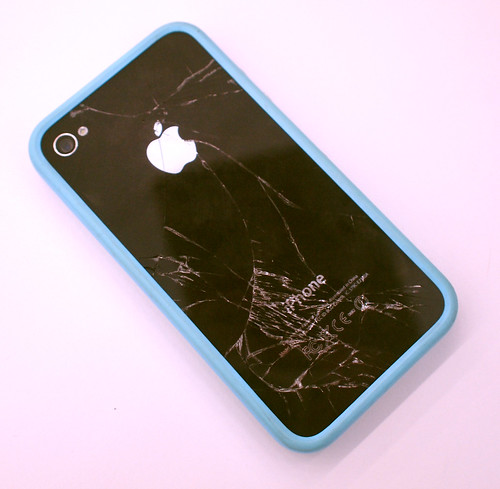
Nick Bilton who blogs for the New York Times has dropped and smashed the front of his Apple-loaned iPhone 4. Here it is a complete, fragmentary, mess.


I thought it would work beautifully until I dropped my iPhone on the concrete on Tuesday evening. The phone’s glass became a Humpty Dumpty look-a-like.

I’m still trying to figure out whose fault it was? Of course, I’m mostly to blame for being clumsy and dropping the phone. But is it also Apple’s fault for creating a gadget that breaks so easily? Electronics Designers Struggle With Form, Function and Obsolescence

Musing on this mini-disaster leads Nick to consider that perhaps the requirement that electronic devices should look and feel uber-slick has led Apple's designers to sacrifice function for form and to build objects which are insufficiently robust.

Jason Brush, executive vice president of user experience design for Schematic, a branding and design agency, noted in an interview that the fragility of electronics today might not lay in the form and function debate, but rather that gadgets are not meant to be long lasting.

“If you purchased a Leica Camera a hundred years ago it would still work today. It was bullet proof,” he said, “But electronics today are not built with permanence in mind.”

Mr. Brush said that electronics are now built as fashionable objects that serve a functional purpose. “When things are made to look beautiful versus being designed to last for 100 years, the products form can look vastly different,” he said. (NYT)

Clearly Mr. Brush is on to something here. iPhones are not built to last the way that Leica phones are, or were. But surely Jason Brush and Nick Bilton are missing the key point with this criticism? Apple's devices (iPhone, iPad, iPod Touch etc) are obviously not built to last, they will be improved upon very soon; more germanely they are not built to be objects in the sense in which the Leica was an object. The Leica camera is a specific functional tool with which quite specific and well-framed tasks would be performed in a professional manner. Nick Bilton has committed what philosophers like to call a 'category mistake'. He has mistaken the iPhone for a Leica-like object when it is clearly an adverbial-appendage. The iPhone and the iPad are not truly objects, they are adverbs. They are only parenthetically about taking pictures, they are mainly about doing all kinds of stuff, much of which you hadn't even considered to be do-able in that way, or at that remove. They are multi-purpose mediators through which the web and the internet interacts with the user. It is moot whether they are appendages to us, or appendages to the web through which stuff now happens. The creative process is now all about the web (subject) doing (verb) to us (object) in a certain way -- perhaps most stylishly in the Apple way. The iPad is, by some distance, the most adverbial of the range of devices that Apple has produced. That it is a range of devices, each of them invoking their own adverbs, and hard to copy or emulate is the key Apple's 'defensive' stance in relation to Android and other competitors. Any company that wants to compete with Apple now has to do some deep syntactic analysis. The adverbial genius of the iPad is that it has redefined and clarified the adverb 'gorgeously', 'stunningly', 'veridically' or 'lazily' in the way that we interact with the web. The genius of the new iPhone is that it has appropriated the adverbs 'instantly', 'face time' (which in spite of sounding like a process, is on its way to becoming an adverb characterizing conversation), 'unintentionally' and 'magically' to the previously more or less routine but increasingly mobile business of using a telephone.

So, Nick Bilton really should not worry about breaking an object (especially since it is one that had been loaned to him by Apple, 'generously'). He has lost an object but gained access to a range of adverbial devices each with unique performance envelopes through which he can interact with the web in the way that Apple envisages smart journalists now need to do that. Guiltlessly and perhaps carelessly. Hold on for the iPad nano, Nick.

Thursday, November 12, 2009

Chasing the Format

The New York Times has been stealth developing a new format for its daily news. TechCrunch has a summary. The horizontal, grid-like layout is reminiscent of the Google Fast Flip, but I buy the suggestion in the TechCrunch comments that this format is being readied for the putative Apple iTablet computer, aka slate device.

That could well be; and it would make sense for Apple to launch the Tablet with something like the NYT as a core offering in its media-player. However, if the NYT is prepping a special format for the tablet, that is almost certainly a poor long-term move for the New York Times (not much different from its earlier play with Microsoft and the ill-fated Microsoft Reader). When the initial Apple enthusiasm is spent and the tablet has been ingested, the New York Times is left with another variant format to support; or as in the case of 'Microsoft Reader' Times readers, another batch of audience to disappoint. The Tablet needs to work with the New York Times as it is and the Times needs to work with every web capable device that there is. Every gadget capable of running a standard browser.

Newspaper publishers feel inexorably drawn towards customising their offering for each new ultra-fashionable device that comes along, and this is an issue at the core of their current dilemma (or their owners acutely sharpening current financial dilemma). The last time I counted: the Guardian (my favourite newspaper) was trying to optimize its content offering across half a dozen different platforms (from print to audio via web, mobile, video, RSS, PDF and blogosphere); and I am sure there are more coming. Even the web site is now being tweaked for optimum delivery in different web environments. There may soon be Apple iPhone, Kindle, Blackberry, Google Android, and Nokia-tweaked editions of different newspapers in web and digital formats (Pre anyone?) for all the different flavours of device out there. And if you think there will be only one dominant Android form factor you may have another think coming.

Newspaper publishers may think that the costs of these proliferating platforms are not falling to them (the adaptations are being paid for by technology partners, or by advertisers, or by new revenue streams from putative subscribers). Wrong. The cost is falling on the publisher who needs to maintain a very complex editorial and content management infrastructure and the cost is also falling on the brand which is inevitably being fragmented as the familiar format and style of the newspaper is poorly distributed and lost in these variant editions. Big damage to brand through content fragmentation and sub-optimal design. One of the principal advantages of a digital edition as the primary offering for a newspaper to its web subscribers is that it is offering the very same newspaper as to print buyers. That correspondence has to re-inforce the brand and develops a climate of continuity, predictability and reliability between print and web editions.

Why are newspaper publishers chasing these sub-optimal, format-based, solutions so frantically? I suggest that there are two reasons. The first is that the horizontal, hierarchical, RSS-friendly formats such as Google Fast Flip are well suited to the sequential, evolving, 24 hour real time operation of the news room. Better adapted than the page-based format of the traditional broadsheet or tabloid newspapers. My bet is that these horizontal formats, with the accent on left/right movement, will be adopted by news organisations that are not primarily newspapers (Fast Flip is working with article feeds from the BBC and Salon) and that a few newspapers will migrate in this direction.

But most newspapers really need to work with their historic format, a package in which news, editorial, features and photographs are integrated and distributed and which does not absolutely require paper since digital pages also work. Digital newspapers, when they have learnt the strength of the digital package that they can easily become, will adhere to their page-format style, their section-based daily organisation; the inescapable penalty of the daily edition cycle, which imposes deadlines and a rectangular organisation on the news, opinions, stories and illustrations that they contain. The new Apple Tablet/Slate will be good for this whether it is held in portrait or horizontal mode, and the New York Times will be making a mistake it it postrates itself in horizontal mode to make the most of the 11" aluminum casing of the early models.

Bring on the tablet which should be an ideal format for digital editions in all shapes and sizes. If it is any good (and it will be) it will be a wonderful showcase for the New York Times just as it is. Oh yes, for a certainty each edition will need to be 'carefully put to bed' as they used to say on Fleet Street. No more than that. Newspapers will thrive on the web when they know what it is to be a digital newspaper. Remarkably similar in many ways to a print newspaper, but better.

Wednesday, November 26, 2008

Hardware Standards Proliferating

The Register has a tantalizing and extraordinary glimpse of a 'new' Samsung device, which is both a mobile phone and a fold-out 5" digital viewer. Here is a YouTube of the device clamped in a showcase at a trade show:


The market for mobile phones and similar (or dissimilar) devices will explode in the next three years. They will be a lot smarter and more content aware than today's models. Publishers are not yet thinking hard about these potential markets. The Samsung device will make it very easy to consider reading a digital edition of a book or a newspaper on the move.

The very diversity of these devices will make it impractical for publishers to create different versions of their properties for different platforms. Rather than re-format and re-package content for devices with varying interfaces and form factors, much better to offer a digital edition that can be served and used through any valid web browser. Let the browser take the strain as Apple have done so magnificently well with the new Safari on the iPhone. Safari defeats the small scale of the screen by allowing web pages and images to be squeezed and slid around within the browser. I wonder if Samsung's fold-away marvel has a touch screen?

I am so enchanted by my iPhone that I am already spending quite a lot of my time on the move looking at content. Favourite sites such as the BBC, the NY Times and the Guardian, seem poorly adapted to iPhone delivery. These sites have too many columns, the links are sometimes over-dense and the lack of thumbnail perspective is disorienting. The newspapers are perhaps better than the BBC, which is particularly irritating since it shoehorns one to a clunky mobile version of the site which is poorer than it needs to be on the iPhone. Is this the last hurrah of WAP? I have a strong intuition (perhaps not solely and entirely motivated by bias) that the Exact Editions use of the original format of content as pages, aided by search, linkage and thumbnails is clearly the way to go.....Don't reformat when you go digital, do let the browser take the strain, do embrace the new platforms with books, newspapers and magazines exactly as they were meant to be: searchable and citeable digital editions.

Wednesday, September 05, 2007

The Trouble with E-Readers

You will find an instructive account, from personal experience, of the deficiencies of the New York Times E-Reader at PersonaNonData. The commercial ineptitude of the NYT is startling, no follow-up calls during the promotional free trial, the dithering over Times Select, and the general uncertainty about what a great newspaper should now become. When the story about this new (Microsoft) E-Reader first surfaced, we wondered why no one was mentioning the old Microsoft eReader (has everybody forgotten what a flop that was?). The deficiencies in the two systems seemed to be remarkably congruent. The killer punch is here in Michael Cairns's review

In my experience there seemed to be less opportunity for engagement with the Reader than with the paper version. I am not sure why I felt this - perhaps it is a tactile thing - but I found myself preferring to buy the paper. I found it frustrating that I couldn't permalink to articles as can be done on the (NYT) web site and attempting to jump to the article on the NYTimes.com is not possible. (PersonaNonData)

There is the rub. If the digital edition makes you feel less engaged than the paper version, the digital edition is bound to fail. When it comes to digital editions, if you can't link to it and you can't easily jump out of it, forget it. The prestigious newspapers who have invested in the Microsoft E-Reader have probably pushed themselves and their readers into a cul de sac.

There is a deeper question here about why it is that newspaper and book publishers continue to fall for the concept of an ebook or an ereader.......No special environment or device is needed.

Friday, April 20, 2007

Earnings Calls from the NYT and GOOG

This is the time of year when big US media companies make their Quarterly reports to investors. Here is Juan Antonio Giner being very direct and quite rude about The New York Times's results. He surely has a point? The New York Times is a fantastic brand, and a wonderful newspaper -- the results don't need to be so dismal. The Economist is a print media brand of comparable reputation that regularly gets more than adequate financial results.

Here is another shrewd commentator being very brief about Google's eye-popping results announced yesterday. "Another very good quarter". That is all John Battelle has to say. Its almost all that needs to be said.

Google press release here. Transcript of NYT conference call here.

The NYT complains about the advertising market. One does not see Google showing any anxieties about the flow of advertising spend. Magazines and newspapers badly need to find a way of catching their share of web-based ads. Digital editions are a part of the answer.