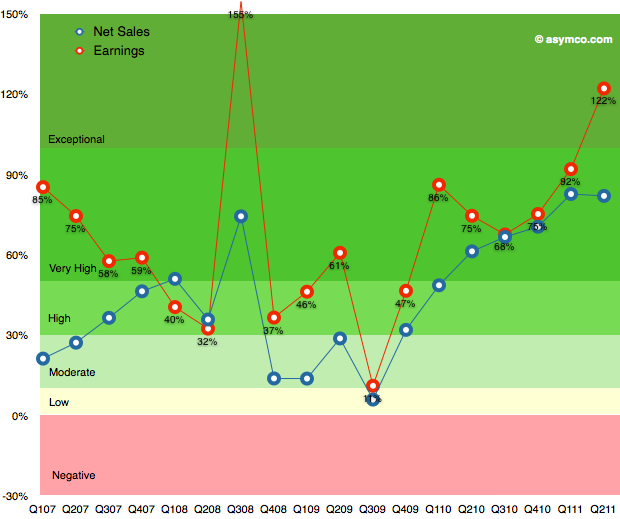
Apple is poised to become the biggest company in the world by 'market capitalisation'. It maybe briefly inched ahead of EXXON yesterday in chaotic market trading, but it will very surely be well ahead of the pack by the end of the year. Apple's sales and profits are rocketing and the value of the company is still being significantly underestimated by the markets.
The remarkable fact is that although Apple is now a large company by any standards (annualised sales of over $100 Billion) its profits and its sales turnover are still growing at an amazing rate. Big companies can be very profitable, and big companies can sometimes grow revenues quickly, but Apple is doing both of these things consistently, quarter by quarter. As can be seen in this chart produced by Horace Dedieu

For fuller discussion of the chart see Asymco's note on Apple's growth scorecard for second quarter 2011. In Asymco's deadpan style these sales and profit growth stats are dubbed merely"exceptional" or "very good". But Asymco is being too phlegmatically Finnish, it is frankly unprecedented for a company with annual sales of approaching $100 Billion to be growing year on year at 82% (and in the preceding quarters 83%, 70%, 67%, 61%, 49%, 32%, 6%). You have to go back to Q3 2009 to find the merely respectable figure of 6% annual growth!
The crazy thing is that there are some very strong planks in Apple's growth strategy that we still cannot infer from reported figures. Only Apple knows, or can guess, how strong a part of the growth story will come in the next decade from the sale of music, film, books, and apps all coursing through iTunes and all generating a 30% turn for Apple. This IP-derived cash will become an important part of Apple's revenue streams and even more of its profits, because the marginal cost of selling more digital media through iTunes is very low.
We dont know much about Apple's revenue from apps in iTunes, but we do know, from a press release, that Apple had cummulatively paid out over $2.5 Billion to app developers by July 2011, which means that Apple has retained $1.1 Billion from its share of sales of apps through iTunes (over the 4 years that apps have been for sale in iTunes). At the iPad 2 launch event in January Apple had announced 2$ Billion in payments to app developers, so it is probable that Apple sales from apps will comfortably exceed 1$ Billion in 2011.
Buried within these gross figures, that are reported in bald outline, there will be an amazing amount of detail that is available to Apple only. Apple now has a good deal of insight on the relative buying patterns of owners of iPhones and iPads (now 150 million and 30 million owners in each case). Apple has a lot of information on individuals buying habits for music, film, and for apps, for games, productivity tools, ebooks and magazines and newspapers. Very little of this information is aggregated or understood outside the confines of Cupertino. It would be very interesting to know what the average iPad owner spends on media in the first quarter or the first year of 'ownership', on games, music, ebooks and periodical subscriptions. If the 'average' iPad owner spends $6 per annum on magazine subscriptions through iTunes there is already an annualised market for nearly $200 million in magazine subs. That figure may be too high at this stage when there are so many 'experimental' magazine apps out there doing their publishers experiments. But it is not outlandish to suppose that periodical subscriptions spending could soon head towards $10 or $20 per owner, which will mean that the market will soon be measured in billions. It would be informative/encouraging to know whether expenditure on various classes of media tends to increase or flatten out? There is a widespread belief that app purchases tend to focus around the very low prices on the Apple pricing matrix: 99c or $1.99. That stands to reason, but many publishers and developers would like to have more information, more guidance on pricing at higher levels for more sophisticated offerings. I suspect, and we have smidgins of data that bear this out, that iTunes is now selling relatively big ticket items well (by 'big ticket' I mean items priced at $15 or over, even $50 and over) Apple does not currently have a way of guiding developers and publishers on these issues: except through reporting sales on specific apps -- which Apple does well, promptly and fairly, in my opinion.
I suspect that the information that the market-wide information Apple now has on some of these issues is both quite surprising and also of minimal use to Apple's competitors. So I expect that Apple will find ways of conveying more information that will help to guide the deliberations of its developers and publishers.
From the snail's eye view that we have at Exact Editions one can say with confidence that Apple's potential for revenue generation through iTunes and the app store in particular is extraordinary. Here are four things that we have learned since Apple introduced its automatic renewals within iTunes:
(1) Renewals are good. We have limited data (less than three months) but there are indications that subscriber renewals through iTunes will be over 75%, possibly over 90%. Month by month. If annual renewals are also good, Apple's and the publishers revenues from digital magazines enter a virtuous spiral.
(2) Any special interest consumer monthly magazine with a paid annual circulation over 10,000 print subscribers will make good money from deploying a branded app in iTunes. The revenues from iTunes, even after Apple's commission, taxes, and Exact Editions development charges, will significantly exceed the costs (there must be some exceptions to this rule of thumb, but we have not seen them yet). A magazine that has 10,000 subscribers in print will find 1,000+ subscribers in the 200 million consumers that have iTunes accounts. Next year that proportion will be higher, when there are 250 million iPads.....
(3) The gap between appreciation of magazines on the iPad ("I love my magazine") and appreciation on the iPhone is widening ("the page IS small"). Most iOS magazine apps are being bought by iPad owners. The new iPad 2 is also clearly better than its predecessor for magazines. We think that the iPad 3 may mark another step change, especially for highly visual magazines.
(4) A significant proportion of users who subscribe to a magazine in iTunes will choose the expensive option of a 12 month sub, rather than the easy option of a 30 day sub. Though all our publishers offer discounts for annual subs when they price their subscriptions for iTunes, in nearly all cases the reward for the 12 month sub is small -- 10/15%. So we have been surprised to see 20%, 25% even 30% of subscribers opting for the bigger ticket (it varies with different magazines). Surely the adoption rate will be even higher when magazine publishers decide to start experimenting with promotional annual subscriptions in iTunes. This is excellent news for publishers who wish to maximise subscription revenues on the digital side, it is very good news for Apple also, though it is going to be another 9 months before we start to find out how good the annual renewal rate in iTunes is!
Wednesday, August 10, 2011
Apple Knows Plenty

Tuesday, June 28, 2011
Apple's Mega Newsstand
At its World Wide Developer Conference at the beginning of the month, Apple introduced iOS5, a close integration with Twitter and its plans for a Newsstand within iTunes. There was a brief overview of the Newsstand service in the presentation and this mention in the Press Release:
Newsstand is a beautiful, easy-to-organize bookshelf displaying the covers of all your newspaper and magazine subscriptions in one place. A new section of the App Store™ features just subscription titles, and allows users to quickly find the most popular newspapers and magazines in the world. If subscribed to, new issues appear in the Newsstand and are updated automatically in the background so you always have the latest issue and the most recent cover art. Apple Press Release, June 6, 2011There is quite a lot yet to be decided about the precise shape and operation of the Newsstand but what we know looks promising. We know that its coming in the fall, which means that it must be near completion; we know that it will enable background downloading; and that it will present the front pages, front covers, of newspapers and magazines in a more topical and attractive way. We know that Twitter will be available as an omni-present system-call in the new iOS. We also know that Apple's newly introduced in-app subscription process, with automatic iTunes renewals is working well, many mainstream publishers have announced that they will support it. This is a separate but important development. We also know that Apple has relaxed its previously announced, but over-restrictive policies on pricing of subscriptions "outside" the App store. Apple will not be 'leaning over' and requiring publishers to charge no more for digital subscriptions on the web or on Android than they charge within iTunes. Apple is loosening up a bit.
This really could be the very best news for the digital magazine and newspaper industry. Here is why:
- Apple sold nearly 20 million iPads in the year to April 2011. We do not know how many they will sell in the second year, but it seems reasonable to expect a very large number. Another 50+ million units seems probable. Three years after its launch the iPad could certainly have a 200/300 million installed base. That is scale.
- Apple has decided to bring some marketing and retailing focus to periodicals within iTunes. This is what the Newsstand announcement really amounts to. Apple will arrange focus and in-store presentation and highlighting. It is as though Tescos or WalMart announced that they were going to have a big newsstand kiosk in a prominent place within all of their retail outlets. The Newsstand will be a sales focus and it will attract masses of titles. Since periodicals have never been aggregated and retailed at remotely comparable scale, it is quite hard to envisage the potential for a newsstand which has tens of thousands of titles in all the main languages. Apple would only be doing this if it considered that newspapers and magazines could be a big category. Apple is building a platform from which it can sell billions of news and magazine subscriptions.
- It would appear that Apple will be going for a very 'format' neutral Newsstand. Apple has not said that all magazines and newspapers should have a specific file format, as happens with iBooks. It has not said that newspapers and magazines should or should not be 'interactive', though it seems certain that interactivity will be there (see most newspaper apps). This is ingenious because it allows/encourages publishers and developers to experiment with different sorts of delivery format. Apple is offering a sales platform, a payment platform, a cloud-based delivery and access platform. But it is not dictating the format or precise implementation of magazine services. This is ingenious in two directions. It encourages publishers with the advantages of a genuine platform (scale in distribution, and simplicity in payment and licensing for customers) but does not constrain publishers or developers in the services that they may offer. The platform does not appear to constrain the potential for innovation and diversity, except perhaps that these periodicals will of necessity have issues and front pages (even that limitation may be negotiable). Since magazines and newspapers have extraordinary diversity in their appeal and in their production processes, this is a masterstroke for Apple. And it is also clever in a second way since it enables Apple to be quite agnostic about how magazines and newspapers should be delivered. Apple does not have the heavy responsibility of managing content and dragging timely editions from publishers' workflow. Apple allows innovation within the iOS guidelines and will benefit (to the tune of 30%) from not having to do the experimentation or day to day content management on their publisher's behalf. Apple does not even expect to host the titles (as it does for iBooks).
- Publishers will complain about Apple's 30%, and although I have some sympathy for the complaint, one notes that Apple's recent loosening of its pricing rules, has given publishers an enormous opportunity. Magazine publishers especially. Magazines know how to sell subscriptions to consumers. They have been doing that for years. Magazines have a business model which encourages them to sell direct and they should certainly use that to build direct relationships with their subscriber base. But they should also welcome Apple as the cornerstone of their digital promotion. Apple is not telling its book publisher partners or its music industry partners that they should sell direct. Furthermore, there is little chance that Jeff Bezos will echo Steve Jobs when he said: “Our philosophy is simple—when Apple brings a new subscriber to the app, Apple earns a 30 percent share; when the publisher brings an existing or new subscriber to the app, the publisher keeps 100 percent and Apple earns nothing.” (Apple Press Release, February 15, 2011) Replace 'Apple' by 'Amazon' in that sentence -- and I am not sure that Jeff Bezos would even recognise it as grammatical, he would certainly stumble if it were included in the Kindroid press release.
Wednesday, June 22, 2011
Now that Apple Owns the Tablet Space .....
When the iPad was launched, there was a widespread view (and I shared it) that soon, and not more than a year or two later, there would be some highly competitive and lower-priced tablet alternatives for customers to choose from. The iPad had opened a new hardware category, but competitors would quickly crowd into this new opening... there would be lots of choice and most of it would not be for Apple hardware.
Whilst dissecting a review of one of the best Android competitor's to the iPad, Marco Ament notes:
Translation: Android tablets have managed to copy the iPad’s hardware well enough — the easy part — but have failed to provide good software and significant third-party app choice — the hard part. The Android Tablet ProblemFor any 'head-to-head' competitor tablet to get into the market for a face off with the iPad there is the possibly insuperable problem that the new tablet lacks a coherent body of developers and of tablet-primed media. Apple has been building its iOS developer community and media resources for four years (arguably more). Apple has huge momentum and capability behind its iOS platform and this cannot be matched by any competitor. I don't think that a 'head to head' competitor to the iPad can emerge in the next five years. The competitive threat if it comes, will be from a completely new approach, an external threat not a mid-size device like the iPad. We should look to a paradigm shift as radical and disruptive as the iPhone/iPad surge that Apple has produced to disrupt the mobile phone and the laptop computer.
Harry McCracken reviews the state of iPad competition and concludes that it is very hard to see why anybody in the market for a tablet would buy something other than an iPad 2.
And yet no Apple competitor has started selling anything that clearly answers a fundamental question: “Why should somebody buy this instead of an iPad?” Sure, it’s easy to point at specific things that other devices do better (or at least differently) than the iPad, and some of the people reading this article can explain why they chose another tablet and don’t regret the move. (If you’re one of them, please do!) Still, sales figures for tablets show that when consumers compare the iPad to other choices, an overwhelming percentage conclude that the iPad is the best option. ....Instead of an iPad (Technologizer)If the 'competitors' to the iPad cannot emerge now, a year after the first iPad was launched, why should it be feasible that the direct competition will be stronger in a year or two's time? The iPad eco-system is getting richer and stronger at an amazing rate and that is the problem any direct tablet competitor faces. The fundamental point about the iPad and the iOS range of devices is that Apple is not really selling a hardware solution; Apple is offering a software and services solution, and it is the whole package that customers are buying into. This is something which no competitor to Apple is plausibly positioned to challenge. Not Microsoft (they don't really do manufacturing), not Google (they don't truly understand selling), not Amazon (who are best placed to have a shot at it, but do not have deep consumer-device engineering DNA).
We will come back to Amazon in a minute. But first let us consider what are the consequences of Apple owning the tablet category for the next three, four years -- by which I mean that Apple has a good chance of being the supplier of most of the tablets bought for the plan-able future.
- Apple will sell a lot of iPads and will certainly offer a modicum more choice (high-end, low-end, high-res, medium res). Moore's law says that Apple should be able to produce a sub $200 iPad for Christmas 2012. Apple will do that.
- The degree of device choice will be constrained by the requirement that as many apps as possible should run across all iOS devices. So no new aspect ratio, but quad pixel density. The coherence and interoperability of the range of iOS devices is already another source of lock-in. That gets stronger as the differentiation within the range is gently increased.
- The lead that Apple has in the deployment of apps for tablets will grow. Enormously, and become even more of an obstacle to 'internal' disruption from iPad-like competitors.
- Android, or maybe Windows, phones may well provide very strong competition at the 'low end', at the small format end of the market. There will be plenty of apps for non-Apple phones. These non-Apple phones will also be well-placed to produce competitive applications which are not tablet-sized and which do not necessarily require the full range of touch interface.
- Apple's competitors will increasingly throw their weight behind web standards and 'open' technologies.
Wednesday, May 11, 2011
Apple's Terms of Trade Finally Win Acceptance with Magazines
Suddenly the dam seems to have broken and the major consumer magazine publishers are lining up for iPad editions sold on subscription through iTunes.
In the last ten days, Time Inc, Hearst and Conde Nast have all announced moves towards selling their leading consumer magazines as subscriptions on the iPad. They are also offering free iPad access to their existing print subscribers, a simple and very necessary step as we have been emphasizing for months.
In disclosing these new offerings the major consumer magazine companies have been stressing that Apple has been willing to make concessions and to grant flexibility (see reports of such by Peter Kafka at AllThingsDigital). I expect some modest concessions have been granted, but on matters of detail and to help with 'bedding in'. Apple has not had to modify its developer contract or bend on its commission terms. Apple has the whip hand and, more to the point, Apple will not make concessions on issues that put obstacles in the way of the successful operation of the iTunes service. Apple will not make concessions which force it to re-write its end-user license agreements. Apple will not make deals with magazine companies on its 30% commission when it has been completely impervious to the pleadings of the music publishers on royalty rates. The bald and uncomfortable truth for these giants of consumer publishing is that Apple is not going to do deals. Apple is not going to cramp the economy of iTunes for the sake of the magazine business. So what follows?
- Magazines will sign up to the iPad service in a growing avalanche. Now that the big 3 of the US consumer magazine business have moved over to the Apple way of doing business, we expect that most major magazine companies will move over to producing iPad apps for their key magazines.
- Within 12 months iTunes will contain many more iPad magazine titles than has ever been collected in one physical kiosk or emporium. Finding titles in such a rich product mix will become more of a problem. But magazines are better placed than most categories to thrive since magazine titles are (usually) so clearly branded and so distinctive.
- The magazines in iTunes will be offered primarily on a subscription basis. Hitherto iPad apps were being offered on a single issue basis.
- The major consumer magazines in all the major national markets will soon be offering iPad apps through iTunes and they will also be offering free digital access to their existing print subscribers. Magazines will do this because in that way they retain more control over their subscriber base and can avoid having all their subscription services handled by Apple. They retain, indeed enhance, the crucial relationship that they have with paying customers.
- The prices for digital magazines within iTunes will be pitched at increasingly aggressive levels, Bloomberg Business Week costs $36 per annum. The Esquire iPad app will apparently cost $19.99 pa. Apple's pricing rules mean that international pricing will level-down to the best home market subscription offers (US subscription prices for consumer magazines are low in comparison to European prices).
- These recent announcements have all been focussed on the iPad. Conde Nast and Time Inc are committed to producing iPad apps, it is not clear whether the iPhone market is being by-passed or merely temporarily left behind.
- Android apps also appear to be taking a back seat. It will be interesting to see whether this week's Google I/O, now in its second day, has any mention of digital magazines. Not much sign of them in the opening sessions.
- The apps that are being produced for the iPad bear a remarkable similarity to the print product. The idea that a magazine app needs to be something radically different from the page-oriented, highly designed and issue-based package that we all know, is losing ground. Most magazine publishers cannot afford to run two parallel design, production and editorial processes.
Tuesday, April 12, 2011
Are Magazine Apps like Games on the iPad or more like Books?
Bloomberg Businessweek produced a pretty effective and straightforward app for the iPad earlier in the week. And it got predictably mixed reviews from the magazine app critics. Grudging and faint praise, at best. Here are some typical gripes from Techcrunch:
It is a perfectly serviceable magazine app. But it is underwhelming. There are no extra photos beyond what’s in the magazine, or even much in the area of additional multimedia other than a video intro every issue by one of the editors about how cover they chose the cover, and a couple audio interviews to accompany columns by Charlie Rose and Tom Keene. Erick Schonfeld Bloomberg Underwhelms with iPad App (Demo)
Erick Schonfeld's reaction here is very typical of the criticism that magazine apps tend to attract. The critics seem to assume that a magazine app should really be something else. Its got to be more than a magazine. Heck, otherwise what is the point? No extra photos, not enough additional multimedia, just the magazine..... It is as though the magazine app needs to be specially designed and uniquely conceived for the iPad platform. In much the same way that computer games need to be adapted and versioned for the hardware platform on which the game will be played.
We should look more closely at this question of what else a magazine app ought to be, other than the print magazine. But, first, consider how unusual this approach is. Content publishers do not, for the most part, look at the iPad and say, "How can we become something completely different on this device?" Hollywood does not think that films on the iPad need to be a qualitatively different entity from the film that one might see in a cinema or via a DVD. The point is rather that via the iPad the consumer gets an experience which is in someways pretty much as good as having the art-house experience (or not quite as good as, which is why we still like going out of an evening). Book publishers are not expecting books on the iPad to be qualitatively different from the books that get published on paper. Can you envisage the fury that would result if the Stieg Larsson books were not the same in their iPad editions as they are in print? Throw in an extra chapter? Have an extra deviation in the plot, an optional app-loop with more time in Australia or Poland, or additional detail on how to apply or remove tattoos, handcuffs, ride motorbikes etc? Publishers and readers are pretty sceptical about iPad app books that merely chuck in various bits of video/visual over-matter, or even passages with the author reading the book. These so-called 'enhanced editions' have something of the air of cosmetic surgery. Messing the book up is not going to do anybody any good, the sag lines show up pretty fast. Why should we not expect magazines on the iPad to be magazines? Just as we expect films to be films? The Exact Editions platform does support and facilitate bonus media for publishers who wish to make their magazines more interactive and use multi-media elements, but it is not clear that this is what readers expect from their apps. Most magazine publishers are sensibly enough avoiding the gimmicks, but many self-appointed app experts, consider that magazines should be something different. Qualitatively better on the iPad and radically different.
There are things magazine apps can do better than print magazines, for the most part these are qualities that come from having a digital magazine. They are not specifically iPad/appy tricks and affordances. And Bloomberg Businessweek certainly gets some of these things right:
- The app carries with it an archive of previously published issues
- The app supports search across the archive
- The app is free to existing print subscribers (for its loyal customers the iPad app is a jolly good bonus -- making that work for your readers is simply good publishing)
- The app has significant potential for sharing and commenting (email, Twitter and Facebook)
- Bloomberg provide real-time news and share price feeds linked to mentions in the articles, for all the major corporations with stock ticker labels.
- This is an app with the potential to grow and evolve in interesting ways
Monday, April 04, 2011
Amazon, Apple and Google
John Naughton has a terrific column Amazon's new Cloud Drive Rains on everyone's parade in yesterday's Observer:
"Impetuosity and audacity," wrote Machiavelli, "often achieve what ordinary means fail to achieve." If you doubt that, may I propose a visit to the upper echelons of Apple, Google and Sony, where steam might be observed venting from every orifice of senior executives? If you do undertake such a visit, do not under any circumstances mention the word "Amazon".
.......
Behind the scenes in the US, though, there has been frenetic activity, with Apple, Google and Amazon racing to get into the streaming business. Apple has cloud services, customers who are used to paying for music, a good range of mobile devices but no licensing deal for streaming. Google has terrific cloud services and millions of Android devices but no music store customers and no licensing deal. Amazon has cloud services, a music store, paying customers, a terrific e-commerce operation, and access to Android devices. But it also had no licensing deal with the record labels. John Naughton Observer, 3 April, 2011
This last sentence is not exactly right. Both Amazon and Apple already have digital distribution deals with the record labels; its just that Amazon's existing digital distribution deal is in crucial respects rather better and more permissive than the Apple deal. Ironically, and again crucially, Google does not have an agreed license, though it has been negotiating hard for months and the Amazon chutzpah may well make it harder for Google to get the deal it badly needs. Amazon has been selling digital music since 2007, so it does have a licensing deal with the labels and the Amazon deal is actually rather more favourable to streaming than the digital distribution deal that Apple was granted some years earlier. The crucial point about the music distribution deal that Amazon has, is that it allows Amazon to sell and deliver 'unencrypted' MP3 files to consumers -- and Amazon's new Cloud Drive is just allowing consumers to store their files in the cloud, rather than on a hard disk. Amazon already has a license to distribute (most) music to consumers through the web in a form in which music can easily and simply be stored in an individual consumers 'music locker'. Amazon's license with the record labels, is not ideal, but it is workable for streaming music and gives Amazon good leverage. It is not ideal because, Amazon's rights are currently restricted to the US (or in practice restricted to the US where individual content shifting is explicitly approved by the courts), and because without more leeway from the licensors Amazon may have to maintain individual Cloud Drives for each consumer (it would be more efficient to have individual libraries where common tracks were represented by 'tokens' rather than full copies). Apple, on the other hand, has distribution deals with the music labels which are explicitly tied to Apple's commitment to encrypting music in the way that is proprietary to Apple, and which limits music to devices recognised by the Apple DRM. Apple, we should assume is still significantly hobbled by these agreements. Having to encrypt all 'streaming' music in the DRM specific to iTunes is the major factor delaying Apple from introducing the 'cloud based' iTunes that it knows that it ought to be offering. A music streaming service needs the freedom for music to be delivered to a device as many times as it may need to be played, but Apple being lumbered with 'Fairplay', its download-tracking, DRM for iTunes clearly needs some permission, some wiggle room, from the music companies for this to happen. Amazon came along much later with its request for a music distribution deal, and the music companies were so desperate to have some competition for Apple that they agreed to Amazon's terms which give them more scope for internet-based distribution.
One irony of this situation is that the roles are reversed when it comes to books. For books, the Amazon distribution rights are more clearly dependent on their commitment to DRM and to a proprietary format. Amazon was the innovator in the ebooks space and Apple was playing catch up, so the publishers were less insistent in their negotiations with Apple on the requirements for DRM. The Apple iBooks standards are less proprietary, more open to industry standards than the Kindle. Apple seems to be cast (perhaps unwillingly) in the role of bad cop for music, whereas Amazon is looking like good cop in the music sphere and 'bad cop' for books. Google would love to be playing the role of good cop in both markets, but it is not clear that it has the necessary leverage. It needs to come up with a proposition for the record labels, that is good for consumers and wrong-foots both Apple and Amazon. That may not be easy.
Tuesday, March 29, 2011
Why Magazine Apps Have to be Subscriptions
The major consumer magazine publishers are backing themselves into an extraordinary corner with their reluctance to engage in subscription transactions on iTunes. Conde Nast for example will be selling magazine issues as apps, one issue at a time through iTunes, requiring existing subscribers who want to read their magazine on an iPad to repurchase an issue to which they may already have access through a print subscription. That the customer already has a print subscription counts for nothing. In fact, things get worse. To judge from the help pages, in iTunes, customers who have bought one of the latest issues of a magazine through the iPad, may be asked to 'repurchase' a previous issue that they had already bought for their iPad, to go through the motions including keying in their iTunes password, but they will not be charged for it. The problem that Conde Nast have created for themselves here, is that they do not have a way of knowing whether or not someone has previously bought a specific issue of the magazine, because the previous purchase was made through iTunes and Apple, not Conde Nast, keeps track of iTunes customers. Conde Nast are trying both to sell single issues, through iTunes, AND meet the expectations of users who should have access to earlier issues when they buy a new number. Conde Nast are by no means the only consumer magazine publisher getting their knickers in a twist over this. When there really should be no problem at all. All subscribers to a magazine should have access to the magazine for the term of their subscription through all available means.
The first point that we should notice is that Apple themselves takes the view that if a customer already has access to content, they should have access to it on their iPod Touch, iPad or iPhone. This is not controversial it is just good customer relations. Furthermore Apple makes absolutely sure that a customer who has access through their iTunes account to content on one Apple device, has access to that same content on the other devices connected to the same account (exceptions of course if the content cannot run on the other devices). Apple, in other words, takes the view that subscriptions are fungible across Apple devices: up to five devices per iTunes account. Why on earth have consumer magazine publishers not taken a similar view, why not grant that customers who subscribe in print should also have access via their iPad? Magazine publishers should view personal subscriptions as fungible across print, web and digital devices. Magazine publishers must do this if they want to retain any hope of continuing to control their subscriber data. Magazine publishers generally have a very good picture of who their subscribers are, they have databases that carry up to the minute information on subscribers, so granting them access through an iPad app is not a tricky issue. Is it not a kick in the teeth for your existing print subscribers when you tell them that they have to buy another subscription, or another single copy sale, to read their magazine on the iPad? Will it not be another kick in the teeth when customers are told that they have to buy another subscription for their Android phone/tablet? Or their Web O/S device? There will soon be many customers with Android phones who also happen to have iPads. If there is going to be a competitive tablet/mobile out there in a few years time (at the moment Apple looks like the only game in town, but we can hope for competitive variety) it will be incumbent on publishers, or purveyors of content subscriptions, to offer platform-agnostic subscriptions. Apple is unlikely to extend the hand of subscriber friendship to Android, so the publisher has a privileged position in this battle of platforms selling subscriptions that cross hardware boundaries. Look at the success that Amazon has been having with ebooks by straddling hardware solutions with the Kindle.
The second point to note is that Apple have said that it is perfectly OK to provide free access to print subscribers from the iTunes platforms.
“Our philosophy is simple—when Apple brings a new subscriber to the app, Apple earns a 30 percent share; when the publisher brings an existing or new subscriber to the app, the publisher keeps 100 percent and Apple earns nothing,” said Steve Jobs, Apple’s CEO. Apple Press Release 15 February 2011
And of course, newspaper publishers are working in this way (the New York Times, the Wall Street Journal, The Times and the Financial Times all reward their print subscribers with free access to the web or app versions of these papers). As indeed are most of the magazine publishers who deliver branded iPad/iPhone apps with the Exact Editions platform.
Amazon tackles Apple
This is going to be a protracted and complex tussle and Google will join in. Doesn't look as though there is going to be an iPhone app, but the Amazon Cloud Player for Web will presumably work fine through any web page...... Safari has a role.

Wednesday, March 16, 2011
iPad Usage is Shooting Through the Roof
We yesterday introduced a straightforward way for our publishing partners to access Google Analytics reports for any of the individual titles that we host for them. Data is available in the amazingly atomic detail supported by Google Analytics, for each title, issue, and page. Also, Google makes it very practical to select specific date ranges, whereas the data we had previously collected from our own logs was lumped together in coarse monthly buckets. The traffic data is aggregated for each magazine, so there should be no privacy issues. Furthermore, each publisher has access to his own data, and stuff that is generic or 'cross publication' is not reported via the Google system. The data spigot for each magazine can be switched on as soon as a publisher sends us their Google Analytics code.....
I love the way Google Analytics can provide flexible geographical breakdowns of the data it aggregates:
33 visits from Bari and 71 from Bologna.
Whenever we collect data on our users we are surprised by the extent to which the iPad is making such a big difference to the digital magazine business. Here are a few data points:
- In the last year we have had more visitors to our website from iPad users than from the iPhone (this time a year ago there were no iPads anywhere outside Apple)
- These iPad users read/access twice as many pages as iPhone users
- The iPhone usage has also shot up in the last year. Six times as many visitors this year as in the previous 12 months.
- iPod usage is also significant and is at about the same level as Android usage. Much smaller than iPhone use but, surprisingly, slightly more sticky (both Android and iPod are slightly stickier than the iPhone)
- Blackberry and Symbian use is low, and Windows barely registers (guess that is Windows 7?)
- Our aggregate visits from mobile users (March 14, 2010- March 14 2011) have increased more than 10 times from the previous year (1000%+)
- Looking at one particular magazine which has been quite popular on the iPhone/iPad, it has had over 20,000 freemium app downloads in the last year and roughly one in 6 of those freemium downloads has led to a sale.
- We regard 1 in 6 as a good conversion rate. The conversion rate for different magazines varies enormously.
- Price is a big factor in the conversion process.
- iPad sampling has marginally outdistanced iPhone sampling. This is really surprising since there must be at least 10 times, perhaps 20 times, as many iPhones as iPads in the market for this particular magazine (which has mostly a UK circulation).
- We do not yet have relative conversion rates but we would expect the conversion rate to be significantly weighted to the iPad -- we know this from smaller samples.
On the other hand our publishers are now in the position that they have access to what Google know about the digital distribution of their magazines and something of what Apple know. Google and Apple are pretty much ignorant of the other guy's data. At Exact Editions we see it as our task to help publishers get their digital magazines on as many platforms as possible and to maintain an overall control of that distribution and data. That ultimately gives publishers a position of some strength.
Tuesday, November 30, 2010
Google goes into Culture Commerce
The rumour mill has it that Google will launch a Chrome netbook, cloud-based, computer before Christmas or early in the New Year. When you put this rumour alongside the others coming from the Googleplex you get an interesting picture
- Is Google going to buy a big package of movie rights? Is that why it has hired the former Netflix executive George Kynci?
- Google is possibly quite close to signing a deal with the major music labels for its cloud-based music-streaming service.
- For a couple of years, Google has been apparently on the brink of releasing a digital books service in collaboration with book publishers. Most recently Dan Clancy told us that Google Editions will be launching very soon ("très bientôt")
Wednesday, November 24, 2010
The Economist's Economical and Effective iPad App
And having played with it a bit, I would say that it is a very nice production. Take a look at it here.
There are four aspects to the Economist app that I particularly like:
- It has been delivered as a complementary (ie free) offering to all existing subscribers. Exact Editions has been helping magazine publishers to make this bridge to current print subscribers for a while, but a lot of industry experts seem to think that this is something very difficult to do, or somehow not allowed by Apple's e-commerce system, or just generally impossible. Since the Economist is now doing this with no trouble at all (the sign up was very easy, and you only need to do it once -- as is the case with Exact Editions' universal subscriptions) perhaps we will now no longer read claims that it is not feasible to do this. There will be followers......
- The Economist delivers all its six editions through the same app, and the user can select which 'regional edition' she wishes to receive. That is a very good plan, simple and in a sense generous. But a generosity which costs the publisher nothing (once it is decided, as it ought to be decided, that all the editions are deserving of a digital service).
- The Economist app delivers the individual stories clearly and well, with re-sizable type, and pictures and diagrams in place. Achieving this smoothly and with consistently good results is not easy and must have involved planning a fair degree of integration between editorial work-flow and the app delivery framework. Well done. I also recommend the Economist for choosing a deployment for the iPad which, I am fairly sure, can be easily adapted to other digital form factors that are surely coming. I doubt that the design and editorial process involved in producing the app in its variant forms is onerous, on an ongoing basis. So the planning and integration will be a good investment.
- I especially like that The Economist does not try to do too much, or to introduce multi-media and fancy additional features at this stage. This is an app for the weekly publication, not for the web site. The RSS feeds do not clutter up the app, though they can still be found on the web service, of course. The app will be ignored by some so-called experts for not being more ambitious and daring as a publishing innovation. But they have chosen the correct path: get the basic magazine up and running and then take it from there. It will not be difficult for them to introduce more interactivity into the framework they have built.
- The Economist app is what I would call a good 'ebook' style of digital edition. The format and design quality of the original publication is mostly lost. Page numbers, and paginated format has gone. The print ads have gone (if I want to apply to be Director General of the World Water Council I will need to go to the print edition). The internal cross references are also gone, and that matters. Furthermore, the user no longer has a simple equivalence between the print edition and the digital edition. This dissonance imposes a bigger cognitive overhead than is generally accepted.
- There is as yet no search and no archive, one guesses that these features will be added. Perhaps they should really be there already.
- The navigation possibilities with the app are not as rich as in many other magazine apps. The hierarchical order of the magazine has been preserved and can be rapidly flipped, but I was looking for a 'scrubber bar', to be found in most magazine apps, or a 'page flow' widget such as is found in Exact Editions apps.
- The Economist's ebook style solution works well for the Economist (which is a more text heavy 'magazine' than most). But I doubt that the same process will work for a very heavily illustrated and page-beautiful magazine. The Economist calls itself a 'newspaper' and I feel that its app solution is better suited to a serious newspaper than to the majority of magazines, where considered layout and clever illustration is a key element in the pleasure of the reading experience.
- Furthermore the Economist does not have the benefit of being a platform solution. The Economist is a big enough and a good enough magazine to contemplate building its own solution, but many advantages will come from working with a raft of similarly designed offerings. For most magazines that is an important consideration.
- Although, I applaud the decision not to launch with many multimedia bells and interactive whistles, the digital magazine is very short of linkage. Linkage to the web and linkage to other information resources that matter to readers. The Economist app will be better, much better, when there is more.
Friday, November 12, 2010
Magazine Publishers and Horse Dentistry

It seems that every other day brings a new bout of moaning about the limitations of the Apple iPad system as a digital magazine platform.
But are these complaints justified, or is it really an indication that magazine publishers are both missing the bus and looking a gift horse in the mouth? The latest piece of mis-guided bleating comes in an otherwise sensible article from Damon Kiesow in Poynter Online. He says:
What publishers and consumers need from Apple is a real digital newsstand, which would allow:Damon Kiesow 3 strategies emerge for charging for iPad publications
- One-stop shopping for multiple publications
- The ability to buy a single issue or subscribe
- Capability to connect print and tablet subscriptions, including any package discounts
- A central location to access purchased or downloaded publications
- Sales via iTunes or a publisher's own circulation system, with royalties adjusted appropriately
These sound like reasonable requirements. But the plain fact is that iTunes and the app store pretty much does all that right now. Let us take them one at a time: (1) iTunes is a one stop shop for lots of publications, it is hardly Apple's fault if plenty of magazines have not ventured in there yet. Even so, the iTunes news stand is better stocked with newspapers and magazines than any other digital news stand. And getting stronger. (2) (the ability to buy single issues or subscriptions) as Kiesow acknowledges earlier in the article Apple through the iTunes app store allows publishers to sell single issues or subscriptions (at Exact Editions we enable publishers to sell 30 day subscriptions to their magazines which is not the same as selling single issues; but there are plenty of publishers and platforms selling single issues through iTunes) (3) (connecting print subscribers to apps) but as Kiesow recognises there is no obstacle to a magazine publisher connecting its existing paid subscribers for free to the app which is being sold by Apple in iTunes (he cites the experience of People magazine, but at Exact Editions we are encouraging all magazine publishers to do this: connect your existing subscribers for free through the branded app which you are offering in iTunes. This is completely within the letter and spirit of Apple's rules and guidance). (4) is completely baffling, because iTunes so obviously just is that; iTunes is a central location for e-commerce, for storing magazine issues and for providing users with access to archives. How would or could an Apple kiosk do that better? (5) (a system for 'sharing royalties') is already in place and Apple has the rather marvellous adjustment that a publisher can choose how to play the game, the publisher can either sell via iTunes in which case he will find that Apple have taken a 30% commission from the sale, or he can choose to give the magazine away, or indeed provide free access to subscribers from whom the publisher has charged an annual or monthly subscription (outside the Apple system). Not only can publishers connect customers who they have acquired via the iTunes system to their existing deals and print-based offers and incentives, but they can do that without paying Apple a cent for the business which is happening outside iTunes. Apple is being a lot more 'open' about this than will be some of the competing digital news-stands that are coming along.
All this should be known to the complainers in the magazine industry and I think that the real source of the griping, grumbling and equine mouth inspections is elsewhere. Perhaps these are the real problems:
- iTunes is not a complete digital back-end system for magazines. Publishers are used to having a specialist distribution house handle all complications to do with physical distribution and maybe they are hoping that Apple would be able to do this in the digital sphere and look after the magazine publishers special interests in the way that fulfillment houses have done. Once this is formally stated the idea is ludicrous, but some magazine experts talk as though its Apple's job to deliver, in full working order, the digital back-end of their industry. This is perhaps the burden of Kiesow's request that the putative Apple kiosk should 'connect' the print and tablet subscription ('including any packet discounts' -- I like that requirement: consider the extreme complications that could arise from blending infinite varieties of print/digital discount packages the magazine publishers will dream up; that modest requirement will keep Apple's engineers busy for years). But Apple is not in the magazine or newspaper business and it is not their job to build a system which solves the transitional dislocations of those industries.
- iTunes does not have an exclusive magazines-only zone. Like the iBooks store. This is true, but it may be a good thing for the magazine industry that Apple does not have a required format and delivery solution for magazines. The jury is still out on the iBooks solution, and perhaps Apple is being very wise in waiting to see how digital magazine delivery evolves. Why should they plump for a possibly half-baked digital standard when we still don't know what the right digital format for magazines is? Certainly Apple has not solved all the problems of digital magazine production, the result is that there is a rather interesting ferment of development and innovation. If Apple had developed a pre-packaged solution (cf Amazon and their so far half-hearted and not very good magazine delivery) we would not be witnessing these exciting experiments within iTunes.
- Apple is not being friendly enough to the existing magazine business. There have been a chorus of complaints about Apple not providing sufficient information on app usage to developers, or to magazine publishers who produce apps. The magazine industry is used to having its own tame auditing service (ABC and BPA being two of the biggest industry consortia providing such information), specifically geared to the magazine industry and its advertising customers. Apple has shown no signs of opening up its books to ABC or the BPA and is frankly unlikely to do so. Why should Apple be unmovable in this respect? Primarily because the business of auditing advertisements has moved on, and there is now no conceivable rationale for having an advertising metric which is exclusively tailored to the magazine industry. Google, Apple, Microsoft and Facebook etc will be the advertising networks that count in the future and they will all be trans-media (web, TV, film, digital publishing, social networking all in a big mix). Since 2005, the boom in digital advertising has shown that measurement and auditing is so closely tied to implementation and operations that it is naive to seek to recreate a magazine-specific analysis or distribution solution. Digital magazines will need advertising but they will need to work with digital solutions and digital metrics which are not narrowly specific to one industry or one media type. It certainly is not in Apple's game-plan or in their interest to gerrymander a magazine specific solution for reporting and measuring usage on magazine apps.
- It is hard to sell magazine subscriptions through iTunes. Kiesow correctly points out that Apple enables publishers to sell subscriptions, and there has never been a problem about doing this (we have been doing so at Exact Editions since the iPad launched). In contrast to Android, Apple in iOS 4 and iTunes actually has a rather effective way of providing in-app purchases of subscriptions. The problem for the magazine industry is rather different: iTunes customers are hugely biased towards buying stuff that is at the low end of the iTunes price matrix. It is very hard to sell annual subscriptions to magazines through iTunes at the prices that magazine publishers would like to charge (and perhaps need to charge). This is a real problem but it really is not Apple's fault, and they can hardly blamed for this supposed shortcoming. iTunes works very well for low-priced transactions. But it is hard to see annual magazine subscriptions through iTunes flowing off the digital shelves at prices of £20/$30 and upwards. So it will be interesting to see how Newsweek fares with its experiment of selling 6 months subscriptions through iTunes at $14.99. iTunes apps are pretty 'frictionless' when priced at $0.99 or $1.99. But it is much harder to sell subscriptions at $9.99 or $19.99. Perhaps Newsweek will start a trend, or maybe magazine publishers should stick with the scheme of using iTunes for customer acquisition and then upselling them to an annual subscription purchased via a credit card direct from the publisher (where consumers are happier to spend $9.99 or $29.99, for a publication they really value).
Friday, November 05, 2010
Adobe's Magazine Solution for the iPad
Here is an informative video podcast from the Adobe evangelist Terry White: "Adobe Digital Publishing to the iPad: A First Look"
It is a 15 minute overview of the solution for building iPad apps that Adobe is building for magazine publishers. As you might expect there are some neat software solutions in the package, especially notable are tools for placing video in a document page, for interactive/panoramic 3D photos and model rotation, and for full integration of a web page in the document. Cool stuff.
But the thing that really struck me with this overview is that Adobe is taking a big, and surely quite a risky bet on the way that we are going to read and interact with digital magazines. Adobe have decided that the information architecture for the digital magazine will be very different from the conventional paginated, linear, sequence of the printed magazine. The Adobe solution is entirely built on the proposition that digital magazines should have a matrix style of layout, with pages arrayed left/right in the horizontal plane, and also up/down in vertical 'stacks'. This concept seems quite natural for a 'story', or a set of photos, or a collection of cartoons, which can be read in the vertical 'drop' whilst the ordered contents of the magazine move along in the horizontal mode. This sounds like a logical way of planning a magazine issue and there is apparently no reason why a digital magazine should not be so arranged. We have seen quite a few early magazine apps already employing this, washing-line, information layout, by no means all of them from Adobe's developers. I am not convinced that users really want to read magazines in this way; but if they do, Adobe will be in a very strong position because they now have a direct set of tools for bridging magazine publishers from the InDesign package with which most high-end magazines are now produced, directly to a file format and an information architecture for the iPad to which Adobe are building an extensive and complementary set of tools.
On the other hand, there are several reasons for thinking that this big bet on the next stage for magazine architecture could be the wrong way for magazines to go digital. Here are some:
- Each magazine issue has to be precisely designed for the iPad, perhaps page by page, with adjustments and tweaks. The automatic layout tools in the package cannot guarantee a 100% result. This means more work in the publishing/design stage.
- Twice over. The magazine on the iPad should really have two sets of pages adjusted for the different aspect ratios of the landscape and the portrait mode of viewing the device. Terry White suggests in the video that the digital magazine could be designed for presentation in only one orientation, but that really is not a good option for the iPad. Magazine apps, or even ordinary documents, that can only be read in landscape or portrait mode on the iPad feel very lame.
- And then the magazine has to be re-engineered again for the iPhone (if that is supported) which has different proportions to the iPad.
- Redesigned, or re-tweaked, many times more (it is probably much worse than you think) since magazine publishers will need to review and tweak the magazine layouts again (twice) for as many alternative devices as will require magazine apps with different aspect ratios.
- Multi-page, multi-column, layouts work better in the horizontal plane than when read in vertical scroll mode. What do we do about that if the whole of the magazine is being matricised?
- This bi-valent, matrix, layout is arguably not a good solution for magazine users, because the arrangement of a digital magazine not only changes in potentially confusing ways as one switches a device between landscape and portrait mode, but it also confuses the reader as one transitions between different devices, or from print to digital. The overhead imposed on a publisher in needing to refine designs for different versions on different screens, is bad enough, but it is outweighed by the cognitive 'overhead' for users who need to relearn how to navigate and understand a magazine which is being presented in different ways on different devices.
- Are readers going to be happy with a reading style for magazines which is completely different from that used in reading newspapers or books? Are digital books meant to work as well in matrix mode as magazines? What about newspapers?
- Will this matrix layout work efficiently when you have magazine apps, book apps and newspaper apps on the same screen; for there will soon be bigger touch screens? Or when we wish to consult two issues of the one magazine? Matrices hog space in both dimensions.
Tuesday, November 02, 2010
Khoi Vinh's Indigestion and the iPad
Khoi Vinh published, last week, a damning and severe critique of the current state of magazine iPad apps. Here are a couple of extracts:
My opinion about iPad-based magazines is that they run counter to how people use tablets today and, unless something changes, will remain at odds with the way people will use tablets as the medium matures. They’re bloated, user-unfriendly and map to a tired pattern of mass media brands trying vainly to establish beachheads on new platforms without really understanding the platforms at all.....
Take the recent release of the iPad app version of The New Yorker. Please. I downloaded an issue a few weeks ago and greatly enjoyed every single word of every article that I read (whatever the product experience, the journalism remains a notch above). But I hated everything else about it: it took way too long to download, cost me US$4.99 over and above the annual subscription fee that I already pay for the print edition and, as a content experience, was an impediment to my normal content consumption habits. I couldn’t email, blog, tweet or quote from the app, to say nothing of linking away to other sources — for magazine apps like these, the world outside is just a rumor to be denied. (My iPad Magazine Stand Khoi Vinh)
In fact Khoi is pretty gloomy about the prospects for the magazine industry:
The fact of the matter is that the mode of reading that a magazine represents is a mode that people are decreasingly interested in, that is making less and less sense as we forge further into this century, and that makes almost no sense on a tablet. As usual, these publishers require users to dive into environments that only negligibly acknowledge the world outside of their brand, if at all — a problem that’s abetted and exacerbated by the full-screen, single-window posture of all iPad software. (My iPad Magazine Stand Khoi Vinh)There are some excellent responses to Khoi's depressing account of the magazine industry prospects in the comments which his blog has attracted. The best full-out response that I have seen comes from Mike Turro.
Mike Turro calls Khoi Vinh's mistake, "beautiful". I am not so sure about that -- it could be a blunder, attributable to his indigestion through consuming too many unripe apps. It seems to me that 'magazine designers' are particularly excited and in many cases particularly disappointed by the possibilities of the iPad, because they have been thinking of the iPad as a new medium and a new design challenge for their typographic and layout skills, as though magazine publishers could own or control the device the way they control paper stocks and printed colour choices. But the iPad is not the medium but a digital device. Magazines will grow and change as they work out the potential of digital media, but they start this adventure the way they are. That is nothing to be ashamed or worried about. The excellence and remarkable quality of the iPad is that it is really a very 'neutral' digital enabler and any virtual, digital, media object should be able to thrive in its embrace. We should not be designing magazines (newspapers, books, films) for the iPad but for their audience, an audience that is increasingly digital and which will now have Galaxies and Droids as well as iPhones and iPads, and this means we should now be designing digital resources which can gracefully leap into different devices and across various media platforms. So if there is a reason for sticking to proven formats (pages, paragraphs, layouts, inserts, wrap-arounds, even belly bands and overlays, indices, cartoons, charts and tables) this is not because these formats are inherently digital, they are not, the reason for sticking with them is that the users/readers understand and enjoy this traditional 'grammar' of type. Too many of the magazine apps that we have seen for the iPad have been designed and engineered precisely for the iPad in a way that will make them impossible to deliver for the iPhone or the successful Android tablet which will surely appear in the next 6/9 months. A publisher or designer who crafts their magazine app specifically for the iPad is building in obsolescence and writing in tablets of stone a message that should be digital, transferable and evolving. The challenge which the iPad and other digital manifestations of the magazine will present to the publisher is this: how can we make a magazine that works well in print and in a range virtual manifestation on tablets, games consols and many other digital gadgets that we have not even considered yet? As Khoi Vinh and Mike Turro both recognise, this is very early days for the iPad and for tablet apps.
Without a doubt the future of magazines–both as an industry and a publishing framework–is uncertain. However, to write off the reading experience provided by a good magazine as a relic of the print world is extremely shortsighted. When Khoi offhandedly and anecdotally declares “that the mode of reading that a magazine represents is a mode that people are decreasingly interested in” he is assuming (though he does give a slight nod to the contrary) that the current use patterns of the web’s most emphatic users (also iPad’s early adopters) are an indication of the eventual use patterns of the population of tablet users as a whole. Khoi is certainly a smart guy, but it may be a bit early to make that call. (@Khoi Vinh's Beautiful Mistake Mike Turro)
The requirement that a magazine should be consistent across a variety of print and digital manifestations certainly does not mean that it should be the same in those 'editions'; if, to take a specific and local example, you look at Exact Editions apps you will find that there is stuff that you can do with them on the web that you cannot do with them on the iPad, there is stuff that you can do with them on the iPhone that you cannot do on the iPad and there is plenty that you can do with them on the iPad that you cannot do on the web versions. The various digital forms of a magazine will be different from each other but they should have a common core; and a clever designer will make sure that a 21st Century magazine not only looks good in print, but also in its many digital variants where additional layers of interactivity and sociability will certainly accrue. I have been struck by the insistence with which the readers who subscribe to the magazine we support with apps and digital editions want the app to reflect and to represent the magazine that they know. They expect it to be on the iPad and they do not expect it to be something completely different from the magazine they may have been loyally reading for a decade and more.
Thursday, October 28, 2010
Will Magazine Reading Be More Social?
Exact Editions is running a public poll to find out how we think that magazines will be read in ten years time. If you haven't yet voted on the issue, please do so.
The sample voting is still small, but I am not surprised that the leading candidate in this race is:
The tablet (something like the iPad)
This is beating 'print on paper delivered via physical distribution'. A bit lower down the list is the option for genuine 'don't knows': ' a device or medium unlike any of the others in this list '.
While I am not surprised that the iPad (or something like it) is the most favoured choice for our most preferred magazine reading medium for 2020, I would have been very much surprised if you had told me 18 months ago that this tablet-type solution would now seem to be the most promising future vehicle for magazines. The iPad is astonishingly successful, but it is only 7 months old. The way that a magazine app should work on the iPad is still very much up for grabs. The way that users will want to use digital magazines is not a settled issue. There is a lot to be done! There are strategic choices to be made!
Exact Editions is running this poll as travaux preparatoires for a round-table forum that we are hosting for movers and shakers in the magazine/technology space in London, on 1 December. One of the key themes for discussion on that day will be 'iPads and other tablets', but another theme, the fifth and last that we have listed for the round-table is 'the social graph'. We are pondering the relevance of the social graph to the shifting technical base of the magazine industry as it goes digital: Few magazines/newspapers have really tapped the social graph (yet). Are Facebook and Twitter the real new frontier for digital publications? Although the social graph and the social context of digital magazines is not yet the top item on most digital magazine executives 'worry list' I cannot help but wonder whether the issue of magazine format and delivery is intimately bound up with the question of how magazines can be most easily integrated into the social graph. If the tablet, an iPad or its equivalent, becomes the primary way in which we interact with our closest, but absent, friends and our wider web acquaintance, then the magazine publishers who are now gearing their publications for tabletisation or iPad delivery will have made a prescient move.
The iPad is a surprisingly social device, more so than a notebook computer or a mobile phone. I do not think that it is just the novelty element in the iPad that makes me much more willing to pass mine around -- much more willing to pass it around than to pass around my mobile phone. The momentary, or episodic, lendability of the iPad may have something to do with its 'touchability' which is itself of social value in a small group, and magazine publishers will be reassured to know that this 'physical lendability' is very limited. Sharing a magazine subscription via the same iPad is feasible for mother and daughter, or husband and wife, but not really practical amongst a wider group of friends.
Tuesday, October 12, 2010
The iPad is Magical but it is not a Mystery
Dan Bricklin has an excellent blog post about the extraordinary but hard-to-define magic of the iPad. It is one of those rare blog postings that one would like to offer to every one who thinks about the way apps are working on the iPad and what the iPad can do for publishers and readers. Here is a chunk of Bricklin-wisdom:
The way I see it, what makes the iPad magical is that with it we are the magician. The iPad is our own specially marked desk of cards. We now have power to easily and confidently control things that we previously did not. It is a very empowering tool.
With the iPad, we are the masterful magician, not the audience watching in awe.
Why is this so? Isn't the iPad just a big iPod touch?
As I pointed out in my first iPad essay, the iPad gives us more screen space than a pocket device like an iPhone to expose control points and to make the operation of those controls clear and easily accessible with fingers. The iPhone-size screens have room for mainly one major UI-control cluster plus a small toolbar or two -- when the keyboard is up there isn't room for almost anything other than a small view into what you are entering with little context. The iPad does not have such severe limitations, having room for many controls and explanatory information. You can sit back in your seat (like Steve Jobs at the announcement) and comfortably control the device, unlike an iPhone where you pull it to your face and squint to see the controls (especially if you are over 40 like I am).
The use of touch and the application of the capabilities of the graphics processor to give the illusion of smooth flowing, directly manipulated operations enhances the feeling of control. The larger screen in a still-portable flat form factor makes it comfortable for multiple individuals to watch as any one of them controls changes -- public magic, not private exploration. The wireless connectivity quickly brings requested data in on demand. The large screen has enough room to give you context and depth of information from that data. Is the Apple iPad really "magical"?
This is helpful and enlightening because much of the magic in the iPad is a result of its simplicity and the way in which its form factor (mid-size, touchability and screen resolution) encourage a direct and human relationship between the object as instrument or display, and the reading or viewing subject as mover and navigator. The success and the magic of the iPad is both subtle and simple, but it is not a mystery, because the way it works is very simple but with a high degree of user control and involvement. Bricklin goes on to note that the iBooks app is only 'so so' in the magic stakes.
Likewise, I've found some other reading applications, like magazines, that look really nice, and seem to give you control, but that fail to deliver enough when you try reading and perusing the publication -- you feel hampered and long for bound paper that you can skim through and with which you can easily flip back and forth with the right feel. As they say, "God is in the details" -- details of implementation are important and can distinguish the winners from the losers.Bricklin does not say this, but I think that many of the newly re-designed magazine apps have been making a grave mistake by supposing that users (or shall we call them 'readers') want something very different from the print magazine that they already know. Most subscribers and readers like the magazine that they subscribe to or read because it is the way it is. For a loyal reader of The Spectator, or The Wire, the digital edition of the magazine, whether on the iPad or on Android, or the web, has to be recognizably the magazine to which the customer is a loyal subscriber. Of course things will change, and they should change, when the magazine becomes digital. But breaking the mould, and starting again, is a mistake because offering readers a new 'matrix' organisation for the magazine framework that they already know is really taking control away from the reader. We know the way a magazine works and we understand that it can be quickly flipped through with sideways skimming. Asking or expecting the reader to navigate with new radically new conventions is likely to puzzle and distract. Similar thoughts apply to multi-media. It is great, indeed magical, that magazines can now incorporate sound and video in their digital manifestations. But magazines are not TV programmes or chat shows. After a bout of early enthusiasm and exuberance, I suspect that magazine publishers and editors are learning that video and hypermedia devices should be used sparingly and subtly in iPad editions. As Dan Bricklin puts it "The challenge in app design is to give the user a feeling of appropriate and comfortable control." You don't do that by ignoring all the subtleties and 'affordances' in the wonderful print objects which are the starting point for creating magical, digital, magazine apps.
To me, a computer is a tool. You use tools to get things done. In the case of the iPad, you can use it to read, to write, to watch, to search, to communicate, to play, and more. The challenge in app design is to give the user a feeling of appropriate and comfortable control.
Monday, October 11, 2010
Do you Design for the Device or for a Virtual Page?
We are hearing reports of what may be the first significant competitor for Apple's iPad: the Samsung Galaxy Tab. Here are some comparative notes from Tim Bray (who is likely to be pre-disposed for an Android tablet and against Apple's iPad), and here is a brief overview of a Tab being put through its paces at a Trade Show by Noah from PhoneDog.
I do not know whether the Galaxy Tab is good enough to provide significant competition to the iPad, but the signs are that there will soon be a 'good enough' Android competitor for the iPad. One interesting point: it looks as though the seven inch form factor may be a significant point in favour of the Tab. Plenty of people find the iPad a bit too hefty, a bit too big. This is an area where Apple will face competition, choosing a different form factor (size and aspect ratios) is a good way of differentiating a rival product. There will be plenty of different form factors: 5", 7", 9", 11" etc.... From what we know of hardware markets and mobile opportunities such differentiation is inevitable.
What message should this be carrying to magazine and book publishers? The obvious message is simple, physical and ergonomic: your consumers will next year be carrying and unpacking devices with very different form factors and screen sizes. If you want your product/service to be readable and useful you absolutely have to factor this in to the information architecture of your magazine, or book. To redesign your magazine for each and every new form factor..... that way lies madness.
As luck would have it, I have this weekend been playing with another creditable 'home-produced' magazine app for the iPad: Esquire's new app. The result is a pretty decent magazine-like experience on the iPad with a degree of interactivity and playfulness. But it is very much of a one-off solution. It will be interesting to see whether Esquire persists in offering such an issue by issue app; an implementation which has a substantial overhead in terms of design and creative input, over and above the production and design of the print magazine. Furthermore the designers have so clearly tied their app to the iPad platform that they would need to engage in comparable investments to deliver interactive versions for the 5", 7", 11", and 12.5" platforms that will be hitting the market next year. The Esquire app, although it is designed for the iPad paradoxically shies away from even this target by being implemented purely for the portrait mode of presentation. The app doesnt swing when you swivel! To most iPad users that is going to feel very wrong.
So here is a number one rule for magazine designers: when you are planning digital implementations think about virtual pages, not about actual pages or specific aspect ratios. That way you have a chance that your precious investment in an iPad app will be adaptable to the next screen size that emerges in the Apple range, never mind Samsung, HP-Palm, or Dell. And if Samsung have hit on a good form factor, there will probably be a new format from Apple soon!