Saturday, September 08, 2007

Pricing Digital Editions

Part of our deal with publishers is that they get most (sometimes it seems like 'nearly all') the revenue from the subscriptions we collect. They also get the subscribers lists (email addresses , country of residence and subscription dates) this being pretty much all the individual identifying data that we collect. They also have the responsibility for setting the price of the annual subscriptions that we sell on their behalf.

It quite often happens that a publisher will ask us for advice on the price that should be set.

Our answer will often touch on these points:

  1. An annual sub to a digital edition service should be at least 10% cheaper than the print subscription. This is what the market expects.
  2. In some cases the digital subscription can be as much as 50% off the print sub.
  3. We discourage the publisher from making the price too low, since if the price is very low our fixed percentage commission gets to be too low to be interesting for us. Also, there is no point in charging very little for a digital sub, because it is significantly easier and cheaper to give a subscription away than to charge for it. Rather than extract $2 or £1 for an annual sub to 50 weekly issues, we would recommend giving the content away through Open Access.
  4. We also advise our publishers that it is not possible or sensible to try to price differentially for markets in different global regions. The price set is being quoted in £UK but one should also think how this price is going to be perceived in eg the $US. At present many British (or European) prices are going to seem very expensive to international markets.
Why should digital editions be cheaper than print subscriptions? Since it is at least arguable that digital editions are better than the print parents, that is a good question. And hard to answer. But one reason for charging less is that the digital subscriptions are limited to one user and to one year of access. A print subscription by comparison is often passed around among several readers (this can not be done with the digital subs), and the subscriber will retain the physical issues of the magazine after the subscription is ended. With the Exact Editions system the reader has no retained back issues when the subscription period finishes.

Anyway, the short answer is that digital editions ought to be cheaper than their print equivalents. Subscribers expect them to be so. But by how much the price should be reduced? That is a matter for complex judgement. Its more a matter of art than science.

Pricing a service appropriately is a difficult issue.

Pavarotti dies -- Amazon has an E-book reader and Google rattles the cage

The event of the week was the death of Pavarotti. Opera recently joined the Exact Editions service and the free trial issue has just one mention of the great Luciano. (If you look at the page --note that the saved search highlights the search term). Perhaps it is appropriate that this is a page on which there is a great picture of the newest operatic mega-star Netrebko.

This sad and moving news should not obscure the earth-shaking announcements about books through the web coming from Amazon: the Kindle as a new eBook reader (more of a well-placed leak in the NYT than an announcement); and from Google a personalisable MyLibrary service. Along with the MyLibrary service (which feels a bit like a knock-off of the excellent LibraryThing), Google simultaneously announces a clipping widget -- which allows a blogger to quote a passage by clipping a portion of a page from a JPEG image of that page. It is kind of Eoin Purcell to point out that this is very much like the Exact Editions clipper.

Speaking of kindness -- is the Amazon a 'Kindle' as in kindly? Or a 'Kindle' as in kindling? I bet it is the latter -- but if we start kindling Joyce or Shakespeare, does not that give one an odd connotation of burning books? Not to worry, it will not catch on -- it is an eBook reader and loyal readers of this blog know that we consider this a misconceived category.

Wednesday, September 05, 2007

The Trouble with E-Readers

You will find an instructive account, from personal experience, of the deficiencies of the New York Times E-Reader at PersonaNonData. The commercial ineptitude of the NYT is startling, no follow-up calls during the promotional free trial, the dithering over Times Select, and the general uncertainty about what a great newspaper should now become. When the story about this new (Microsoft) E-Reader first surfaced, we wondered why no one was mentioning the old Microsoft eReader (has everybody forgotten what a flop that was?). The deficiencies in the two systems seemed to be remarkably congruent. The killer punch is here in Michael Cairns's review

In my experience there seemed to be less opportunity for engagement with the Reader than with the paper version. I am not sure why I felt this - perhaps it is a tactile thing - but I found myself preferring to buy the paper. I found it frustrating that I couldn't permalink to articles as can be done on the (NYT) web site and attempting to jump to the article on the NYTimes.com is not possible. (PersonaNonData)

There is the rub. If the digital edition makes you feel less engaged than the paper version, the digital edition is bound to fail. When it comes to digital editions, if you can't link to it and you can't easily jump out of it, forget it. The prestigious newspapers who have invested in the Microsoft E-Reader have probably pushed themselves and their readers into a cul de sac.

There is a deeper question here about why it is that newspaper and book publishers continue to fall for the concept of an ebook or an ereader.......No special environment or device is needed.

Tuesday, September 04, 2007

AnOther Magazine


AnOther Magazine joins the shop. Or yet another magazine (55th) joins the shop. This is an enormous magazine (400pp in the trial issue and counting); like its brother AnOther Man and its sister Dazed & Confused the magazine is full of wondrous photography, much of it in the ads.

Friday, August 31, 2007

Old media, new media

Some interesting advice from a young fogie, Ben Goldacre, apparently ensconced in one of London's smarter Gentlemen's clubs (hat tip to Martin Stabe).

10 bits of advice about what to do and not to do about newspapers and their web sites. Mostly very sound. These two caught my attention:

(8) Make all of your content work on mobile phones, blackberry browsers, old computers, and PDAs. You have no idea how many people own these. You have no idea how bored they get at the bus stop, on the loo, and in meetings under the table. ..........
(9) Do not use flash, or other complicated animated web nonsense. It looks good on the developer’s laptop, when they come to show you the site, but it’s slow to load, and irritating to browse. ...............

So keep it simple is a big part of his message. But we would say that there is an even more basic rule. Make the newspaper, the magazine, the periodical, the printed supplements and the special issues, make them all Digital Editions. Make them available on the web. The print publication can speak for itself and stand for itself on the web. Once you have done that well (and hardly any newspapers have done that at all well), you can spend time on inventing the most impressive array of additional web services. You can even spend your afternoons in the Garrick or the Carlton drinking chablis with a good conscience and your young advisers.

Thursday, August 30, 2007

Copyright in a technological flux

Microsoft, Google and others, working through the C&CIA (a technology trade group), has mounted a campaign Defend Fair Use for the liberal interpretation of fair use/fair dealing for copyright materials. It is surprising to see Google and Microsoft as allies... but of course they have a fair point. In a clever piece of timing, today, Google's YouTube strikes a deal through which it will remunerate music copyright holders for the 'performance' of their materials on submitted YouTube videos. The artists' deal was negotiated by the Perfoming Rights Society. According to the Guardian the deal could be worth 10s of millions of pounds. I wonder how they know that?

At the very same time, in a text-book illustration of how not to mount a pressure group the STM (Scientific Medical Technical) publishers have announced PRISM which has drawn understandable derision from the blogosphere. To see how botched a PR move this is, take a look at Andrew Leonard on Salon. The STM publishers are very worried that they may lose a profitable market because scientifc researchers are being encouraged to make their research Open Access (ie freely available, especially when the research has been publicly funded). Their PR move has really just drawn attention to the impossible position they appear to be defending -- that it is a good and necessary thing for the results of publicly funded research not to be freely available to the public. Whatever you do, you dont want to appear to be arguing for that.

These are difficult issues, but Google and Microsoft appear to understand better how to manage and present a case than the Association of American Publishers. Anyone seriously concerned about copyright and the impact of technology on our current practice, should take a look at Pamela Samuelson's Preliminary Thoughts on Copyright Reform. Professor Samuelson points out that any major statutes on copyright are unlikely in the next few years. She does not say this, but we may conclude that the practice on copyright will be reformed by technological breakthroughs more than by legislative fiat. As the Chinese proverb has it:- "when the typhoon rages the bamboo bends". Clever of the MCPS-PRS Alliance to bend with the YouTube hurricane. Clever of Google to let it be known that 10s of millions will be going to musicians who may have been ripped-off, just when they are mounting a campaign for relaxations in the expectations of fair use.

Opera


Opera joins the Exact Editions shop. The free trial issue has plenty to tempt the keen opera buff:

Wednesday, August 29, 2007

Historic Motor Racing News


I will soon stop counting, but this is our 53rd title.

  • A spectacular front cover and contents clickable from there.
  • This is a magazine with an international editorial coverage. As you can tell from the masthead (or is that a mastfoot?).
  • It also has some intriguing small ads. I have always fancied a Lola.

Monday, August 27, 2007

Amazon becomes a publisher with PrintOnDemand

A couple of week's ago we referenced the new Amazon service Create Space. Last week the development drew some interesting discussion on the Charkin blog: see notes and discussions 'On Retailers Becoming Publishers', 'Death of the Publisher?', (NB the question mark) and 'Print on Demand'. There was a deal of concern expressed in the comments that Amazon may be in too strong a position and that publishers may get 'disintermediated'. But I suspect that the Amazon threat to book publishers from this service is limited. After all Lulu (which was only mentioned once in the discussion -- by Dan Penny) has for some time been doing for self-publishers pretty much what Amazon Create Space promises to do, and Lightning Source (not only them, also Antony Rowe) does for publishers a similar job. Its funny the way that the company that initially defines a market service on the web has a good chance of holding it and maintaining market leadership, even when big competitors come in with technically sweet alternatives. I suspect that Lulu and Lightning Source have established important bridgeheads, and they will be hard to dislodge. Even for Amazon.

Perhaps the most significant aspect of the Amazon announcement is that it is really an endorsement of what Lulu is already doing. And the key point about that, which the Charkin discussants mostly missed (include me in that) is that the act of writing and publishing your own book to semi-professional standards is being radically democratised. There could well be a million or more ISBN-ed titles published each year in the US and the UK before long, (yes Lulu and Amazon make it easy to get your own ISBN). Some of these books will be very good books, and a few of them will be best sellers. If I was a book publisher or literary agent I would be closely studying the Lulu and Amazon Create Space lists or employ someone in an "A&R" role to do it for me.

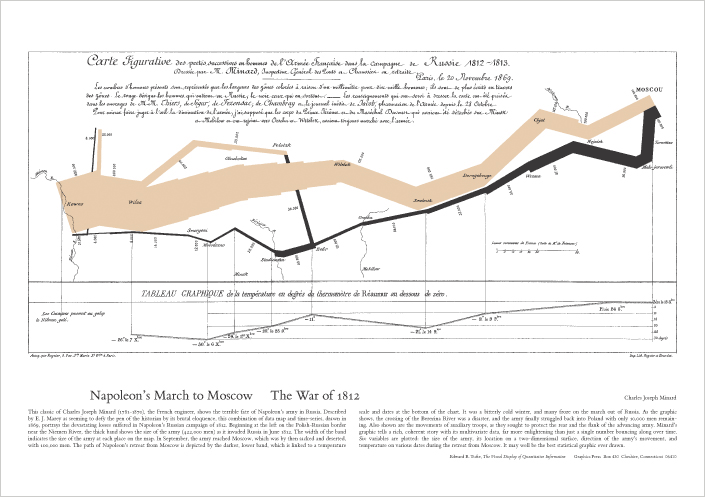
Successful self-published authors are not unknown, but they have usually been picked up by real publishers after their first or second book, or after their first mainstream reviews. One of the the most successful self-published author of recent times is Edward Tufte. He has also achieved standards of quality design and successful promotion that almost certainly would not have been his with any publisher. If you don't know Tufte you should probably buy one of his books. I suspect that most readers of this blog will be familiar with his work and the lessons that he draws from this remarkable diagram of Napoleon's Russian Winter.

You can buy Tufte's books from Amazon, they are cheaper than from his own web site, but I doubt if he needs to give them a 50% discount.


The Minard diagram also plots the size of the average print run over the last 150 years. Moscow represents the invention of photolithography 50 or so years ago, which meant that it was no longer necessary to cause books to be written in metal before reproducing them in reasonable numbers. ;-).

AnOther Man


We had some feedback today asking for more fashion magazines. So this fits the bill.

Quest Bulgaria


Our latest title

Thursday, August 23, 2007

A University Press Report

A few days ago, Charkin Blog mentioned a report on University Publishing in a Digital Age. Its an interesting report and Peter Brantley mentions it today. Brantley links to a location where the report can be read and commented upon in CommentPress "an open source theme for the WordPress blog engine that allows paragraph-by-paragraph commenting in the margins of a text". What an interesting idea, and congratulations to the Scholarly Publishing Office of the University of Michigan and the Institute for the Future of the Book for putting it to work. Simple but very effective and I hope that they get a lot of comments (is this the first?). The Ithaka report is exactly the kind of consultative/informative document for which the CommentPress solution is well suited.

The University of Michigan has been at the front of the charge with Google's Book Search. But its time the libraries began to steer the Google Book Search project. So its encouraging to see the American universities and their presses begining to seize the challenge of digital publishing.

Tuesday, August 21, 2007

Intelligent Life and Bright Paper

The Economist -- which may be the most valuable and interesting magazine on the planet -- is about to launch a new magazine called Intelligent Life.

I am such a fan of The Economist that I will be pleased to be proved wrong, but the announcement gives me a sinking feeling. There is surely some hubris in launching a magazine with this title. The web site gives nothing a way (that is not a good sign -- the web site for a magazine which is going to be launched in less than a month should give a lot away).

The current edition of the parent magazine has a fascinating piece on how a cellulose, paper-like, substance can store electricity as a capacitor and as a battery. If you need to know more, I refer you to Professor Ajayan's web page. He has done the research. Who knows, in a few years time we may be reading newspapers and books on a paperlike substance, like a large pocket handkerchief, which holds its own electricity and navigates us to any web page. By then the web will be a superset of all printed literature.

Since the alarms of last week, Skype has returned in a reliable form. In fact, it seems to be a lot clearer. No background muzziness. Have we been palmed off with a phony explanation. Were Skype surreptitiously improving their network software whilst appearing to heal a bug?...... I am also relieved to hear that its not Microsoft's fault. Though the first Skype explanation did sound a little bit as though it was.... ("those dunderheads in Redmond with their routine patches" did appear to be the subtext).

Friday, August 17, 2007

Skype and the challenges of 24/7

Yesterday Skype had a major software failure across its network. It seems to be persisting today. I had not realised how much I now use Skype, and quite how much I depend on it. I am not in the mood for complaining, even though I am a paying Skype user (Skype Out is a great aspect to the service). I just hope that they come back on line soon and that there is no deep flaw in the code. That would be a nightmare!

Any business that runs a 24/7 service will have sympathy for the engineers in Luxembourg.

Why do I use Skype so much? The first reason is that because its a VOIP system and completely web-based, every name and phone number on our wonderful CRM system is a click a way from a phone call. Since I have never been good at managing Address Books, this is a great boon. I can also note the phone call on the integral Wiki within the CRM. This home-brewed CRM -- fondly known as Crumb -- is even more integral to my daily work than Skype.

The second reason is that Skype is extremely easy for conference calls (and if you have Skype Out you can run the conference and bring in participants who will not realise that they are being Skyped). The third reason is that Skype links beautifully from the links on our digital magazines. Here is a page with lots of live phone numbers -- but please only try them if you really need to ring up!

Wednesday, August 15, 2007

idFX


This is our 50th title. Its another gorgeous magazine for designers. So here are some pages to whet our appetites:

Google Maps will be embedable

Its hard to avoid Google. They are doing so much, most of it very well. The latest innovation to catch our eye:

Google will be releasing a new feature next week that will enable people to easily embed a Google Map into their Web site or blog, just like you can do with a YouTube video. No coding or programming required; just copying and pasting a snippet of HTML, a Google spokeswoman says. (from Elinor Mills on CNET)
How immensely useful, Google maps can now become an even more essential, an even more networked, reference resource. As Elinor says this sounds like YouTube for maps. Will such widgetised maps now come with little counters telling us how many people have viewed this particular embedded map? One can be sure that Google will know this statistic:- perhaps they are introducing the feature so that they can better understand how maps are used.

Tuesday, August 14, 2007

Book Searching is not the same as Book Preserving

It has been fairly clear to the library community for a while now that the Google Book Search project is not going to deliver sufficient quality that 'preservation' is assured. There is now a rather detailed critique at First Monday, from Paul Duguid. His essay (noted via Peter Brantley) focuses on some editions of Sterne's bizarre novel, Tristram Shandy, included in GBS in several editions. His conclusion:

The Google Books Project is no doubt an important, in many ways invaluable, project. It is also, on the brief evidence given here, a highly problematic one. Relying on the power of its search tools, Google has ignored elemental metadata, such as volume numbers. The quality of its scanning (and so we may presume its searching) is at times completely inadequate [14]. The editions offered (by search or by sale) are, at best, regrettable. Curiously, this suggests to me that it may be Google’s technicians, and not librarians, who are the great romanticisers of the book. Google Books takes books as a storehouse of wisdom to be opened up with new tools. They fail to see what librarians know: books can be obtuse, obdurate, even obnoxious things. As a group, they don’t submit equally to a standard shelf, a standard scanner, or a standard ontology. Nor are their constraints overcome by scraping the text and developing search algorithms.
When I mentioned the article to a friend he said that it was possibly a little unfair. But I guess that is the issue that Google has to confront. If Google is going to assume the responsibility of scanning, and to speak plainly, the responsibility of establishing, these texts, it will attract the highest standards of scholarly nitpicking. Which is often and notoriously unfair. That after all is why Professors study the early editions of Tristram Shandy. They are professional and unrelenting pickers of nits. Companies such as ProQuest are used to collecting and aggregating materials with careful and scholarly procedures. They know that they will be pilloried if and when their scanning is unreliable or their selections are unwarranted.

I think that Dr Duguid has some good points, but there is perhaps more of a case to be made for Google than he allows. After all his paper is a very good example of how easy it is to cite and use the material that Google is assembling. He clips and shows the messy pages he has found. Scholars will like that (as those in Europe will dislike the fact that for strange copy-right related reasons the Google citations do not work. In the US that link will give you the first/?second page of the Harvard edition. Nothing visible in Europe.).

But I also wonder about Google's methodology. Why should they ignore the way that librarians and scholars have assessed this material in the past? Not recording volume numbers seems like a laughable error. On the day in which the New York Times reports Google's and Microsoft's urgent drives to capture and utilise health records, we may wonder whether the medical services which Google develops can possibly be so apparently haphazard as the Book Search record appears to be.

Monday, August 13, 2007

Site upgrades

Every couple of months we have a site upgrade. The software that runs our service, the databases and the individual user accounts, is enhanced with a new version. We do this so that additional features can be added to the service, and usually there are some small but subtle changes to our interface. Today, our Technical Director told me that there had been a site upgrade and that with luck no changes at all would be apparent. Why have a change which changes nothing?

While I was pondering this, he told me that the point of the new release was so that we could accommodate linguistic changes......So here is a clue:


About half the consumer magazines in the world are published in languages other than English. At some stage we need to be capable of delivering them.

Dont you love the newsagents that you see in big capital cities that are stuffed with magazines and newspapers in umpteen different languages?

Saturday, August 11, 2007

Google Videos Canned

Google aims to prune the number of services it offers, and has announced that it is closing the program that allowed you to rent or buy videos from its video store service. See Philipp Lenssen's posting and the comments at Google Blogoscoped.

This is a surprising decision. Sure there will have been good reasons for it -- maybe Holywood didnt like the model that Google was pushing, and so it was hard to fill the store. Or there may have been other good reasons for stopping a program which encouraged users to rent and buy from Google; but read this quote from the Google email:

As a valued Google user, we’re contacting you with some important information about the videos you’ve purchased or rented from Google Video. In an effort to improve all Google services, we will no longer offer the ability to buy or rent videos for download from Google Video, ending the DTO/DTR (download-to-own/rent) program. This change will be effective August 15, 2007.
................................................{snip -- note about compensation}.....................
After August 15, 2007, you will no longer be able to view your purchased or rented videos.
This is pretty bald. If I have understood it correctly the email is saying "you bought it, but with less than a week's notice it won't be yours anymore"? That seems like a pretty graceless way of serving customers/subscribers.

After this mess-up, Google will need to be very careful about the way it offers subscription services to media content in future.

If Google is thinking of pruning its services, maybe it should take a look at Google Catalogs. With its limitation to US-only Catalogs and its inability to tie in to the e-commerce systems of the Catalog companies, this has always seemed to me like one of the good Google Ideas that really dont cut it. And yes it really was a good idea.

Thursday, August 09, 2007

Amazon is innovating in all directions

Google rightly gets a pile of credit for its rapid innovatory pace. But people tend not to focus on how well Amazon is doing in the innovation stakes. Their impressive S3 has been around for a while and is very good value in providing deep infrastructure for developers. But lots is happening at Amazon. Three typical developments caught our attention in the last week.

  1. Amazon Flexible Payments System enters beta. From the description, this sounds like a very serious and useful piece of infrastructure for e-commerce. It led us to wonder whether major libraries are already using Amazon services. If they do, Amazon FPS would be a very important framework for new library services (eg IP address-based access to consumer magazines). Do libraries order books via Amazon? I feel I ought to know, but my awareness of the library supply market is very rusty.
  2. Amazon do a rather nice click through on front covers for the magazines they sell in the US market. We had never noticed this before and it may have been going for a while. This is a tiny feature but since it touches on magazines we were intrigued. Amazon will surely do more with magazines one day.
  3. PersonaNonData led us to review their Books On Demand service. It certainly looks like a very appropriate part of their range of services.

Wednesday, August 08, 2007

Magazine Week

Its good to see that Magazine Week, which we blogged earlier in the year, is coming to fruition. I like the 10 amazing facts about magazines.

Jeremy Leslie blogs that the YouTube video produced in support makes him weep. He is right. The idea of a YouTube video is good, but this promo is cringe-making, and way too self-regarding. Magazine Week needs an altruistic, engaging, or 'other regarding' aspect if it is to make a similar impact to World Book Day.

Institutional Sales

There is an old rule of software development which says that it is a very bad idea to talk in public about developments before you implement them. But this is August, and blogs are not press releases, so here goes.

We have had a growing chorus of requests for institutional access to some of our magazines. Mostly from universities, but not just from them, also from businesses.

We have decided that we will support institutional access via IP-addresses, but whether or not any specific publication will be available this way will depend on our publishers. If a publisher does not want to support institution-wide access it will not be available from us. We have also decided that our publishers will set the prices (all the prices in our service are set by the publishers). So we expect to support IP-based subscriptions to some of our magazines in Quarter 4.

Also, we will not be offering aggregated packages. It will be entirely up to the subscribing institutions, the libraries or universities, to decide which magazines they need.

Tuesday, August 07, 2007

Harry Potter is also a Rare Book

The first edition of the first issue is rare and valuable. We missed the midsummer frenzy, but several members of my family have already purchased and consumed the final installment.

One of my favourite magazines, Rare Book Review, in its latest issue, reminds me how valuable that first edition would now be if we had not allowed it to be read to destruction:

Friday, July 27, 2007

Mae West was a Bibliophile

"Is that a library in your pocket or are you just pleased to see me?" Lorcan Dempsey found the connection, reflecting on Peter Kaufman's startling prediction: by 2020 an iPod sized device will be able to contain all the media content ever created. Kaufman is just extrapolating the familiar Moore's law trends. iPod style computer disk memory is now 3.6 millionth of the price of 1982 costs. So its not hard to believe that such a small device could contain a million times more content in 15 years than it does now.

The talk which accompanied Kaufman's ppt is pretty interesting. He points out how the world of content (published, played, filmed) is becoming totally integrated. How everything is potentially 'advertisable against' and how information content needs to be and become more sustainable and computable (means at the very least findable, authorised, visible, discriminable). He also points to an important paper by Michael Jensen which can be read here.

Wednesday, July 25, 2007

eBooks and Libraries

There is a fascinating post from Adrian Hon and lots of good discussion on the revolution facing the book publishing industry (noted via Charkin blog). Adrian is amusingly rude, but spot-on, in his criticisms of the book publishers current web offerings:

Most of these sites are so awful that there’s plenty of room for easy improvement, providing that someone else smarter doesn’t step in and capture all the traffic first. Maybe that someone will be Amazon with Shelfari, or some unknown web 2.0 upstart. But at this rate, it most certainly won’t be traditional publishers. And whoever captures the traffic can capture the sales.
There really isnt an adequate business model for ebooks that any major book publisher has yet produced and the marketing efforts on behalf of printed books are feebly unimaginative. On the other hand many of the large STM (Scientific Technical and Medical) publishers have produced effective systems for selling access to technical literature (especially scientific periodicals). Its not as though publishers could not devise a digital strategy.....

There is much of interest in the comments on Hon's original posting. But, there is one deep running problem in this discussion of ebooks. The focus is all wrong in being a focus on BOOKs, as individual titles. This discussion should be on elibraries not on ebooks. Hon says:
Physical books are about to be superseded by more advanced technology that will allow for the mass and trivial pirating of every single book ever published.
Maybe, but then again maybe not so straightforward. What if ebooks are primarily distributed and accessed via a system such as Google Book Search? That is not so easily pirated. In such a system what matters is that books can be easily accessed, searched and cited; any pirated digital copies are of no real use without the database access system. Hon also makes the comparison with the iPod. But the success of the iPod system is mistaken by ebook enthusiasts. The key advance of the iPod was that it was a half-decent personal music library. Not that it was another MP3 Player.

In thinking about ebooks we need to think about elibraries first and foremost. Publishers need to think about how their content will be digitally accessed and how it can be sold, and profitably given away. Publishers distribution options have always been title-focussed in the past. They need to start thinking more broadly.

How are libraries of digital content to be accessed and services allocated? The hardware on which ebooks can be read or consulted is not so important.

Tuesday, July 24, 2007

The Clipper

Exact Editions now has a new tool -- a Clipper -- which allows readers to extract clippings from magazines on the Exact Editions platform and reproduce the exact clipping in a blog.

You can access the Clipper from the tool bar. There is a new icon which comes up in full green when you are on the Full Page view. This is the icon:


Clicking on that icon gives you a view of the page from which you can select the rectangle which you intend to Clip. For example, this clipping from the current issue of The Spectator:


Perhaps its no surprise that The Spectator is supporting Boris Johnson, but his video diaries will be a popular source of amusement.

As this clipping shows -- the Clipper will, by default produce a citation for each extract. Also, a subscriber who clicks on the clipping will jump straight to the full content, while a non-subscriber will be offered the change to buy a subscription.

There is a general presumption for 'fair dealing' in the use of copyright material. We have given the Clipper tool a default limit of 12% of a print page. Publishers who wish to encourage citations and clippings can request that the maximum is raised. Likewise, if any publisher wishes to prevent any form of clipping or explicit citation the tool can be withheld entirely from a publication. Since citation enhances the reputation of a magazine, we think that this option is not likely to appeal to many publishers.

Monday, July 23, 2007

Are newspapers in trouble?

Its good to lose touch occasionally; I have just had a week of holiday in Elba (a beautiful island and a great holiday). No contact with the web for a week, just a steady flow of emails to view on my Blackberry. So a very good holiday -- and as I tune back into the flow of blogs and trends and technology opinions there seems to be plenty of grounds for gloom about newspapers:


But if newspapers are really in such trouble why are Google (and Yahoo and Microsoft) so interested? Even interested in the old print technology....

Once newspapers have the confidence to produce and sell subscriptions to digital editions they will begin to see how their businesses (service businesses for sure) can still be highly profitable on the web.

Friday, July 13, 2007

New Consumer

The Guardian this week produced its list of top 100 media types (those who wield the most power in the UK media sectors). It strikes us as a crazy list (registration may be required). Barely a representative from book publishing (Marjorie Scardino of Pearson doesnt really count, her background is in newspapers). Eric Schmidt of Google comes in at (1) and Facebook stops the list at (100), with a great many here-today, gone-tomorrow, journalists, pundits and media personalities in between them. Its a nonsense list. If Facebook deserves to be there at all it should be in the top 10, and I wonder how many Googlers think that Schmidt is really more influential than Page and Brin?

Much more interesting is the list produced by New Consumer in the current issue. The magazine's Top 100 Ethical Heroes. You should get a subscription. Here are a couple that I was pleased to see:


And


Perhaps Jamie Oliver is more deserving of his place in this list, than Gordon Ramsay is of his position of 90th in the Guardian's.

Wednesday, July 11, 2007

Athletics Weekly


AW is the latest addition to our service. The magazine has been running for over 60 years and brings weekly results and reports to athletics fans in the UK and overseas. Noteworthy in the free trial issue:

This title was the speediest yet to join our service. We first heard from them less than a month ago, and after a few emails and some trial runs the magazine is now a fully fledged part of the service. I guess that you can count on Athletics Weekly to be fast out of the blocks.

Monday, July 09, 2007

Social Documents

It looks as though there is a new category of web application emerging: services which encourage the sharing, posting and processing of online documents. Techcrunch mentions two of the more prominent: Scribd and Docstoc..... the Techcrunch comments also mention Thinkfree.

Its not completely clear how these services may evolve and what new forms of writing and reading they may encourage, but this has to be a hot area when you look at the enormous success in the last couple of years of YouTube and Facebook, MySpace etc

Exact Editions is a technical service for publishers, and it may be my failure of imagination that cannot see it becoming a social end-user tool. On the other hand there is clearly an unmet need -- on Saturday I was hearing of such a need from a friend who has built up a database of literally hundreds of peace agreements (Sri Lanka, Sudan, Burundi etc -- unfortunately/fortunately its a hot and growing area in international law). She was explaining the difficulty of satisfactorily providing access to them through the web. HTML versions and PDF versions have obvious drawbacks. There is also the need to provide precise citations and comprehensive searches and for the database to grow gracefully. Exact Editions would be a good solution, but its hard to see the business model and our process is one which still requires a significant degree of human intervention and some investment on our side.

Hmmmm. Anybody got any suggestions? I know we could do it pro bono, but that is probably not scaleable.

Saturday, July 07, 2007

Flickr Typefoundry?

Eric Kastner's clever simple idea:

Exacteditions

E
x
A
C as in Monte Carlo
T
e
D
Regis_I
T
i
O
N
S


Hat tip to John Naughton.

Friday, July 06, 2007

If the iPhone is the best eBook Reader ever .....

And it is. What follows?

  1. The iPhone will be much more important as a new way of promoting and selling physical books, than it will be for selling digital books..... for the next few years. Few of us want to read digital books all the way through on our handheld, but the iPhone is a bookshop window with an infinite catalogue. In your pocket. This is very good news for Amazon and publishers who want to sell you print copies. Its good news for all small publishers who want to sell books direct through the mail. Publishers need much better websites with more digital samples on their pages. The digital book market will follow more slowly.
  2. The iPhone does not support Flash (and that is not an oversight and its a decision that will not be rescinded). YouTube is already on the iPhone because YouTube/Google have re-engineered the database so that YouTube doesnt need Flash. It uses H.264 which is what AppleTV will also build on. This is a big change for publishers who have used Flash for digital books. Harper Collins and Random House will be re-engineering their book display systems. Its again good news for Amazon Search Inside and Google Book Search who do not.
  3. One of the things wrong with the eBook reader concept is that it compartmentalised books. As though an eBook reader could manage with a Black on White only capability. There is no reason for this and the Apple engineers have produced a user interface through which all print products are equally accessible. Newspapers, magazines, journals, books, Bibles, concert programmes, user manuals and printed packaging. Sooner, well before later, we will be able to read and search anything through the web which has been printed. Even cereal packets, and especially seed packets, wine labels and user manuals. The iPhone is good news for printed ephemera.
  4. Apple will not own the books market, or the digital books market, the way it is hoping to 'own' or predominate in the music and Hollywood digital distribution channels through iTunes. Books, magazines and newsprint will be much more open, because all that is needed to sell them and make a market is the infrastructure to display and search them. All that the consumer needs is a web browser and access to an e-commerce system. Again Amazon and Google are in poll position. Google will soon be selling pay-per-view books.
  5. Because there is no library equivalent for books built into the iPhone, in the way that there is an iTunes for music, all those players who have a potential to fill this space will move aggressively to help fill the gap. Look for OCLC, the LibraryThing, Amazon, Bowker, Google to market and promote metadata through the iPhone eco-system. When you key an ISBN into an iPhone, what is going to happen? Apple need an answer to that question. Metadata is going to be very big on the iPhone.
  6. Because we will carry our iPhone everywhere and because we get used to searching book catalogues, bookshops and libraries from our peripatetic window-on-the-library, we will inevitably get used to doing a lot more snippeting and browsing. Comments, snippets, citations, gobbets and controversies will grow. Deep reading will diminish. Deep listening is also a declining skill.
  7. Digital books, newspapers, magazines will gradually grow to become ambient, transient and omnipresent. Not sure that anyone has yet subscribed to one of our magazines from an iPhone (but I wouldn't know if they had, and I was surprised to find that a subscriber to the Baptist Times was reading it on his Palm). Digital subs through the iPhone are on their way.
The iPhone's initial reception tells us that it will be a huge success. The best review I have seen is at Engadget. There are some interesting comments by Marc Hedlund at O'Reilly.

Thursday, July 05, 2007

An analysis of the news weeklies

Magforum has a useful round up of some of the new entrants in the weekly news segment. Tony Quinn reckons that the Economist will fight off the various new challengers to its crown, as the.... pre-eminent London/International business, current affairs weekly, newspaper/magazine. In fact, it is not easy to define exactly what the Economist's slot is, but it does whatever it quintessentially does very well. One million+ copies a week sold. Most of them on subscription.

But the Economist is not (yet) as big as the biggest US titles (Time, Newsweek, and it may be level pegging with Business Week though it seems to be growing faster and may well be more profitable then any of them); and, especially in the US market, The Week has made spectacular advances in the last four years. One can see why magazine founders/strategists at the BBC, News International and the Guardian may be eyeing the US market carefully in the view of The Week's powerful performance.

Two things struck me from the Magforum analysis:

  1. One should not forget that other languages have spectacularly successful titles in this slot. Stern gets a circulation of 1 million every week.
  2. None of the new launch challengers to the throne of the Economist (five current/imminent launches are mentioned) has, so far, come out at launch with an effective digital edition strategy. Why on earth not? Having a good web site is not good enough, though very necessary, when digital editions can be given to all new subscribers, and can be used for low-cost promotion to all potential new subscribers? Given the costs and distribution obstacles to launching a primarily print product, this oversight is unforgivable. This is a slot (whatever it quintessentially is) in which the digital edition has a strong role to play. Time-challenged, technologically savvy, international and mobile, these readers are digital consumers. And the fact/opinion that the Economist does not do an adequate job with its own repurposed HTML version is no excuse!
Noted from MagCulture

Wednesday, July 04, 2007

Hard Problems and Fuzzy Solutions

Google Book Search ('search the full text of books and discover new ones') now supports 'text versions' of some of the out-of-copyright books that are in the Google Book Search database. Google Blogoscoped has a report. This is interesting, Google are OCR'ing books which have been scanned and figuring out how to reconstitute a reasonable ASCII version of the underlying text. Its also interesting that it is not possible to get a consistently good result -- mind you Blogoscoped picks a hard example, a Shakespeare text with 'f's' for 's'es'. But computing the underlying text of a book if you don't already have it is a really hard problem.

So what? Well it suggests that pirating books in Google Book Search is, and is likely to remain, a very tough proposition. Easy to make dumb copies, easy enough if you can invest the effort in re-keying, but to make accurate, usable, automated copies with the text in the file, from an image file. Don't even try. Google, with all their software geniuses can't do it, so there is little chance of a pirate in Macao being able to get a quality solution. Exact Editions has a very similar production and content management system to the Google Book Search service. So it looks as though its going to remain very difficult to produce useful pirate issues of Exact Editions magazines unless the pirate gets access to the publisher's copies of the PDF files. PDF files contain a lot more useful information than the dumb JPEGs that Google Book Search and Exact Editions ship out to web browsers. Publishers who care about their digital rights should be very careful with the security of their PDFs.

Fuzzy solutions? That is easy, even a poor machine-readable text version is pretty good for automated searching witness the way Google, Yahoo or MSFT Live already search out of copyright books. The fuzzy solution has been working for a while.

Saturday, June 30, 2007

Bye Bye the eBook reader?

Personanondata finds an in interesting YouTube 'concept' for an Apple eBook reader.

The movie shows an iPod which fits into a folding tablet device which opens out to give two reading pages. Cute. I slot my iPod into a Bose speaker system, why shouldnt I slot my iPod into an eBook tablet?

But this vision of the book-specific hardware is all wrong. Yesterday Apple launched its eBook reader the iPhone. The hardware-specific eBook reader was and is a mirage. The eBook reader that matters is the humble familiar web browser (Internet Explorer, Firefox, Safari, Opera -- you take your pick). Steve Jobs says that the iPhone is the best iPod ever. Its also the best eBook reader ever. The best phone, the best music player and the best eBook reader ever. All in one package, which does the phone and email as well. The iPhone will read Exact Editions digital magazines, but we still need photographic proof of that.

Google Book Search wasnt the first, but its method shows that digital editions will be page based (five years ago that was NOT obvious). All print pages will be web pages. Are becoming web pages. Once that equivalence is accepted its all down to the software which has to work within a web browser (preferably not Flash -- which the iPhone does not support) and to the databases which run libraries and subscription services. Pages matter. Libraries matter. Databases matter most of all. eBooks dont... They really dont, they are just collections of web pages.

Sunday, June 24, 2007

Permaculture


47th title in the shop. All the readers of this magazine care about the environmental impact of publishing and the ways in which digital editions can reduce that impact.

Print lives on the web (1)

There is a view that the web is such a potent and direly competitive medium that newspapers, magazines, books will not be able to meet the challenge. As though these wonderful cultural artefacts will be replaced by something else....... whatever that may be.

We think this gloom is misplaced. Print thrives on the web, and so far from being dead it gets a second life when relaunched as a digital edition and a searchable resource.

And its all too easy to underestimate the amazing cultural and social attachment we have to these systems of communication.

As an instance of the unreasonable love of newspapers and newspaper culture, consider Scott Walker, assistant managing editor of the The Birmingham News, Birmingham Alabama, who has re-engineered a coin-operated newspaper box so that it now sits in his living room and displays on an LCD the current front pages of his favourite newspapers.


We think its time that some devotee of magazines, took a leaf from Scott Walker's book and made the real coffee-table magazine. Manolis Kelaidis is already building the book with circuitry which hyperlinks.

Hat tip to Martin Stabe.

Friday, June 22, 2007

Environmental magazines

The Press Gazette today has a special section on the environmental agenda in the newspaper and magazine industry. It includes an important article from Peter Phippen, managing director of BBC magazines. As he says, we need 'a combination of rapid technical innovation and significant behavioural change'.

Press Gazette, 22.06.07, p 18. For digital subscribers link here.

Then Phippen covers key aspects of the distribution and recycling chain: the BBC is now using paper only from sustainable sources, paying careful attention to the way waste is generated, particular focus on polylopes and cover mounts. Its all praiseworthy and 'steps in the right direction'. But Phippen does not mention digital magazines or a digital strategy. What a missed opportunity! Get the digital magazine strategy right, and the BBC will not only save money, it will improve revenues and profits. Of course it will dramatically reduce its carbon footprint at the same time.

"Rapid technical innovation and significant behavioural change", yes that is something for the magazine industry to embrace at its core. Get the digital strategy in place. This is much more important than 'cutting down on cover mounts', though that is also a priority.

Wednesday, June 20, 2007

Rock Sound


So we now have 46 titles in the Exact Editions shop.

Tuesday, June 19, 2007

Dennis Publishing

Timing is everything in magazine publishing. In business.

The Guardian tells us that Dennis have sold some of their big US magazines for £121 million (think that is only a rumoured price). A year ago EMAP simply closed the US edition of its FHM which competes with Dennis's Maxim, included in the sale. But Dennis will hold on to The Week, which has been extremely successful in the US. Growing rapidly in the last three years.

EMAP are reportedly being circled by Private Equity. Perhaps the winning PE house should simply put Felix Dennis in charge.

Monday, June 18, 2007

Open Archives (5): Mousetraps and Cafes

The business of selling subscriptions has changed. Fifty years ago, the 'mousetrap' model of subscription-selling ruled. There are two parts to this commercial strategy: first you must have a fantastic product, a piece of cheese which smells terrific and which appeals to all the mice; second you need to have a well designed and secure cage -- and for consumer magazines, quarterly direct debit payments and a continuous flow of new issues, fitted the bill. Once the first piece of cheese had been tasted and the direct debits were in place, the mice tended to stay in the cage and renew their subs. Everyone was happy.

In fact, publishers, fifty years ago, had another factor working in their favour -- the mice were mostly hungry. The system worked even better if they were starving (there were no satirical magazines when Private Eye was launched, and Rolling Stone showed that rock could be intellectual, so these magazines grew like topsy).

Things have changed. The marginal cost of supplying information through the web is close to zero. It is effectively zero. When printing on paper, the marginal cost of supplying an additional copy is always significant. The web is now a medium through which vasts amounts of information are available to anyone with a broadband connection. Too much. The smell of cheese no longer has an attraction. With this abundance comes a wandering audience which knows that it can have everything, or at least anything that is particularly relevant.

On the web users are always one click away from something else, and the idea of a content cage or content silo makes little sense. Increasingly we are moving to a 'cafe' society, where abundance prevails and users expect to help themselves in a convivial atmosphere. The publisher is no longer a gatekeeper (severe frown, rejection looms), but an orchestrator and a host or service provider (friendly smile, no need for bouncers here). In H A Simon's words "Hence a wealth of information creates a poverty of attention".

Acquiring a subscription is still an attractive proposition, but it has to be presented more as club membership, as bestowing privelege in the core audience, with a premium service. If some are excluded, that may be an unfortunate commercial necessity. But in an information-rich culture our consumers value their priveleged information more if there is the prospect of sharing this (albeit after a lag) with the broader community, and they wish to be seduced with attention and selection rather than swamped with everything. Information subscription services need to be self-selective, individually definable, in an age of abundance.

The moving wall of a potentially Open Archive helps develop this 'cafe' society: of provisional exclusivity and selective membership.

There is still a role for subscription, but its use is primarily to enable the consumer to select the sources which he/she particularly wishes to receive and to enjoy them in the best possible ways. Excluding others from the information is not a primary objective (except in highly competitive situations).

There is a balance to be struck here and how the balance is struck will vary from one magazine to another. So the wall can be a moving wall -- in two senses, (1) month by month, issue by issue, more is included (2) if the publisher decides to stretch or reduce the gap between publication and Open Access, then this can be done.

O'Reilly is now selling Chapters

Interesting post from Tim O'Reilly. I have not counted how many different ways they can now sell or package rights in their books. But there must be at least a dozen e-commerce options, apart from the obvious one of buying the book as a physical object.

Every chapter costs $3.99, which buys you a PDF. If you were thinking of getting started with Ruby on Rails.....

Friday, June 15, 2007

Open Archives (4): Citeability and Moving Walls

There is a strong case for Open Access to scientific research and scholarship published in article form. This was crystalised in the Budapest Open Access Initiative in 2001. Scientific and scholarly research publications benefit from being openly accessible, because the value of the underlying research is enhanced when it is made freely, easily, accessible to other researchers. If scientific research is to be effective it needs to be cited and referenced; it is clear that open web-based publication makes it easier for researchers to cite the work of others in the field. Open web-based access is the way that research in an internet age can be most efficient.

The Budapest programme specifically limited its recommendations to:

The literature that should be freely accessible online is that which scholars give to the world without expectation of payment. [my emphasis].
This is an important limitation. For sure, commercial consumer publications are not obliged to follow the STM (Scientific, Technical and Medical) and other scholarly periodicals in providing free and Open Access to their magazines. After all most consumer magazines pay their contributors, often very handsomely. Yet it may well be in the interests of a successful consumer magazine to make a substantial portion of its archive freely accessible as a web resource. Why should this be?

One reason -- is that Open Access to an archive enhances the authority and renown of a magazine. Consumer magazines are often quite specialist, quite limited, in their appeal. But this tight focus is part of their strength and gives them potentially authoritative status. The reputation of a magazine or a periodical is immediately enhanced if its articles can be effectively cited, referenced, commented upon, by others. The prevalence and searchability of the web has enormously increased the extent to which magazines can build a reputation through links and citations. Citeability/referenceability/linkability is the strongest reason for making some portions of a consumer magazine archive available as a digital resource.

This way bloggers, enthusiasts, journalists, emailers, advertisers, and reviewers will pile in to amplify the reputation of the publication. An obvious way of gaining the advantages of a citeable archive, whilst not giving away the baby with the bath water, is for the publisher to make the archive freely available through the web, outside of a 'moving wall, so that issue become available after a period of some months (6 months, 12 months -- whatever is judged necessary to maintain the perceived value of the personal subscription). The concept of a Moving Wall in this sense comes from JSTOR -- an archival system for scholarly periodicals. Interestingly, JSTOR was originally set up simply as a way of archiving and aggregating inaccessible periodical archives, but they are now trying to reach through to an Open Access model (or a more Open model).

So making portions of a consumer magazine archive Openly Accessible makes sense if this significantly enhances the reputation and the authoritative quality of the publication, and if it does so without damaging the commercial prospects of the magazine. We think that in most cases it will clearly do so, but it is a matter for publishers to decide and our system enables publishers to control the extent to which the archive is open.

Because Exact Editions is a middle-man we have an interesting perspective on the dilemma of Open-ness. We do not publish magazines and our subscribers are always subscribing to a magazine where the publisher has control of the product, the subscription price, frequency, extent, design, copyright etc. Exact Editions is a distribution partner whose reward is a small commission on the digital subscriptions sold. So we are keenly interested in having more subscribers.

Furthermore, the way our deal works with the publishers we absorb the distribution and maintenance costs of the digital edition. So it costs Exact Editions, not the publisher, a bit more to maintain an Open Archive. We think these costs are easily containable within the parameters of the small commission we obtain from selling additional digital subscriptions, so we encourage our publishing partners to offer Open Archives with a moving wall. The marginal costs of maintaining Open Access are marginal. So you dont need to feel sorry for us!

On the other hand, if you enjoy the open archives and never buy a subscription you can thank us as well as the publisher for making this service available. We like subscriptions best, but we also like appreciative feedback or fan mail ;-)

Open Archives (3): Browsing Sells

We have compelling evidence from usage statistics: usage of a magazine's trial issues drives subscriptions. It certainly does. Interestingly, the different magazines have different conversion rates: for some magazines the conversion rate may be as low as 1 new subscriber gained for every 50 sample pages viewed in the shop, and for others the average can be 100s of pages freely viewed for each new sub. The highly pictorial magazines are highly sampled. I think this is a very positive take-home from our experience of digital magazines. A lot of users enjoy looking at the well-designed and glossy magazines in our system!

Some of the more specialist titles seem to pull viewers through to a subscription more rapidly than the general interest titles. Another interesting fact, the magazines are used from from front cover to back. All the sample magazines seem to be sampled/tasted throughout (there is a usage weighting towards the front of the magazine, the front cover -- this is one of our busiest last month, the contents pages -- this is our busiest last year -- and the opening articles -- lots of tasters have read this article on 9/11). This usage weighting towards the Front and the Table of Contents is a consistent pattern for magazine samples on Open Access and also for the usage of the titles by subscribers.

So what does this tell us? One lesson that we have taken from our monthly stats is that a significant increase in trial usage will boost subscriptions. It is actually a very obvious point, if a publisher promotes the archive of the magazine, and the quality of its back issues is more widely appreciated, more subscriptions will be sold.

Magazines are much like books in this respect. Just as Amazon's Search Inside works -- "Browsing pages sells more books", so also with magazines. Browsing sells more subscriptions. If only dentists waiting rooms were points of sale, we would be leaving his surgery with a couple of subscriptions as well as our dental floss. Of course, on the web they can become that.

This is one good reason for making a substantial section of a magazine's archive available as a free resource which prospective subscribers can search and browse. Usage of the archive will tend to drive subscriptions. But it is the publisher's choice to decide how much to offer for free access and our system now enables publishers who use our system to make this choice.

The Catholic Herald


The Catholic Herald, the leading Catholic weekly newspaper, joins Exact Editions today as the 45th title in our shop. It is a full broadsheet and has an archive approaching 250 issues. For the first six weeks the publisher is offering free access to the whole archive, for all-comers. So there are plenty of things on which you can do research. We usually pick out a few nuggets, so here are some items that caught my attention in a brief browse.

  • A scrumptious recipe for slow-baked lamb. I once ate a meal cooked by Timothy Gardner and it was very good.
  • With its extensive archive, this paper required a way in which searches could be ordered by first or last.
  • Also a way in which the user can jump to the issues of a specific year eg 2003 or 2005.
  • For a moment of reflection read about Oscar Romero.

Open Archives (2): The First Two

The Catholic Herald joins Exact Editions today with a substantial archive running back to 2003. For six weeks the whole archive will be freely accessible (including the current issue). It is a substantial archive of over 200 issues. Try some searches: here are 43 occurrences of the phrase: "Oscar Romero".


The Ecologist is also throwing open its Exact Editions archive of back issues, behind a six months moving wall -- this means that the archive is steadily enlarged as more issues are published. You should subscribe to the magazine to have access to the current issue, forthcoming issues as they appear, and the 6 issues contained by the moving wall. The open archive offers 23 pages with a mention of "Kyoto". Versus 33 occurrences for those with a subscription. I expect that the search term will continue to be used for many years.

More of our magazines are putting their archives open, to varying degrees, in the next few weeks.

Wednesday, June 13, 2007

Open Archives (1): How Open?

Exact Editions has recently improved its content management system, so that a publisher can determine HOW MUCH of the magazine archive should be exposed for open access to the general public, the general web user.

Our system is set up so that a publisher can offer five levels of access to an archival resource:

  1. An archive can be completely closed except to subscribers. This might be an appropriate solution for certain types of B2B publication (eg membership only magazines). None of the consumer magazines in our shop is completely closed.
  2. All the magazines currently in our shop have at least one, open, free trial issue. We will maintain this option for the publishers who want it.
  3. A publisher may opt to make all except the last year of the publication 'Open Access'. We call this option a 12 month moving wall.
  4. A publisher may opt to make all except the last six months of the publication 'Open Access'. We call this option a 6 month moving wall. We will also support more current, more proximate, moving walls: three months, two months, one month, should this be needed.....
  5. Finally, a publisher might opt to offer the magazine as a completely free 'Open Access' resource. Currently we are delivering The Publican for CMPi on this basis.

There are good reasons why some magazines should be completely Open Access -- many scientific periodicals have moved to this model of distribution. They now have to pay their costs by levying a charge from the contributors or sponsors of the research reported. Also, Open Access makes complete sense for magazines which are essentially free in print; but we think it is unlikely that a consumer magazine which is completely Open Access will sell many personal subscriptions.

So complete and immediate Open Access is not recommended for a consumer magazine which aims to sell personal subscriptions. But it, of course, does not follow that a consumer magazine which aims to sell digital and print subscriptions should be completely Closed. Far from it. But there is an interesting question as to "How Open should a consumer magazine be?" when it wishes to sell the most possible subscriptions? We will look at this issue in the next few days.

Tuesday, June 12, 2007

The iPhone, with bated breath


Like most nerdy types we have been waiting for the launch of the iPhone for months. From its earliest demo , Steve Jobs was showing it with a newspaper web site and stressing the advantages of being able to read the paper on your phone......


Today we hear that the iPhone will come with Safari. Unlike most digital magazine platforms, Exact Editions only requires a standard browser on the client-side. Our pages are simple web pages, no proprietary file format, no Flash is needed.

So, it is looking secure that Exact Editions will run very sweetly on an iPhone. Furthermore we have live -phone numbers in many magazine web pages (International format phone numbers are callable with a click-through). The first user who confirms that you can click-call a number from a digital magazine on an iPhone, gets a free subscription to any of our magazines that they choose (send in a photo of yourself holding the iPhone with sample page, to claim your prize).

Here is a page with some live phone numbers. Please do not ring the New Internationalist's international offices, unless you need to do so!

Monday, June 11, 2007

Postal Woes

What is worse, a postal strike which appears to be looming in the UK? Or lousy postal rates which threatens to cripple magazines with a smaller circulation in the USA? On this read an excellent essay from editors of the Nation and the National Review, on the Bosacks blog.

Answers on a post card please (sorry, pathetic joke).

A digital edition does not solve either problem, but it can lessen the pain.