Wednesday, October 28, 2009

Will the App Store make a Good Book Store?

There are a few reasons for thinking that the iPhone's App Store may become the next and best digital book store. These are a few of the reasons that occur to me:

  • iTunes is already the most important digital music store and the AppStore is inheriting a lot of the momentum and the kharma of the iTunes e-commerce system
  • the iPhone App Store is already a pretty good App Store and seems to be building Apple a possibly dominant position in the race for mobile Apps. Robert Scoble has some perceptive observations on this.
  • Apple is rumoured to be building and close to launching a tablet computer, which will share the iPhones touch interface and the e-commerce system that supports the iPhone and the iTouch. The possibly mythical Apple tablet was last seen bounding through the Australian outback looking for media content, but when when this wallabook/kangoozine finally lands it will be a gorgeous display for newspapers and books. So Apple in producing a tablet is trying to make their hardware the best for books (and newspapers, films and albums!).
  • Users like reading stuff off their iPhones and when there is a tablet the chances are that they will like that even more.
  • The Apple system despite its creaky approval process, and the very weird rules that Apple imposes on its developers, is in some respects (and surprisingly) more open than the Amazon or the Google systems. Amazon for its Kindle and Google (for Google Books, or Google Editions) require that the books they distribute or will sell reside on their servers and in their 'format'. Amazon and Google already know what digital books are. Apple is not so sure. The architectural potential with Apple is more open: any publisher or author or inventor can throw an App with some new software and display potential at the Apple system (paying their small fee) and see if it catches on (Vooks or Enhanced Editions can be experimented with in the Apple media space). Google Editions and Amazon's Kindle have no such open-ness, no inventor-driven potential, and the same goes for Sony and Barnes and Noble.
On the other hand, we can find some reasons for not too readily buying into the Apple-flavoured vision of the App Store as bookstore (or even Vookstore or Nookstore).
  • I think it was Tim O'Reilly who said that the book as App does not scale well. Which I took to mean that whilst we can envisage having one or two or several Books as Apps on our phone, it is not likely that we can manage libraries this way. That may be correct, but individuals, unlike institutions, merely accumulate libraries. We buy books one at a time and if we buy enough of them within our iPhone ways will be found for managing those collections. I have been impressed by the way in which Apps can be found within the App Store. Even though it seems to be lamentably lacking in shopper-oriented convenience and friendliness. Users have been finding and buying the Exact Editions Apps for the Spectator and Opera magazine, though there has been very little explicit advertising or promotion for them (yet). The offerings within the App store are being found. Traffic is being generated. With a bit of merchandising skill from Apple, it is conceivable that millions of individual book Apps could be found and purchased within the App store by the tens of millions of users who have iTunes accounts. Scaling may not be such a big problem.
  • Perhaps a more serious issue with the one book per App model for the Apple Bookstore is that books need to be open and to work with each other in ways which Apps do not. Apps are self-contained applications and do not provide much scope for interoperation and interaction in the ways that digital books really need to do. But is this merely a short-term problem? Apple are developing their mobile developer environment and interoperating Apps are bound to come.
The Appstore/Bookstore could work out rather well. Especially if Apple resists the temptation to over-control the environment. If Steve Jobs really is sitting on the final specification of the iTabloid as he scans the latest field reports from Wooloongabba, Woomera, Bullaroo, Geelong and Gulgong, my advice is that he should ditch the pink, opt for matt black, OK the slightly larger form factor, the bigger memory, better battery (please! a better battery) and sign off. It will not be in my Christmas stocking but I am ready to stand in line in January, or February, or whenever....

Tuesday, October 20, 2009

Bookserver and the Right Architecture for Books

The pace of change in the books space is hotting up. Two weeks ago Amazon announced that its Kindle will be internationally available. Google last week at Frankfurt announced its Google Editions proposition (or perhaps we should say they re-announced it). In three weeks Google has an appointment with Judge Chin on November 9, to re-present its much discussed Google Books Search Settlement. Techcrunch had a piece on 24 Android phones (some of which are admittedly merely rumoured, but most of which will be touted for reading books). Yesterday Barnes and Noble presented their new Nook, eReader. And the day before yesterday the Internet Archive (with several collaborators) announced its BookServer project.

The BookServer proposition seems to be very much a work in progress. Thinking on the hoof and probably a fair bit of smoke and mirrors (see Peter Brantley's Web of Books presentation and Roy Tennant's blog) . But one aspect of it feels a great deal more right than the Google Books Search proposition in its various forms. The architecture is essentially and deliberately open and multipolar:

As the audience for digital books grows, we can evolve from an environment of single devices connected to single sources into a distributed system where readers can find books from sources across the Web to read on whatever device they have. Publishers are creating digital versions of their popular books, and the library community is creating digital archives of their printed collections. BookServer is an open system to find, buy, or borrow these books, just like we use an open system to find Web sites. (Internet Archive's BookServer page)
This is a good central position around which the Internet Archive can build its coalition. But it would seem that they may end up with some unlikely allies. They are following the path of, and working with, Lexcycle's Stanza (now Amazon owned) in their strategy of orchestrating, coalescing access to formatted ePUB files, and one wonders whether the BookServer backers will fill their obvious lack of full text search through an alliance with Microsoft's Bing. There are indeed some interesting challenges for Microsoft and Amazon as they contemplate whether to address Google's potentially massive lead in proprietary book aggregation by making a more Open alliance with the Internet Archive and other champions of free and open. If the Internet Archive can maintain its footing in a genuinely open and independent position (which includes encouraging Google to spider and search, as well as Bing), it has a good chance of establishing the crucial principles that it articulates. It has a good chance of being more open to innovation than Google.

Friday, October 16, 2009

Google is Going for It

It looks as though Google has decided that it is going to get the Google Books Settlement that it wants (and I suspect that a large part of the American public want it too). Google is just going to push it through as close as it can to the original proposition. There were, after all, two ways of interpreting the decisive and late intervention from the DoJ. According to Michael Cairns it gives a blueprint for how the original Settlement could be renegotiated to pass muster. According to Pamela Samuelson, Google Book Settlement 1.0 is History, it would be astonishing if the Settlement in its current form were to be approved: a new balance and a new settlement is needed which takes account of the deep issues identified in the DoJ brief.

Normally, I would back Professor Samuelson, one of America's most distinguished IT lawyers, against a self-confessed 'know-it-all' mere publishing consultant. But on this occasion I suspect that Cairns has called it right (he may know more about how publishers go about arm wrestling with regulators). The Settlement will be nudged to accommodate the 'objections' raised by the DoJ but it will be broadly as agreed. Here are three tell-tale signs:

  1. The timescale for resolution is short. The revised Settlement will be presented to the Judge in on November 9 and he has said that he wants matters to be concluded speedily (within a few months). So Google cannot be planning major changes. No extensive process of consultation and commentary is in view.
  2. There was the rather extraordinary New York Times opinion column, A Library to Last Forever, in which Sergey Brin explained the great advantages of the Googe Book Search project, exactly as though it were to be executed as envisaged in the Settlement. He breezily acknowledges that there have been concerns about 'competition' and 'copyright' but effectively dismisses these concerns as misunderstandings (I bet the DoJ lawyers were surprised to see their analysis so airily brushed aside).
  3. Google has this week announced its Google Editions project, which is intended to make its books database resource, title by title, available to all readers everywhere in every format of ebook reader. So Google at one step is embracing and enlisting all the ebook platforms which might otherwise be a form of competitive counterbalance to the Google Books Library. I wonder what the DoJ competition experts think of the decisive way in which Google has also pre-announced, long before it is operative, how the discount system is going to work between Google, the publishers and the various retailers envisaged as operating Google Editions? And with Google selling direct as well? And with Google running the search engine for all parties? Is there no potential for anti-trust concerns in all of this?
Google Editions has nothing directly to do with the Google Books Settlement. Google has taken off its left shoe and is banging the table: "Forget about orphan books, the books of rights owners are also on our servers with their full agreement and hey we are going to be selling them as well soon, moreover in distribution channels not mentioned at all in the Settlement. Wake up please!" Google could have announced the plan last year; or next year (it is in any case not going to be ready until the first half of next year); or the year after. Google Editions, so far, only appears to be a distribution channel for books sourced from publishers or books in the public domain. As such it is quite independent of the Settlement. Yep Google Editions is orthogonal from Google Editions. Nothing to do with that controversy. But one wonders why Google should announce it now, drawing attention to the fact that Google may, one way and another, become the primary source for books in all digital and electronic formats? Three weeks before they present the revised deal to the judge (presumably with comments from DoJ).

My guess is that Google is pretty confident that the DoJ really do not want to veto the deal (do you want to stop a deal that enables ten million titles to reach the 30 million Americans who are 'print-impaired'?). The judge probably will not want to veto the deal. Not when push comes to shove. So Google had better hang in for the deal to be the way it wants. After all, Google has digitised the 10 million titles. Google has, we presume, clear vision of the way this is going to work. When the deal is agreed, Google not the Federal Government has to deliver the service. Note who is doing the heavy lifting. Note who is paying the lawyers.

Google has a great database system (oxymoron alert), Google has the ability to deliver a fabulous service, Google has been at the forefront and it has sustained its initiative, and if turns out that it has a de facto, and to a degree, a de jure monopoly, once the dust settles that will be challenged. A monopoly of books will be defeated (ultimately by competition as much as by the courts). Google's confidence is justified and is the other face of its boldness in setting the whole scheme going, and if it misapplies its momentum (which it probably will), it will come unstuck.

There is plenty of scope for Google critics: Angela Merkel, Pamela Samuelson, Peter Brantley and Bob Darnton. And we need them. But Google is getting done something which will bear a lot of fruit. So this settlement is going to go through and stopping Google Books Search dead in its tracks is not going to happen. Sure it will be appealed..... all the way (paid for by those of Google's competitors that want to slow the juggernaut down). But more to the point the Google Books Search settlement is not the last innovative step in this march. Time to move forward. Time to compete with Google through innovation, not through writs.

Wednesday, October 14, 2009

Opera Magazine App now in iTunes App Store

Opera magazine now has its own branded App in iTunes.

The Opera iPhone Application offers access to the latest monthly issue as well as to an archive of back issues stretching back to August 2006. The week-long subscription costs £1.19, or $1.99, or €1.59. Renewing for a month costs £3.99, which compares to a news stand price of £4.99.


I am now hoping that the Opera App will now be reviewed 'operatically' if not 'ecstatically'

Exactly Reviewed Ecstatically?

AppShouter has one of those reviews that tells you the reviewer really enjoyed him/herself.

As a journalism major, I was thrilled, perhaps ecstatic is a better word, for how I felt when I came across this app. Exactly is literally like having a newsstand in the palm of your hand. It is amazing. I can’t put it down!
.....................

The interface is also easy to navigate as it looks a lot like the jukebox feature of iTunes. Stroke left or right to turn pages, double tap the screen to zoom…I could go on, but I am sure you get the picture. Exactly is easy! I’ll also say, that as a journalist, in an industry that is continually pooling resources and charging more and more for content, Exactly is definitely a friend to my pocketbook. I cannot thank it enough.


Thank you Yantezia P for having some fun with the Exactly App.

Saturday, October 10, 2009

Healthy Media

Joe Wikert's Publishing 2020 blog is often thought-provoking, mostly about ebooks. He has been a great fan of the Kindle, but today he fires a salvo in the direction of the existing generation of ebook readers with the Kindle bang in the centre of target:

The problem with these devices is that they encourage quick print-to-e content conversion and nothing more. In fact, they even discourage some of the simplest ways of enhancing print-to-e conversions. Embedded links are a great example. If you're a Kindle owner how often do you click on those links? More specifically, how often do you groan as you click on those links, knowing that the browsing experience ahead is painful at best? The irony is that although the Kindle was the first to include wireless functionality, that feature is really only good for one thing: buying content from Amazon. Every other time I've used the "experimental" browser I've been disappointed. That's because, at its heart, the Kindle is a reader and it doesn't encourage any other use. How the Kindle Prevents eContent from Evolving
Well put. It is lame to have live links in a digital text if the system does not support good browsing. Part of the trouble with much of the current design and thought about ebooks, is that too often publishers and technologists assume that the only thing that matters with a book is the reading of it (perhaps abetted by the 'buying' of it). The Kindle has been designed and the Amazon digital e-commerce system has been built as though the only thing that really matters with books is the reading of them. One after the other. Books are much more multi-functional than the buying/reading/moving on, modulus would suggest. And digital books need to be more than digital representations of the printed object (though they need to be that at least).

Where does this take us? Arguably books, magazines and newspapers in their digital form need to be at least as good as print books. At least as useful as print books. But also much more open and much more inter-related. They need to be on the web and of the web, because that is where we increasingly do our reading. And we don't only read books and newspapers. Our digital reading experience is inevitably becoming more various, more public, more connected and more horizontal (embracing other media types as well as all forms of print media). Taking digital books as seriously as they need to be taken, is a matter of enabling them to be open to all forms of cognitive action (reading, referring, learning, analysing, interpreting, sharing, comparing, etc) but also making them inherently more open (to search, to citation, to annotation, to quotation...). My thoughts were brought in this direction by a fascinating blog by the Philosopher of Information Luciano Floridi. Floridi writes about the ways in which ICT (digital technologies) are revolutionising health care and medicine:
Behind the success of ICT-based medicine and well-being lie two phenomena and two trends.

The first phenomenon may be labelled “the transparent body”. By measuring, monitoring and managing our bodies ever more deeply, accurately and non-invasively, ICT have made us more easily explorable, have increased the scope of possible interactions from without and from within our bodies (e.g. nanotechnology), and made the boundaries between body and environment increasingly porous (e.g. fMRI). We were black boxes, we are quickly becoming white boxes through which anyone can see.

The second phenomenon is that of “the shared body”. “My” body can now be easily seen as a “type” of body, thus easing the shift from “my health conditions” to “health conditions I share with others”. And it is more and more natural to consider oneself not only the source of information (what I tell the doctor) or the owner of information about oneself (my Google health profile), but also a channel to transfer DNA information and corresponding biological features between past and future generations (see 23andme). Arsenic and e-Health
Books as bodies? Or bodies as books? The metaphor can work in both directions. As our books, newspapers and magazines become digital they should become transparent. Digital editions will be shared, even integrated in other contexts, and as publishers and editors we need to understand and extrapolate the way in which the information they contain can flourish in other information systems. This is not a matter of abandoning the old formats but of reinvigorating them in a new technology matrix in which they become more porous. A Kindle which traps books in its hermetically sealed account is missing the main chance. A Google Books which abandons all pictures and illustrations is stunting the digital possibilities of the books it fillets. And newspaper owners or author's agents who think that they can close those digital systems down are pointing us in the wrong direction.

Tuesday, October 06, 2009

Wherefore Art Thou Roneo-ed?

A friendly journalist referred the other day to one of the Exact Editions Apps as a 'photostat' of the magazine. One of my colleagues noted that this was a word she hadn't heard for 20 years, and my wife's cryptic observation was: "At least he didn't call it a roneo-ed version". I was wondering whether this comment was a curious compliment. Have you noticed the way in which 'vinyl' has become a term for musical quality and tonal fidelity? Perhaps the roneo-ed Digital Magazine is the acme of approval in an app, and the photostat is just a step on the way to wax cylinder bliss?

Perhaps. But I think not. Exact Editions is so named because we believe that digital editions of magazines (books, newspapers, bibles, periodicals, catalogues, compendia, scores, and print objects in general) should be faithful representations of the digitised pages. But of course a digital edition has to be much more than a simple reproduction. To see the result as a photostat or a mere copy is to miss more than half the point. Here is a non-exhaustive list of the other features one should expect in a digital edition:

  • Every page in the digital edition should be citeable (which means that any other web page, or web service can make a targeted reference within the publication to a specific page on which some relevant content resides).
  • Pages within a digital edition should have links out. Which is to say that a digital edition should be just as capable of being the source of a citation as the target for one.
  • Putting these two points together (citing, and being cited) in effect means that every page in a digital edition will be a web page, a part of the web. Far too many of the 'e-magazine' solutions that we see in the marketplace fail in this basic requirement. Many publishers have been using digital platforms which allow them to distribute blobs of content through the internet, but the publications are not proper web resources.
  • This fact about the pages or parts of digital editions being themselves a part of the web also has the consequence that a proper digital edition should be readable/usable by standard web browsers and it should be accessible to standard web operations (eg crawlers, counters, mashups and tweeters)
  • Every page in a digital edition with text on it should ideally be searchable by a search engine, by Google or Bing (should be capable of being searched by Google -- though a publisher may decide to withhold content from Google/Bing searching).
  • Every page in a digital edition should be searchable by the edition itself. That is a digital edition should have a mechanism whereby the search for a term can be restricted to the publication itself.
  • Digital editions should also have their own appropriate internal navigation (eg live links from Tables of Contents, Indexes of Advertisers).
  • Digital editions should offer their users and readers immediate links to relevant web resources (eg live links to web resources mentioned in the text).
There are other things one could add to this list, but it is long enough to make the point. Digital editions are much, much, more than roneo-ed editions. I am fairly sure that the early users of the Spectator App which was released just over a week ago, have not yet realised how much coiled web energy there is inside the App. There are, by my back of the envelope estimates, over 200 issues, well over 10,000 digital pages, over 5,000 live phone number links, perhaps 20,000 internal links within the magazine issues and well over 20,000 external links from the issues, all of this is accessible from the App. But the App is not really a product at all, it is a subscription service to a database which manages the magazine for its subscribers. Publishers are all now in the service industry, and digital editions are the service that they should be offering their readers.

Monday, September 28, 2009

A New Exactly and Free Branded Apps

Today Apple approved and released our first revision to Exactly. This is the free App that can be used to access any of the subscriber services provided by Exact Editions. Version 1.3 has some cool new features:

  1. Search is now supported. So a single issue, a title, or a collection of titles can be searched and the results displayed on the iPhone.
  2. Easier "settings" so that the user can select, from within the App, the account she may need to access.
  3. A contents page is always available on the Toolbar.
  4. Better performance on slower networks (but WiFi is still usually the best).
  5. Better UI eg in sliding between pages.
Oh yes, we can see more ways in which the App can be improved and there will be new releases in due course! But it is already finger lickin' neat and tasty. New versions are available in the standard way for Apps. There will be a flag on the App Store icon and users can effect an upgrade whenever sync-ing the phone to the iTunes account.

We will produce new releases quite regularly, but there is an Apple approval process at each stage: so allow for occasional pauses. We will also upgrade Branded Apps regularly, and new versions of the Athletics Weekly and the Spectator App will today/tomorrow be wending their way through the approval process. (Yes the Spectator App has only been in the App store for three days, but it did spend 9+ weeks in the approval process, so improvements have been racing ahead whilst the bureaucracy grinds).

Today was a busy day for the Exact Editions segment of the App store, because the INEE App has also been released. This is a free branded App for the Inter-Agency Network for Education in Emergencies, a global network of NGOs, UN agencies and other independent policy makers and practitioners who work to ensure all those affected by crisis have access to quality and safe education. They needed an App which would be available when there is minimal communications infrastructure and this also a way to boost the awareness of their standards and policy position. The INEE App is the first EE branded App to support search:


Free branded Apps are an important new capability for the Exact Editions platform, and the potential to offer interactive 'promotional' catalogues and resources for iPhone users will not be lost on direct marketeers. Calling from the page is a key asset in this regard.


Saturday, September 26, 2009

The Spectator as an iPhone App


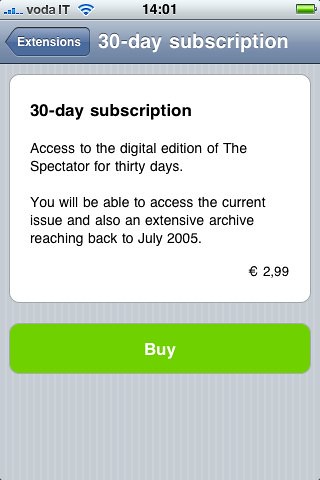
The Spectator now has a branded App, http://bit.ly/iphonespectator, in the iTunes App Store. This App gives users access to the complete magazine on the iPhone. The App is launched at the highly competitive price of 99c (59p, or €0.79). This buys a 7 day subscription to the magazine, and provides access to over 200 back issues. When the sub expires the purchaser has the option to renew for 7 days, or 30 days.

Three features of the Exact Editions App platform should be drawn to the reviewer's attention:

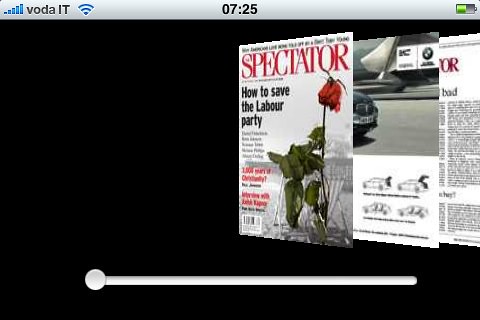
  • The whole magazine can be viewed rapidly and attractively in PageFlow mode (this analogous to CoverFlow for a collection of CD covers on the iPhone/iPod Touch). PageFlow is a very easy way of browsing the magazine and gives the user a clear sense of 'where' in the publication she may be. Note, also, that this is the magazine exactly as it was printed.


  • Every phone number in the magazine is a live phone number, and when clicked (and confirmed) the number will be called. The App works just as well on the iPod Touch, but clearly this click-to-call function will not work on an iTouch! The magazine appears on the iPhone exactly as it was printed, but with crucial additional functionality through the live links. In addition to the phone numbers, page numbers are navigation links (within the text and from the Table of Contents). Email addresses, url's, and postcodes are also live links to other Apps on the iPhone (its browser and the Google maps App which are fired up as required).


  • Apple's App Store is a way of selling subscriptions to publications. Publishers of books, magazines, and newspapers can now offer their valuable content for subscription to iPhone/iPod Touch users. The iPhone is a compelling platform for mobile consumers, and for that reason it will become a fabulous platform for publishers. €€€ £££ $$$ !


The Spectator is not the first magazine to be sold on subscription through the iPhone platform. That record fell to Athletics Weekly but The Spectator has launched its subscription offer on the iPhone shortly after moving to a 'paid for' approach to its web distribution. Many other magazine and newspaper publishers are considering their options in this respect so the The Spectator's experience of moving to a 'charged' model will be studied with interest.

We have a slideshow at Flickr of images from the iPhone App. We also have a short YouTube video showcasing some of the interface in the platform.

Wednesday, September 23, 2009

What Should Google Do Next?

The DoJ, late on Friday, produced a brief ("A Statement of Interest of the United States") which stopped the Google Books Search Settlement in its tracks. Pam Samuelson thinks "This is the most significant development since the settlement itself was announced." (HuffPo). She also predicts "Now that the DOJ has weighed in so forcefully, however, it would be astonishing if Judge Chin approved the settlement in its current form."

I guess that Google, The Authors Guild and the APA take the same view because they have now asked the Judge to delay matters whilst they re-negotiate. The judge will surely agree to the delay, but the renegotiation is not going to be easy. The DoJ's brief can be read in two ways. Pam Samuelson reads it as pretty much a rejection. That is the way it struck me. But there are also elements of the rhetoric which suggest that the DoJ (speaking for "the United States") would like to see something positive emerge from the brouhaha. There are sentences like this "Because a properly structured settlement agreement in this case offers the potential for important societal benefits, the United States does not want the opportunity or momentum to be lost." (see Page 4) Michael Cairns has picked up on this at Personanondata, and he reckons that this is an invitation to the parties to join with the DoJ and amend the settlement forthwith "this agreement will be approved with many of the changes DoJ has specified" (Deal Done).

The trouble is that the three principal difficulties that the DoJ identifies are profound and go to the heart of the deal. Are the members of the class adequately identified and their interests adequately represented? Are there fundamental difficulties in relation to copyright which is at the core of the dispute? Is there a looming anti-trust problem? The DoJ has not prescribed a solution to any of these tricky issues and if it were to prescribe a solution it would set the bar very high. I dont think they will be in the smoke-filled room with the Google lawyers and the Authors' Guild hammering out royalty rates, distributor discounts, and pricing algorithms.

One doubts that the Google lawyers are looking forward to the next few months. Few months? This is beginning to look like an interminable process. How could it be terminated? Since we think that the DoJ is right to like features of the Settlement we wonder whether the Google lawyers can craft a simple and interim agreement which gives them and all parties something in the short-term, whilst the long term negotiations on the big Settlement proceed.

An intriguing possible interim solution would be one that separated the issue of search from the issue of full text distribution. A partial service which enabled full text indexing and snippet search results of the kind envisaged in the original Google Print project. Ideally, Google should propose that this corpus of material would also be open to any other search engine (ie Google does not leverage its first mover status -- though inevitably it still has that!). Such an Interim Settlement should permit anybody to deliver search services, up to and including limited display snippets over 'books' as defined in the draft Settlement.

This specific interim compromise may not fly, but one hopes that the parties can identify some provisional elements of the project which can soon see the light of day. Holding everything up whilst the legal complications ramify is an unattractive prospect.

Tuesday, September 22, 2009

Business Week's New Business Plan

Business Week has been on the block for months, and by reports it will soon be sold. At the start of the sale process, the story was that the magazine might be sold for $1. Now there seems to be enough interest that it may be sold for rather more than that, perhaps to Bloomberg. That would be an ideal outcome. Bloomberg have the capital and the network to restore Business Week to its rightful place as the most important general business magazine in the US market.

What are the essential planks of the new business plan that Bloomberg should enact?

  1. Advertising has been the bedrock of Business Week's revenues for decades. Until recently was a massive cash gusher; but it has fallen dramatically. In 2000 Business Week carried 6,000 ad pages (yes, that averages over 100pp a week). Last year fewer than 2,000 ad pages were filled and this year the total is heading towards 1,250 pages (source: 24/7WallSt.com). Since the page rates will inevitably have softened, it is likely that BW will in 2009 gather perhaps only 15/20% of the ad revenues that it clocked up in 2000. Do not neglect the print advertising, it is still far too important to the annual budget. But the business plan should not be predicated on rapid recovery in print advertising.
  2. Do not assume that the web site advertising will hold up either.
  3. Advertising is not the solution. A solid subscription base to the circulation has to be the bedrock of the new business plan. The easy part is to fix the print subscriptions and to do that by charging a realistic subscription rate that makes money for the magazine from marginal subscribers. Some print subscriptions are being sold at a 90% discount from the official rate. Such deep discounting undermines the list prices and there is no point in selling subscriptions at a loss when the advertising targets have been drastically reduced. Hold the print price and be prepared to increase the price....
  4. If increased value is being delivered to print subscribers be prepared to raise the price on the news stand and through subs. Quality in the editorial matter is fundamental. Improve the editorial product, so that the magazine again becomes a must read for its core audience. The circulation may be pruned by reducing give away subs, but it can be rebuilt from a firm content offering.
  5. Develop the digital subscription offering. This means delivering a digital edition service which is complementary to print subscribers (automatic benefit when they have communicated their email/user name), which provides comprehensive access to the excellent archive. Make it a genuine web subscription so that bookmarks work, so that special issues can be given away as samples via the BW web site, and so that the subscription works on all web-enabled devices (iPhones, TVs, Wii's etc).
  6. The print circulation base to BW is just under 1 million. Some of those marginal subscribers will be lost as prices are adjusted, but it is perfectly realistic for BW to aim for a digital subscription base much higher than that. BW as a digital offering could become the leading international business magazine for consumer-subscribers. But it will take time to build the digital subscription audience to 100,000 and then to 1,000,000.
  7. As well as offering complementary digital subscriptions to all print subscribers, offer digital only subs at a reasonable price (not too low, perhaps 50% of the real print sub price). This will mean that the digital sub is very good value for overseas subscribers. But that is an audience that BW already to some extent has, and needs to consolidate.
  8. Do not muddy the waters by 'throwing in BW' subscriptions as part of the Bloomberg subscription. Tempting though that option is, the aim has to be to develop BW as a distinct and valuable subscription offering in its own right.
  9. Consider carefully whether it really makes sense to offer BW via the Amazon Kindle, when Amazon is taking a 70% cut, and the Kindle edition is showing up without colour and full content.
  10. Consider carefully whether it would not be highly advisable to sell digital subscriptions via the iPhone App store. Having a Free App is an interesting starting point, not an end game.
  11. Fundamental rule. Believe in the value and quality of the magazine as a print product and as a digital service. The integrity and editorial substance of the magazine is its key asset and lies at the heart of its digital success.

Many of these recommendations amount to saying "Make Business Week more like The Economist". One can be sure that The Economist does feature in a competitive analysis of what has gone wrong with BW, but The Economist also has not yet figured out how to deliver a solid audience of digital subscribers. BW will have some advantages in getting this right first. This sale is a break with the past. So much has not been working out well for BW in its digital initiatives that it is time that some sacred cows were sacrificed and some simple steps taken. Building digital subscriptions is the obvious path that needs to be developed.

Friday, September 18, 2009

Google Fast Flip and the Future of Magazines/Newspapers

We took a pot-shot at Fast Flip the other day. There are a few more lessons to be drawn. The Search Engine Journal take particularly struck me. My issue was really with their headline: Google Labs Rolls Out Fast Flip, Google Book Preview for News
Whilst one can "kind of" see what SEJ are getting at: images of the publication; full page views; a linear arrangement for navigation (but note horizontal rather than the predominantly vertical scroll in Books Search); the same database squirrelling away in the background to serve pages, searches and deliver links. The overall feel is certainly more like Google Books than it is like Google News. But what had struck me when I first sampled it was the way in which Fast Flip as an interface differs from that supplied for the books collection. The intention is also very different. Fast Flip is really about skimming and Google Books is a proto-reading system. There really are some big differences between Fast Flip and the way Book Search works.

  1. Google Books Search does not present us with arrays of parallel book content, fast flipping between books, the emphasis in Books Search is to drill down into the book. In effect to read the book. If Google had launched Books Search with the manifesto: "In the age of the internet the atomic unit of consumption is the page and the Google library will allow you to fast flip between pages in different books using the relevance tags inserted by Google." there would have been uproar in the halls of learning.
  2. Some magazines are included in Book Search (though periodicals, including magazines) are excluded from the Settlement) and they are treated pretty much in the same way as books. But again with horizontal layout and thumbnails as an option (primarily, I guess, because of the prevalence of double page spreads). But these magazines are the print magazines not the web services.
  3. Google Books Search allows the user to preview the actual image of the book's page. But Fast Flip is entirely predicated on the fact that many newspapers have built websites which repurpose their issues to web pages. Google Books Search is deeply 'type-based'. Fast Flip is snapping images from web pages. Quite a different matter and much less predictable as web pages are often dynamic. In its approach to books Google presupposes that what matters is the actual printed text and its fixed pagination.
  4. Google in the light of their probable/maybe settlement of the Google Books Search cases will be committed to selling individual books. Selling them in large packages to libraries, but also selling them individually. But Fast Flip has been launched in a barrage of Google comment that presupposes (along with much conventional wisdom) that newspapers and magazines cannot be sold through subscriptions on the web. Or only in exceptional circumstances. But Google has a business plan in which millions/billions of licenses to individual titles within Google Book Search are going to be sold to individual consumers (and held within individual accounts until the expiry of copyright or account holder)? If so, digital magazines should also be saleable to subscribers. As we know, at Exact Editions, that they can be.
Google Books Search has plenty of problems (not all of them legal), but in its conception and its goals it is much, much better than Fast Flip. Newspapers and magazines would do much better to pay full attention to the way in which the Google Books Service is shaping up. Fast Flip is an experiment, a jeu, from Google Labs. Google Books is a mammoth, a juggernaut, a tsunami for publishers. Not only for book publishers. Magazines and newspapers need to figure out how they can make money selling digital editions of their publications which sit alongside that juggernaut and which are database driven web services providing paid for and (on many occasions) free access to the content which would otherwise have been printed. If digital books are to be sold online to libraries and individuals why should not newspapers and magazines be licensed to subscribers in very similar fashion?

Controlling Your Own Destiny

It continues to amaze me that magazines do not take care to preserve an effective archive of their published issues. Most of the smaller magazines have learned that it is handy and useful to retain an archive of their back issues in PDF form. PDFs are an important insurance policy, even if the publisher plans to deliver the archive in some other way.

The biggest magazine companies often find it surprisingly difficult to lay their hands on a solid collection of PDFs. Sometimes all that they have managed to archive is the vectorised form of the PDF (which means that all the text information in the file is lost). We were running a test for a big magazine and the publisher was appalled to be told that the repro house would charge them £5,000 pa for supplying a PDF of each issue. In these straightened times publishers dont like taking on any additional costs. And why should they? Since spinning a PDF out of the workflow is simply a matter of flipping a switch at the appropriate moment, this is simply outrageous profiteering from the repro house.

Magazine publishers are a special case in this negligence of their archives. Newspaper publishers and book publishers have learned through bitter experience that having a solid archive of PDFs of their publications is necessary. And it is easy to do. The repro houses are only trying it on. If a major magazine tells its repro house that it will lose the business unless the PDFs are supplied on demand, then the repro house will jump to flip the switch..... The cost to them is zero.

Wednesday, September 16, 2009

Fast Flip: How Google Reads Newspapers and Magazines

Google yesterday launched Fast Flip at Google Labs. From the announcement:

Fast Flip is a new reading experience that combines the best elements of print and online articles. Like a print magazine, Fast Flip lets you browse sequentially through bundles of recent news, headlines and popular topics, as well as feeds from individual top publishers. As the name suggests, flipping through content is very fast, so you can quickly look through a lot of pages until you find something interesting. See Googleblog.
This is a highly revealing way of characterising our on-line reading experience. It is as though Google thinks there are only two ways of reading. Search, of course. First, and foremost, search in which you know more or less what you want and use a search engine to find it. And then 'flipping through content very fast until you find something interesting.' Publishers and educators know that this is not the way that most serious and most recreational readers read. Although much reading is exploratory, the reputation of a title, an author or a publisher is and will remain important to readers of newspapers, magazines and books. Metadata matters. Titles, editions, dates, authors, correspondents, replies, corrections, editorials ....

Google makes this 'fast flipping' possible by hosting images from the newspaper and magazine web sites. Incidentally, they only use the newspaper websites. I did not see any pages which actually used the Print Image. They are building on the look and feel of the publishers web sites, not their magazines and newspapers as printed. The service is clearly aimed at attracting publishers through a revenue split, but the activity is hosted and managed by Google and one wonders whether the collateral advertising which appears in the margin of the page images can generate significant revenues. Paul Bradshaw thinks not:
Of course, by hosting screenshots Google are eating into one of the key metrics that publishers use to sell advertising: the time a user spends on your site. And given that many readers don’t read beyond the first few pars, there’s a good chance it will eat into the numbers clicking through to the actual page at all. So unless Google’s ad rates are significantly higher, what reason at all would a commercial publisher have to sign up to a scheme that devalues their own ad inventory in exchange for some pennies from Google? Blind panic in the midst of a crisis, that’s all. Google's Fast Flip -- A Cruel Joke on the News Industry
The commercial proposition is highly dubious. But Google is being completely sincere and genuine in offering its helping hand . Google is convinced that this Fast Flipping is the way that consumers want to read news on the internet.
"We have tried to build platforms and tools that build a healthy, rich eco-system online that is supportive of content. This is a new way of looking at content." Marissa Mayer quoted by BBC News.
Having seen the success of Google News, and keeping in mind the atomisation of music, and the considerable success of the iPod Shuffle, Google appears to consider that a rapid flipping (navigation) between atomised stories is the way to read news. The point has been clearly stated by their spokespersons.
...... the structure of the Web has caused the atomic unit of consumption for news to migrate from the full newspaper to the individual article. As with music and video, many people still consume physical newspapers in their original full-length format. But with online news, a reader is much more likely to arrive at a single article. While these individual articles could be accessed from a newspaper's homepage, readers often click directly to a particular article via a search engine or another Website.... Marissa Mayer Testimony to the US Senate on the Future of Journalism (PDF)

The Internet has changed the unit of consumption. The unit of consumption for news is now the article, not the newspaper. I still love reading the newspaper. But I use the Internet to look at a lot of news stories, too, and on the Internet there's a different way of consuming things. No one is saying that newspapers shouldn't make money...
William Patry, Google copyright expert, Interview with Publishers Weekly

Google News and Google Fast Flip embody the view that the context of publication in which a story is published is unimportant. News therefore works best on the web if it is atomised and decontextualised. Newspapers and magazines have to an extent prepared the ground for this. Their own web sites make it increasingly difficult to locate the story in the context in which it was published. Magazines are careless about the value to subscribers of the contents of their current and forthcoming issues. Newspapers and Magazines need to recover the confidence that reading the magazine or the newspaper is an experience that can be enjoyed on the web as much as it can be in print. The newspaper and the magazine as a digital experience have to offer sufficient value that a readers is prepared to become a subscriber to the magazine or newspaper. Subscription services -- especially of the digital edition and its archive will generate much more for most publishers, than a Fast Flip of streamed content which will catch a trickle of Ad-sense revenues. Of course, there are changes and more will be needed. Search within a publication is very important. Internal navigation is very important. The possibility of citation and book-marking is essential. External navigation is especially important when it is relevant to the reading experience. But, Fast Flipping? That may be about as much use as Shuffling the news.

Tuesday, September 15, 2009

Delayed Apps

Apple clearly hasn't yet figured out how to handle the Apps that its developers deliver. We have had one App in their 'approval process' for 8 weeks (tomorrow).

The App in question gives the user complete access to the current issue of the Spectator and a substantial archive. Apple are not willing to give us any information on when it will be approved for release (the messages they send are very polite, but automated and without real information). The App certainly works. I have been enjoying it myself and it was submitted at just about the same time as our App for Athletics Weekly which is functionally identical and has been merrily ringing up sales in the App Store for a month [App Store link]. Here is a screen shot of the Spectator App in action:


Why would Apple hang on to such an App for 8+ weeks? Why can they not give some helpful explanation for the delay? Is their software evaluation leading them to search through the five year archive in the account? Are they stuck with a protracted review because the Spectator has an occasional (and very good) wine column? The lack of explanation is puzzling and clearly self-defeating. When the App is made available in the App store, Apple will be capturing a substantial 'top-slice' of the revenue it generates. Until that moment arrives, the keen student of British politics will make do with a Spectator subscription from the Exact Editions magazine store, and can she supplement this with the Free App Exactly.

The most frustrating thing about this delay for us (which is also quite damaging for Apple if it is the experience of other developers) is that our generic App software is improving all the time and we have withheld offering a new version of the App platform to our users, for the moment. Clunky and protracted review processes seem so twentieth century, surely Apple want to encourage rapid development and innovation on their splendid and attractive platform?

Wednesday, September 09, 2009

Free Magazine Apps: What do they Achieve?

Time.com the web site for that great magazine Time has recently released a Free App for the iPhone, which you can obtain here. It is one of the best Free Magazine Apps that I have tried.

The App combines thumbnail images and content elegantly:


Cool that you can Tweet an article as well as email it:


I am highly impressed by the design and software intelligence that has gone into building this App. But one has to question the fundamental business strategy.

  • Why distribute an App for free which does nothing to help to sell subscriptions? Maybe I missed something, but I found no link or information on any part of the App about buying a Time magazine subscription, either in print or in digital format.
  • If you are going to distribute a free App which gives a thin/medium thick layer of content from each issue of the magazine you really must offer an iPhone App which gives a subscription to the whole magazine. This Athletics Weekly video shows how subscriptions to magazines can be sold through the App store.
  • My guess is that giving away 10/15% of the content of the magazine does not seriously undermine the value of the subscription in print form, but one has to question the advisability of giving away, via the App, content which is going to appear in next week's print issue (eg a news story from today about Afghanistan). What is this real time generosity telling Time's print subscribers, who are increasingly the life blood of the magazine?
  • What about the advertising? Perhaps the real point of this excellent App is to generate advertising revenues, and one notices that Siemens ads appear throughout the App and are credited on the web site with sponsoring the venture. We have no idea how much Siemans will have paid for this privileged position, and there is no way of telling whether this sponsorship is really additive, or coming at the expense of additional revenue to the existing web accounts. There is no way of telling, but the lack of visual punch in the in-App Siemens ads, and the fact that Apple release very minimal demographic data, tells me that the advertising prospects for Apps of this style cannot be great.
The bald truth is that magazines are repeating with their free magazine Apps, the mistake that they have been making with their web sites. In most cases the web strategy has come unstuck. And these Apps, which are essentially re-packaged RSS feeds from the web sites, are not going to help at all. Partly because of the demographic obscurity of the Apple customers.

It is not a good idea to give away content on the web or through the App if this is undermining the value of your core subscriber proposition. Advertising-funded web and App developments will only work for magazines that have tremendous reach, or a very high value audience. There are very few of them. It is becoming increasingly unlikely that any magazines fit that bill. Time should really be building its subscriber base with its App. Magazine publishers have gradually learned that a lot of their subscriptions do come through purchases made on the web. It is time that they drew the obvious conclusion that subscriptions to digital magazines will also be purchased through the web and through the iTunes App store. Exact Editions will be pleased to help Time to develop a branded App for Time magazine (not Time.com) which will enable any iPhone/iTouch user to purchase a subscription to the entire and visually compelling magazine....

Tuesday, August 25, 2009

Digital Book Clubs

A few months ago there was a burst of enthusiasm for Twitter book clubs. We participated in some of the excitement around the Wossy bookclub. Like a lot of good ideas, this one seems to have fizzled. There have been other Twitter bookclubs, but like the Jonathan Ross experiment, it seems that they quickly need to invoke the aid of a more substantial platform (wossy went to a news forum), Facebook or an email list. Perhaps Twitter with its 140 character limit doesn't really have the bandwidth for the conversation engendered in a proper book club. That may be part of the problem....

But a more serious, and remediable problem with these book clubs is that it is very hard to share the reading experience through the web if the club is using a print book or even a traditional eBook. eBooks dont generally facilitate straightforward citations and bookmarks. This is of course where a platform such as Exact Editions (or the pre-eminent Google Book Search) come in. Such digital editions can be easily shared and precise passages cited and even excerpted by their book club readers. It would seem to us that there is big scope for the revival of the book club idea through the web. This could either be the informal 'reading group' style of book club that has become so popular with readers in the UK and the USA in the last decade, or the special interest type of book club for a relatively mass market, which was the foundation of Bertelsman's fortunes in the 1950's and 60's.

Such book clubs would work well with a subscription service which gave their members access to a book for a period of time. Our interest in this idea was sparked by a suggestion that the Guardian is planning to create a readers club. That could well be the basis for a valuable subscription service: valuable both to the Guardian, its readers and the publishers and authors of books who might be very willing to grant the Guardian very favourable leasehold rights.

But in some ways the most obvious sponsor for a new wave of digital book clubs will be found amongst publishers. Publishers could now launch digital book clubs (for a small annual fee, say £9.99 per annum) which would give limited access (a month or two) to books, 3 or 4 a month, with rights that they control and with audiences which they can develop. The advantage of a private book club for a publisher are several:

  • It can become a premier layer in the catalogue (a title which is selected for one of the slots each month) is gaining additional promotion
  • Providing full access to some books, to club members for a month or two is in most cases not likely to preclude sales of the title to club members (but perhaps the lightest forms of fiction would not be suited to such temporary loans).
  • Selling print copies of the books that are on digital loan for a month or two would be a key objective
  • As would be the option of selling digital subscriptions to those titles. Sales direct and indirect would be encouraged by promotion through a digital book club.
  • Publishers who have a direct sales operation in place will be particularly interested in these opportunities.
  • Bookclubs will foster word-of-mouth success. Digital book clubs will merge into digital word of mouth (even as some of the book choices inevitably die through word-of-mouth).
  • The publisher who develops his direct links to a reading audience is well placed to develop other attractively 'social' elements of the reading experience (Twitter, Facebook, Myspace etc)
  • A key value of a book club is the proposition of membership. The publisher who can boast of having 5,000, or 10,000 or 40,000 members in his history book club is going to be in a very strong position to attract new authors. And new members.
  • Choice, but 'limited choice' is also a key value, both for the members and for the publisher in negotiating rights (and negotiation will be needed, not all authors and agents will immediately recognise the advantage of having their new book out with 4,000 members on a 2 month loan)
  • Publishers like propositions which develop their unique role as a builder of lists. It is the publisher with a strong and coherent list, or strong and coherent lists, who can most successfully launch and possibly 'twig' such book clubs. But above all publishers should like this proposition because it is non-exclusive. Developing your own bookclub is not going to stop you selling books via the Guardian book club, the Tesco bookclub, or the Walmart bookclub if and when they come to pass. It certainly is going to help you sell eBooks to Amazon or Sony if you can point to some of the opinions that have surfaced on your own readers' comments and reviews.
'Book clubs' are an attractive idea, and as the web becomes more social and more content oriented, their time will come again. The concept of a book club is so much more attractive than the concept of an ebook, or a digital edition, don't you think? But I suspect that the bookclub may be a key part of making ebooks that flourish.

Friday, August 21, 2009

The Athletics Weekly Branded App

Earlier this week Exact Editions release through the Apple iTunes App store a branded magazine App for the UK's leading sporting periodical Athletics Weekly. If you have an iPhone and work in the magazine business you really need to treat yourself to a short subscription to this publication. Direct link.

To speak frankly, this is a breakthrough for the magazine industry and it has not yet been properly noticed. One key point: on the iPhone, a magazine is an enjoyable read in just the spatial arrangement and layout in which it is printed. Exactly as printed. The text is readable, column by column, and of course can be expanded or shrunk with the touch gestures that iPhone users love. We were lucky that the App became available just as Usain Bolt produced his amazing runs in Berlin:


Even more important than the readability of the magazine text, is the new shape and potential for digital browsing. In its iPhone implementation, 'pageflow' encourages rapid browsing of the whole magazine. Here is a still shot of the coverflow feature (comparable to the coverflow with which iTunes users survey their CDs).


Pageflow is a crucial step through which digital magazines can benefit from the quality and the design values of the print magazine. Pageflow in action gives the digital reader the quality, the artwork, and the design built in to print magazines. Magazine publishers have for too long worked on the assumption that it is their task to adapt the magazine to the web by 'repurposing' its content and its design values. Nonsense. The web, or at least an iPhone rendition of the magazine, gives the publication its full visual quality. Perhaps even better than in print (though I would rather be judged on this claim once Apple has produced its new Tablet device. The 10" tablet with a digital magazine will be more sumptuous than many printed versions).

Finally, the key point about a magazine App is that it is for sale. This is commerce: the iPhone is a way of selling subcriptions which simply are the whole magazine and as much of its archive as the publisher cares to offer to iPhone subscribers. Athletics Weekly offers subscribers access to over 100 back issues, which makes the weekly subscription price, of £1.19 amazingly good value. From the magazine publishers point of view, the key thing about a branded iPhone App is that this is a way of selling magazine subscriptions. Athletics weekly is now being offered through weekly or monthly subscriptions and readers are buying subscriptions and making in-App purchases for renewed subscriptions. The Apple iPhone App-ecology is working. This is some really good news for the magazine industry. Sell subscriptions to iPhone users and iTouch users. There will soon be over 50 million such digital customers waiting for their magazine subscriptions.


The sad truth is that much of the magazine industry is so stunned by the way that advertising revenues have collapsed that business strategists are finding it hard to think about anything else, about anything positive. But the community of iPhone users is a huge market to which magazine publishers should be selling subscriptions.

It is amazing how slow the industry has been to see and to seize this potential. We know of no magazine which currently makes itself commercially available in its entirety through the iPhone App store. Athletics Weekly is the first magazine to show how it can be done, and it came through Apple's unpredictable approval process in the very week in which Usain Bolt showed us that 100 metres can be run at lightning speed. Some of our biggest and best magazines are slow off the mark!

We have a short video which provides a brief overview of the way this App technology can work for a magazine. Note the way that telephone numbers become call-able off the page. There can be no doubt this is the way that magazines should behave on an iPhone. All phone numbers should be callable from digital editions that work on phones. This is another big step for the industry, and one that has key potential in reviving those advertising budgets.

Tuesday, August 11, 2009

Lessig on the Google Books Settlement

Lawrence Lessig contributed a 40 min discussion to the Berkman Center's seminar "Alternative Approaches to Open Digital Libraries in the Shadow of the Google Book Search Settlement”. (In the 'shadow' of the Google Settlement -- doesnt this make it sound a bit ominous?)

He opens with a comparison between Tiger/Kitten and Tiger/Tiger. Google has to be the Tiger. So although not explicitly anti-Google, his rather mournful assessment of the Google project is moving away from it. Watch out for the claws. He recognises that the GBS Settlement may represent progress and have some positive results, there are even so a lot of downsides: "We need a framework to encourage experimentation"; "We should not trust our culture to kittens that turn into tigers"; There is a tendency in the extraordinarily complex settlement agreement "against the ecology of free access which we have had since the invention of printing".

Lessig's position is not hard and fast, and tries to avoid being anti-Google. There is something rather soft, touchy-feely, about his extreme example of what is happening to books: it is far-fetched, in my view, to suppose that books will be as ham-strung with temporary permissions as documentary films. It is not clear what his recommendation really amount to. The 'appropriate or the best ecology of access' is a vague idea.

But Lessig is putting his finger on some of the tender issues in the Google project. There is a worrying tendency for the Google Books project to dissappear in a vastly complicated and centralised network of permissions, concessions, exceptions, pettifogging access restrictions, content omissions and database-driven implementation decisions which may yet stifle the project. Or, at the very least, cramp its style. With Google Book Search, code is very much becoming and making law, but not in ways that Lessig can welcome. Something looser, more rounded, more democratic and multi-polar is needed. The ultimate and inevitable failure of Google's project as it is currently shaped is that it is not putting books in the centre of its intentions. Books are not being given room to breathe.

Thursday, July 23, 2009

Wisden on the Ashes


Wisden on the Ashes, (the authoritative story of cricket's greatest rivalry) published by Bloomsbury, is now available through the Exact Editions platform for an annual subscription of £10. With 500+ pages of detailed reportage and statistics this will be on the shopping list of every geeky cricketer, or cricket enthusiast.

I was never much of a cricketer, but I have always been a geeky cricket buff. So what do you think of this scoreboard?

Strauss 22
Cook 10
Bopara 0
Bell 18
Collingwood 13
Prior 7
Flintoff 32

Doesnt that have an all too sickeningly familiar feel to it? And for your reassurance Bradman is mentioned 122 times in the book. England may be one up in the series but I have a feeling that Ponting, 41, may walk off with the Ashes again.